Podcasts Archive - Sanford Health News

Cancer myths vs. truths – and what truly matters

Dr. Dan Almquist:

The best thing to do is get information, ask questions, bring it to the table, have a conversation about anything. If it’s your fears, if it’s your anxieties, if it’s medicines, if it’s supplements, bring it to the table. Our job as physicians is to actually educate you and teach you and help you navigate these really tough things in life.

Courtney Collen (host):

This is the “Health and Wellness” podcast brought to you by Sanford Health. In this episode, we’re unpacking some of the most common myths and misconceptions around cancer from diagnosis to treatment. Whether you’re a patient, a caregiver, or someone who just wants to be informed, this conversation is for you.

Our guest is Dr. Daniel Almquist, a board-certified specialist in hematology and oncology at the Sanford Roger Maris Cancer Center in Fargo, North Dakota. Our host is Courtney Collen with Sanford Health News.

Dr. Almquist, thank you so much for joining me for this conversation. Nice to have you.

Dr. Dan Almquist:

Hey, thanks for having me.

Courtney Collen:

Cancer is one of those heavy topics where everyone seems to have some advice or guidance, like add superfoods, cut sugar, eliminate plastics, less processed foods, more red wine. Like if you do everything right, you’ll be safe. We hear so much about doing this or that to prevent cancer, and it is kind of overwhelming. That’s why I’m really looking forward to digging into some of these things, like what you hear in your clinic and what you want our listeners to know.

So, to start us off, Dr. Almquist, why do you think cancer myths are so persistent, even with so much information available today? Or is too much information the problem?

Dr. Dan Almquist:

Oh, that’s a great question. That I think that’s one of the ultimate questions actually. You know, I always, I guess I always go back to like information or knowledge is power, right? So the more information you can have, the better decision making you can have.

But when it comes to like scientific evidence, this is where it gets really tricky because even in the papers and research that we use, there’s different scales of validity. You know, like how is it powered? Is it the correct patient? Are you actually trying to study these things?

And so even when studies get done it gets complicated. Because sometimes people, if they’re reading it on their own and they don’t have a background in scientific evidence, or even statistics, let’s say, it gets complicated. Because to be able to interpret this, you kind of have to have a background on that.

So sometimes I think people, this paper will come out or the study will come out, it hits the media in the news and people run with it and they don’t really know what it actually means. It’s like when someone asks me like, “Hey, can you fix a car?” It’s like, actually I can’t, like I don’t have that ability. I can read a paper, but like, you want me to take a part of the engine? I can try to read about it and do it, but I just don’t really know how to do it, actually. I kind of get that we all, before this we talked a little bit.

I think we all have these different roles in life and one of it is this where my job is to examine the data and proclaim it forward and kind of say, hey, this is real benefit. This isn’t benefit, this is a negative study, a positive study. At the end of the day, I think information’s important. Asking questions about that information is super important. So I’m glad it’s out there. Because then people can bring it to you and ask questions, which I think is so good.

At the end of the day, why do these continue to go forward? It’s probably because we have this sense of hope, right? Like, we all have this in us where we’re like, “Man, this is going to help me, or this is going to change my life, or this is going to improve the way I feel.” So I think there’s just longing in us to just make things better all around. And I think that’s why these can perpetuate and continue.

Courtney Collen:

Yeah. Thanks for the insight. I want to jump into lifestyle and diet. We hear a lot that certain superfoods can prevent or cure cancer. Is there any truth to that, Dr. Almquist? And if so, what foods are generally more helpful? And maybe on the flip side, what foods should we be avoiding?

Dr. Dan Almquist:

Great question. You’re talking about somebody who’s very, I kind of practice what I preach. So it’s one of those things where if I’m going to tell a patient like, you shouldn’t be doing this, then I shouldn’t be doing it myself. Or if you should be doing this. I’m going to start with the back end of that question.

What should we be avoiding? That is probably easier said than done in all realities. So a couple weeks ago actually, or earlier this year I should say, the World Health Organization came out and said, deli ham, right? Deli ham is a class one carcinogen, which means it has a similar impact on cancer and health as smoking, which is like what? Like how is processed ham as bad as smoking? So if you eat it regularly, the preservatives, the nitrates, those kind of things that are in it are super detrimental to us.

Increased risk of colon cancer. So it’s one of those things where processed foods, ultra-processed foods, there’s more and more evidence that are saying, hey, we should probably stay away from these. And so that would be kind of my first step is like, what can we avoid? And what can we, like for longevity and risk reduction in cancer, what can we stay away from? And that’s the first step. I would say processed foods, ultra-processed foods. There’s more and more evidence mounting against them saying that they’re bad for us.

The flip side of that: What should we be doing? You know, superfoods I would honestly, I wouldn’t classify as superfoods. I would say, hey, fruits and vegetables are super important and it’s honestly, the world has gotten so complicated in just terms of convenience and access and these kind of things.

You know, if we went back 400 years, 200 years and we’re like working on a farm and you’re butchering your own food, you’re planting your own garden, you’re harvesting your own things, that’s probably the best approach in terms of health. Just in general, right? So you’re eating fresh fruits and vegetables, you’re eating unprocessed meats, you’re just eating what was on the farm. In all reality, that’s probably the best thing.

And so, for me, the data has been mounting more and more that fresh fruits and vegetables, not canned per se, but whole vegetables are going to be beneficial on multiple reasons. So one is that just the vegetation itself is good for us. You talk about fibers and those kinds of things which are good for our gut health, but on these unprocessed foods, you’re going to have bacteria and microbes.

And we know more and more that these, this, these microbes on the fresh fruits and vegetables that help sustain gut flora actually reduce inflammation, promote good byproducts, and reduce the risk of colon cancers and those things. So for me, fresh fruits and vegetables, you know, fresh meats, unprocessed foods is kind of where we should go for lifestyle.

And then the two big things we always talk about is smoking and alcohol, right? Stay away from those things. Smoking is the number one risk factor. It’s going to cause you harm no matter what disease you’re talking about.

And then alcohol, there’s different kind of levels with this. The general consensus is abstinence is probably the best approach with that, but fresh fruits and vegetables, you know, they just redid the pyramid. Yeah, and I actually kind of agree with that. You know, when I look through it, I haven’t studied the recommendations in depth, but when I’ve glanced at it, proteins are good, fresh fruits and vegetables are good, whole fruits and vegetables – it’s like those are going to be the mainstay and should be our mainstay for everybody.

Courtney Collen:

Good to know. Thank you so much for the insight. Does sugar, speaking of foods, does sugar feed cancer?

Dr. Dan Almquist:

That’s actually one of the most common things. Besides supplements, like can you take supplements? The next is always sugar and what to do with it. I think that myth started with the scans that we use, right? So there’s a special scan that we use to kind of find cancer and it’s called the PET scan. And we use sugar moieties with that to kind of find where high metabolism is at, which then helps identify cancer.

So, I think that’s kind of where it came because we inject people with this moiety, they sit for an hour, they go through a scanner and we see this glucose uptake and it’s one of those things, or sugar uptake. And it’s one of those things where I think they, they think, oh man, this thing’s living off of sugar. So, the thing I always tell patients about that is like, cancer’s super evil.

If you’re not putting sugar in your mouth, it’s going to find a way to make sugar. So, if it breaks down your fat going after your liver, going after muscle, it’s going to find some way to find sugar. So if you’re not eating it, not only are you going to be starving the healthy parts of your body, so your muscles, your organs, you’re also just allowing cancer to destroy more of your body.

So for me, it doesn’t, it’s not a matter of sugar; it’s a matter of metabolism. So when there’s active cancer, there is just going to consume calories and sugar faster than the rest of your body. And so the worst thing we can do, which is really common in cancer and chemotherapy, is a term called sarcopenia or muscle loss. The muscle loss happens a lot with chemotherapies. And so if you’re not eating, if you think about a bodybuilder, right?

Like they consume a ton of calories and a ton of protein and a ton of sugar just to build muscle. So if you’re not putting that in your body, you’re going to lose muscle faster. And it’s like, man, if you want to stay walking, you want to be moving, you want to be up and down stairs. Like it’s so important to get calories and nutrition in.

I’m not afraid of sugar in these things. So those kind of things. There is some data like intermittent fasting, you know, reduced sugar, ketos, ketosis, which there’s valid data. So scientifically it’s been shown, like it improves processes. And what I usually tell people is, save it for before you have cancer or after you’ve done treating cancer, not during. Sugar’s our friend. We need energy. We need strength.

Courtney Collen:

Yeah. Thanks for clearing that up. As a medical oncologist, I can imagine you’ve seen a variety of lifestyle factors, and we’ve talked about that become common with different cancer diagnoses. If there’s one thing we should stop doing Dr. Almquist or stop consuming to reduce our risk of potentially developing cancer, what would that one thing be? Even if we’ve already talked about it.

Dr. Dan Almquist:

The number one thing’s going to be smoking. You know, in terms of just across the board, if you look at a modifiable risk factor, smoking is the number one thing. If people stopped smoking and they put me out of a job, I would be happy. I would go find something else to do. Like I love what I do, but I would gladly to go serve someplace else in the world and do something else with my life.

Courtney Collen:

But smoking – is it our knowing that people are maybe healthier, a little bit healthier, and taking care of their bodies a little bit more by just cutting that one thing?

Dr. Dan Almquist:

Yeah. So, in nonsmokers, we go back to the nutrition piece. Exercise and nutrition, you know, those are the three things and studies keep showing over and over again, exercise and nutrition. I mean, there, it’s such a simple thing. If you ask a question like eating healthy, it’s like, oh yeah, but it’s so hard to do.

Same thing with exercise, it’s like, oh yeah, that makes sense. But it’s so hard to actually do. So like in terms of just health and life in cancer reduction, it’s like if we could literally as a society nail down healthy foods and 30 minutes of exercise a day we would drastically change how much cancer we’re probably seeing.

Courtney Collen:

Let’s talk family history and risk. I may think if I have cancer in my family, it’s if inevitable for me, or if I don’t have any family history of cancer, then I’m not at risk. Can you help us clear the air with that?

Dr. Dan Almquist:

Yeah. That’s a tough one because – and there’s some blood disorders that, where we see just because you have like this genetic predisposition, it doesn’t always mean you’re going to get the disease. And so it’s one of those things where it’s hard to always to talk about just like family history because there’s so much that goes into it.

You know, was your family all smokers? Like, were they all drinkers? Were they exposed to radiation or whatever else in the environment? So a lot of times, there’s multiple things that stimulate cancer to develop. So the immune system surveillance misses it. There’s something in our environment that triggers it. But for sure family history does weigh in on that.

So there’s definitely some genetic, and we have these syndromes that run in families that predispose you to cancer. And if it’s caught in those families, then we change the way we screen and we follow and we check to make sure we’re not missing cancers earlier in life. But it doesn’t mean it’s going to happen. It’s not a hundred percent guaranteed just because your family’s had it that you’re going to get it.

And the caveat of that too is sometimes there’s cancers that run in families and we actually don’t know the genetic reason for it. We haven’t identified these genes as of yet because this is an evolving area, right? This is still ongoing research about what drives cancer and what doesn’t and what we can modify and what we can’t.

But it does not mean if you had every family member have cancer, it doesn’t mean you’re going to get it. The opposite is a hundred percent true too. Like if there’s no family history, you still can develop cancer. You know, I just, this last couple weeks I had a number of patients, they’re like, there’s zero. We have a lot of heart disease, we have diabetes, no cancer, but why did I get cancer?

And it’s like, well, you ask questions and you realize they maybe weren’t doing their routine screening. You know, the things that we’ve recommended as a medical society saying, “Hey, you should do X, Y, and Z just to make sure it doesn’t happen to you.” And you come to find out like, oh, you never did that. That’s, you know, a reason why we recommend it is to prevent these things from developing.

Courtney Collen:

Yeah. OK. Here’s another myth. I want to dive into if I feel healthy, I don’t need to worry about cancer, or I can skip a screening. A lot of people may assume no symptoms means no cancer. Why is this such a dangerous misconception?

Dr. Dan Almquist:

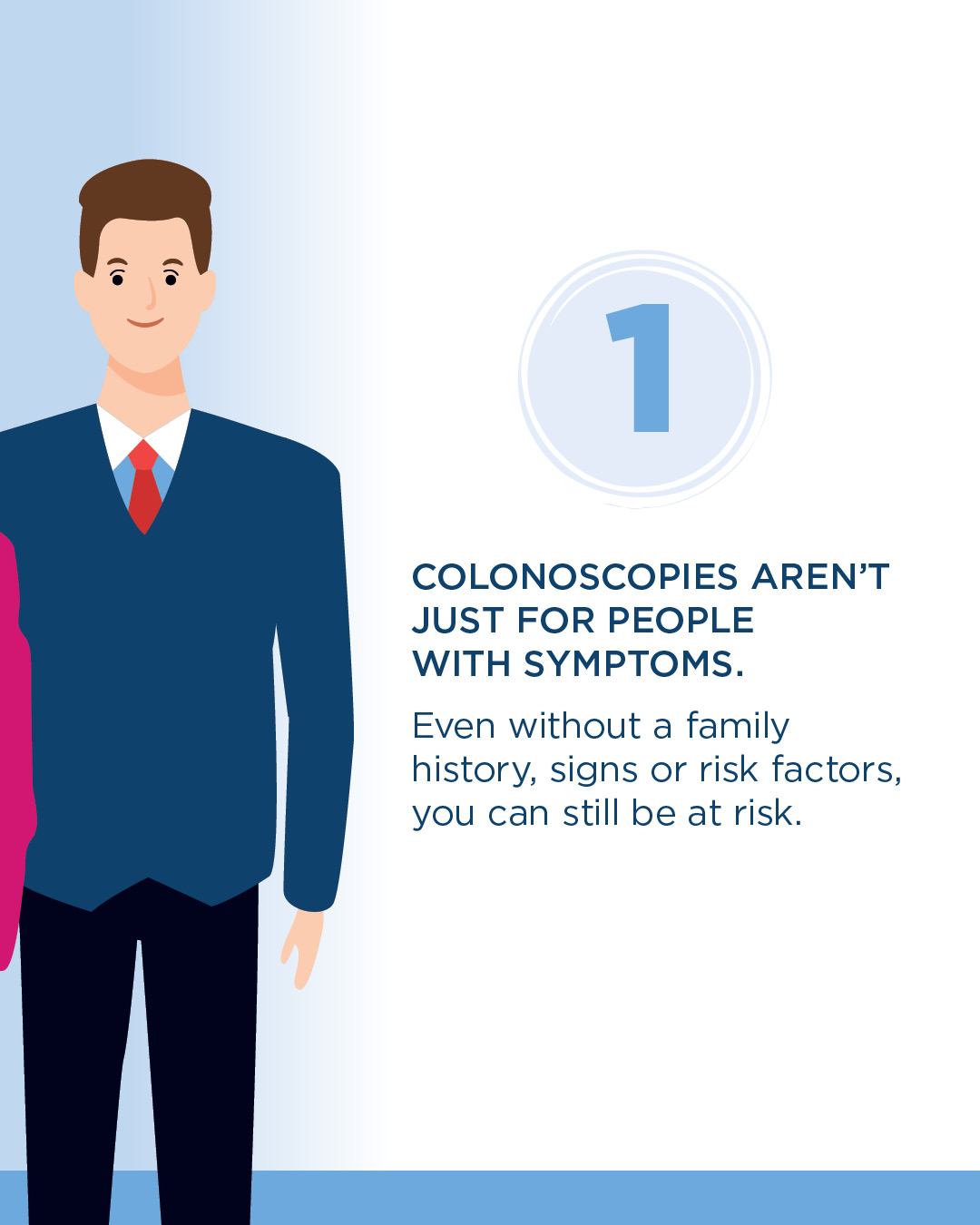
Oh, this is. It’s always so hard. And I always get heartbroken when I see a patient who skipped their screening. A lot of times people fear colonoscopy and it’s either from the prep or from the procedure itself. But it’s like, one of the big reasons why we do that screening and at even a younger age now, is to prevent cancer from forming.

There are certain polyps and certain family histories that will predispose you to colon cancer. And it’s like, man, if you would’ve at 50 years old or 45 years old gotten that colonoscopy and we found that you had a ton of these premalignant things, we could have followed you closely for a number of years and this would’ve never happened.

So for me, screening is so important. It doesn’t matter how healthy you are. You could be one of the most healthy people. You could live in a bubble and check all the boxes. Like, I ate right, I drank water, I didn’t smoke, I exercised. I did all those things. But there’s still so much more to cancer development than just that. So for me, screening is so important just in terms of cancer prevention, you know?

We can catch a lot of these things if we do them earlier. But you always talk to those people and you’re so heartbroken because it’s like, man, this was preventable if we would’ve just done the colonoscopy.

Courtney Collen:

Yeah. Yeah. I appreciate the insight. Beyond the screening, let’s talk about a biopsy or surgery. Here’s another myth. Can a biopsy or surgery spread cancer?

Dr. Dan Almquist:

That’s actually a tough conversation. The answer is, you know, I guess I always get this question like, oh, when the tumor’s open to air, it will spread. And it’s like, no, that’s a myth. That’s not true.

Now, there are some certain circumstances where when you do a biopsy you can develop what they call a drop met. So a metastasis next to the tumor that when, like they pulled the needle out or they did the procedure, it contaminated that tissue and then it dropped a few of those cells there. They started growing. But it is not one of those things where you go do a biopsy and then all of a sudden the cancer’s everywhere. That does not happen. So that part is just, they have aggressive cancer.

Let’s say you do a biopsy, you had one tumor, and then six weeks later you do a scan. They just had really aggressive cancer. But there is this scenario, and I think this is where that myth comes from, is that when someone got a biopsy, when they pulled the needle out, it brought a couple of those cells and put it right next, or just outside that tumor. So really that happens locally. It doesn’t spread it throughout the body. It just can move it to a local area.

And sometimes you’ll see it where they do a biopsy and then they’ll get the skin nodule and it’s like, oh, that’s a tumor in the skin. But a lot of times if we’re treating it, we can take care of it and just treat both of those at the same time.

So again, it doesn’t risk spreading it all over the place, but there’s this chance, this drop that could develop locally. If I’m honest, in the last few years, I’ve only seen that I can honestly (count on) one hand, like a couple of times. You don’t see that very often.

Our surgeons are really good in the techniques they use this day and age. Very rare that that shows up. But it does happen. But again, it’s local, not everywhere. It doesn’t spread everywhere.

Courtney Collen:

Sure. Is cancer contagious?

Dr. Dan Almquist:

No, the answer’s no. Like flat out, if my mom had breast cancer and my mom kissed me, I’m not going to get breast cancer. And so that part is a no.

But there are, you know, we know like HPV mediated infections, right? So there you could have HPV, you could pass on HPV to a partner and all of a sudden you are spreading HPV to each other, which then can subsequently, you know, oral pharyngeal cancers and other cancers related to a viral infection like that. But cancer, in of itself, you’re not going to get from another person.

Courtney Collen:

Can a patient work and live normally during their cancer treatment?

Dr. Dan Almquist:

Oh, for sure. There’s some people, honestly, every person’s different. So I always tell people that. So I do a lot of head and neck cancer, and when you’re doing chemo radiation, it is super tough, like debilitating, really morbid. There are some people, like, they go to work full-time, they live a normal life. And you’re like, man, that is amazing.

And then there’s some people that that it hits them harder. They have more side effects. And we had the management more so they back off a little bit. But I can promise you there’s probably people you know who are going through cancer treatment and you don’t even know it. They’re just living their life as normal and they’re just out in the community. They’re walking around and you would never guess like, oh, they’re getting cancer treatment right now. It’s really person-dependent.

But yeah, you can definitely, especially if your doc’s good at managing your side effects, you can live a full life. And that’s the whole goal of cancer treatment, right? Is to reduce cancer-related morbidity, give you a good quality of life, prolong your life. So if you’re getting the right treatment and the right care, you should live a full life.

Courtney Collen:

Yeah, absolutely. What have we missed? You care for cancer patients. What are some of the myths or things that aren’t necessarily true that you hear most often that you want to share with our listeners that maybe we haven’t touched on yet?

Dr. Dan Almquist:

Oh man. Well, supplements are a big thing. So that’s the big one. And it’s not necessarily a cancer myth, but there’s just so much online, you know, about ivermectin and vitamins and all these things. And the reality is we just don’t know a lot of this stuff, so in terms of cancer treatment and in terms of how we approach patients, we really just stay with what we know.

So we have scientific evidence that says that. And when you look in these trials, you know, we don’t know if you’re getting high-dose vitamin C, does it influence this chemotherapy or not? Does it influence your immune system? And so it’s really hard. So we get asked a lot about these different supplements.

At the end of the day, a lot of them were preclinical, which means they were studied in a lab and not necessarily in humans or big studies. So when you get a chemo from a doctor, they’ve been studied for lots and lots of people, big, big studies. These supplements may have been studied in a lab and there’s a dish and they run and say, hey, look, this may treat cancer really well, but the problem is maybe they’re really early in their studies, so they haven’t done full human studies.

Does it metabolize appropriately? Does it actually do anything in the human body? You know, just because it worked in a mouse doesn’t mean it’s going to work in us. So that part, we’re just different, right? We’re different animals than those mice. So the reality is, a lot of those things, when we hear about them, it’s kind of like, we just don’t know. Is it good? Maybe. Is it bad? It could be really bad. I don’t know.

So a lot of times those are the questions we face and some supplement that we hear about, and it’s just like, you know, the answer is really, we just don’t know. And so I try to stay away from those things that I don’t know. I know what treatments work. I know what meds can help with symptoms. But then when we start getting into the weeds, a little bit of these, you know, these different supplements, we just don’t have enough data to say yes or no to it.

And it’s a hard conversation because some people are just adamant that these things are going to work, and maybe they will. I don’t know. But at the end of the day, I always try to bring it back to like, this is what I know. This is the care I can provide. Right? And this is where I’m comfortable in helping you.

But there’s, again, there’s a little bit of this, like people believe it. So sometimes it’s hard to argue logic with belief because they believe in it, you know? And that’s their prerogative that they can do that. It just makes it a little bit more complicated for us.

Courtney Collen:

You’ve got to be your own advocate at the end of the day, right? But how important is it to address concerns, questions, things that you’re hearing that you want to clarify with your primary care provider, physician, oncologist? Like how important is that communication with your care team?

Dr. Dan Almquist:

Oh, that’s, so again, like I said earlier, knowledge is power. So, the more you can know, the better decision making you can make, especially under stress and that processes. So for me, I always tell patients the squeaky wheel gets the grease, right?

So you know, it’s one of those things where if you’re making noise, you’re asking questions, you know, I’m going to do my best either to answer them with the knowledge I know or go help find information for you. And so I think, especially at our cancer center, I know that’s kind of the mentality here.

Truly we want to do what’s best for the person in front of us. We want help them the most. If they have questions about the things, we want to discuss them. I’d rather know about it, talk about it. If the patient decides to do something that I don’t necessarily agree with, that again, that’s up to them and that’s their life, and I’ll talk about it with them. But I think talking through things and discussing kind of the risk-benefits and those things regarding anything, you know.

Like, “Can I go to Mexico this weekend?” It’s like, well, you know, “Yes, but we’ve got to do this.” So it’s always good to have conversations about everything. So for me, squeaky wheel gets the grease. If you have something that you desire or a question you desire, bring it forward. We’ll talk about it. And I think most docs truly, they go into this to help you and provide the best care possible. And part of that is just that communication piece.

Courtney Collen:

Dr. Almquist, if a listener has a loved one, maybe, or a friend who has been recently diagnosed with cancer, how would you encourage showing support? I’m sure patients come in, they’ve got a support person, whoever it may be, their questions maybe revolve around, how can I show support? What can I do? Because I’m sure it’s so hard to not be able to do anything to physically take the cancer away. Right? Or the symptoms around treatment, make someone feel better. What can we do to support a loved one or a friend who is going through cancer?

Dr. Dan Almquist:

Oh, that’s a great question. Obviously being there to just talk. For me, the cancer just affects you physically, mentally, emotionally, spiritually. So being present, being open to conversation is number one. At the end of the day, this is something I’ve learned over the last few years which was, so for me, when someone pieced it together for me, it was so insightful for me.

One of the big struggles is when you get diagnosed with cancer, you feel this loss of control. It’s like your body’s doing something you don’t want it to do. These doctors are telling you this stuff. You have to do medicines you don’t want to do. And so you lose a lot of control in your life, which I always think, you know, we have this illusion that we control everything, even though we can’t predict tomorrow. But we, we lose control.

So one of the biggest things I think family members can do is allow a patient to make decisions and control some aspects of their life. You know? And it’s hard when you’re passionate about something, you love something, someone so much, and you’re just like, you’ve got to do this, you’ve got to do that. But at the end of the day, giving some control back to that person, I think is hugely beneficial for them.

It gives them kind of a solid point to stand on. Like, I’m still in control of these aspects in my life. And I think that’s one of the hardest things about cancer is that you just feel like you lose control. So giving that back to them, allowing them to get some control in their life I think brings some peace during the journey.

Courtney Collen:

Dr. Almquist, is there anything else that we didn’t touch on that you would like to add here today as we wrap up?

Dr. Dan Almquist:

I think these questions are great. They truly are things that we face as oncologists or hematologists-oncologists every day. And they’re that process of talking through it, that journey is hard. And like, even as an oncologist, like I try to give the patient as much control as I can, right? I kind of just say I’m here to teach you, educate you. Your job is to decide on what you want to do with this.

And I would say if you’re going to make some crazy decision, I’ll try to try to redirect you a little bit. But at the end of the day, I think it’s a hard, hard journey for patients to go through and families. It’s so devastating and you hear in the news, like if you watch the news, you see people pass away from cancer all the time. It affects literally everybody. It doesn’t have wealth or position or anything. It affects everybody.

So again, I think the best thing to do is get information, ask questions, bring it to the table, have a conversation about anything. If it’s your fears, if it’s your anxieties, if it’s medicines, if it’s supplements, bring it to the table. Our job as physicians is to actually educate you and teach you and help you navigate these really tough things in life.

Courtney Collen:

Well, that’s why we are so grateful for your expertise, your insights here. I really, really appreciate this valuable conversation. It’s not always an easy one to have, but we really do appreciate your insight and all that you had to offer on this topic. Thank you so much for your time.

Dr. Dan Almquist:

I thank you. I appreciate being here.

Courtney Collen:

This episode is part of the “Health and Wellness” series by Sanford Health. For additional podcast series by Sanford Health, listen wherever you hear your favorite podcast and on news.sanfordhealth.org.

Get more episodes in this series

What every woman should know about uterine fibroids

Dr. Jennifer Enman:

Women, in general, downplay their symptoms. Everybody thinks that it’s normal, but quite frankly a lot of us aren’t ever taught what is normal and what isn’t normal.

Courtney Collen (host):

Hello and welcome to “Her Kind of Healthy,” an informative and unfiltered podcast series brought to you by Sanford Health. I’m your host, Courtney Collen with Sanford Health News. I’m so glad you’re here. We’re starting new and honest conversations about age-old topics from fertility to postpartum and so much more with our Sanford Health experts.

In this episode, we are talking about uterine fibroids, something that affects so many women, probably more than you think. If you’ve ever had painful periods, heavy periods, pelvic pressure or felt like something just isn’t quite right, this conversation’s for you.

Uterine fibroids are very common, but there’s a lot of gray area. So to help us break it down in a way that makes sense, and answer those common questions from symptoms to diagnosis to treatment and also how they affect fertility, I have Dr. Jennifer Enman joining me.

She is a board-certified OB/GYN at the Sanford Aberdeen Clinic in Aberdeen, South Dakota. And the perfect person to join me for this conversation. Dr. Enman, thank you so much for your time. Welcome.

Dr. Jennifer Enman (guest):

Thank you for having me.

Courtney Collen:

I have so many questions. So let’s start simple with this: What exactly are uterine fibroids and how common are they?

Dr. Jennifer Enman:

That’s a great question. So I think we should start with first, what is your uterus? Your uterus is the muscle where a baby would grow when you’re pregnant. It’s also the muscle that contracts to help push menstrual products out. So it’s a muscle, and fibroids are usually benign or non-cancerous muscle growths on or in your uterus.

Courtney Collen:

Who are they affecting? Are some women more prone to these than others?

Dr. Jennifer Enman:

So the literature suggests about 70% of women will be affected by fibroids by the time they go through menopause. However, we don’t know the accuracy because many women can have fibroids and not have any symptoms at all.

Courtney Collen:

Is it hormones, genetics, lifestyle?

Dr. Jennifer Enman:

We don’t think that it’s lifestyle. There’s definitely a genetic component. We see women between 30 and 40 (years old) and sometimes after 40 most affected by fibroids. There is some data to suggest that Black women may be at increased risk for fibroids.

But again, it’s difficult to know because some women have fibroids and aren’t aware of it. Or on the contrary, some women have had fibroids for so long and their periods have been so painful and so heavy they don’t know that it’s abnormal. So we don’t ultimately find out that they have fibroids.

Courtney Collen:

I feel like a lot of women will normalize the symptoms. So tell us what are the signs or symptoms that it could be fibroids versus just a normally painful period?

Dr. Jennifer Enman:

Unfortunately you can have a variety of symptoms, but the most common ones will be a change in your period. They can be a little bit longer, they can be more heavy or they can actually happen more frequently than previous.

So on average, we say every 28 days is considered normal, but I will say there’s variants from female to female in that. But when you have fibroids, they tend to have more frequent periods and the periods are a lot heavier.

You can also have more pain with your periods, and sometimes, depending on the size and the location of a fibroid, you can actually have pain with intercourse. Some women who have very, very large fibroids will actually have constant pelvic pressure, urinary frequency and actually in severe cases cannot fit into their clothing anymore.

Courtney Collen:

What determines how severe the symptoms are?

Dr. Jennifer Enman:

So usually it’s based on the size of the fibroid and the location in general. Fibroids that are very large are going to cause more severe symptoms, bleeding, pain, while very small fibroids – and we’re talking one to two centimeters – most women aren’t going to know that they have those. Now that’s not true for everybody, but in general that’s a good, good way to think about it.

Courtney Collen:

Are there different types of fibroids, and do they affect women differently?

Dr. Jennifer Enman:

We differentiate fibroids based on their location. So some can be within that uterine wall. Some can be within the outside layer of the uterine wall. Sometimes they can be inside the uterine layer, so that’s when we see them affecting pregnancy. Or people with fertility issues. And sometimes they can completely be on the outside and actually attach by a little stem.

And again, depending on the size and the location, that’s when we see the biggest variance in the symptoms that somebody might have. In general, lifestyle doesn’t necessarily affect the fibroids, but someone who has a really big fibroid and is experiencing really heavy bleeding and pain might not be able to participate in the things that they love to do, exercise, et cetera.

Courtney Collen:

Let’s move on to diagnosis. Dr. Enman, how do you diagnose uterine fibroids and why is it difficult in some cases to diagnose these in women?

Dr. Jennifer Enman:

The best way to diagnose uterine fibroids is usually based on imaging. Now when a patient comes in and they’re complaining of different symptoms that they’re having around their menstrual cycle, I want to preface that it can be a variety of things.

Sometimes it definitely can be fibroids, but there’s a lot of other things. So if you came into the office and said, I’m having really heavy periods, they’re super long I’m having a lot of pain, then the first thing we would do would be a physical exam.

And depending on what you had tried – hormones, NSAIDs – then the next step would usually be an ultrasound. In general, that ultrasound can be transabdominal or on the top of your belly. But sometimes we do have to do what’s called transvaginal, which is where you have a probe inside the vagina, which allows us to better measure the size and determine the location of the fibroids.

Some additional ways that we can diagnose fibroids include hysteroscopy, which is a device that has a camera and we insert it through the vagina, through the cervix up into the uterus. This helps us to see fibroids that might be within that uterine cavity.

We can also do a test called a hysterosalpingogram, which is an X-ray that allows us to see abnormalities within and around the uterus. Finally, you can do a sonohysterogram, which is when we actually put fluid into the uterus through the cervix and then we use an ultrasound to show the inside of the uterus to see if there’s any intracavitary fibroids.

And then there’s surgical diagnosis, which usually occurs through laparoscopy, which is when you have small incisions on your belly and we go in with a camera and take a peek at your uterus. If we think you need advanced imaging, sometimes we will do an MRI, which just allows us to better see where the fibroids are and how big they are. But usually we use that for surgical planning purposes.

Courtney Collen:

When we talk about treatment, how would a uterine fibroid be treated? And let’s just walk through some of the options that patients have at Sanford.

Dr. Jennifer Enman:

Sure. It really depends on the severity of symptoms. So if we have someone who has painful periods, also known as dysmenorrhea, and heavy bleeding, but that bleeding isn’t heavy enough where it’s causing anemia – which is when you bleed so much you have low blood count – it’s just kind of annoying, then we might start with some form of hormonal treatment, whether that’s birth control pills or a Mirena IUD.

And again, it really depends where those fibroids are, what treatment we’re going to best utilize. But if we have small fibroids, a little bit of pain and a little bit of annoying heavy bleeding, we might start with hormonal options.

NSAIDs like Motrin is going to be helpful with the cramping. If we have somebody that has more severe symptoms, then we can utilize something called gonadotropin-releasing hormones. And these medications are kind of big-game medications that stop the menstrual cycle and can shrink fibroids. Usually we use these when we’re trying to shrink fibroids prior to surgery to just better prepare for surgery.

As I said, an IUD is a good option. There’s another medication called tranexamic acid, and that just reduces heavy bleeding and blood loss during periods. And then there’s surgical management. So depending on what we’re trying to treat – and right now we’ll just say it’s heavy bleeding and pain – if we’ve gone through all of the noninvasive options without success, then we can move on to a hysterectomy, which is when we remove the uterus. And in doing so, remove those fibroids.

Now in someone who plans to have babies in the future, this would not be a viable option. So there’s another surgical option called myomectomy, and that’s when we actually go in and remove the fibroid itself while leaving the uterus in place. And this gets pretty complex depending on location and size but if you want to preserve fertility, that would be an option.

Courtney Collen:

Can you tell us about any new or emerging therapies that we should know about?

Dr. Jennifer Enman:

So some newer options are radiofrequency ablation, and what this does is it uses energy and heat to shrink the size of fibroids. And usually this is done by a laparoscopy, which is the small incisions on your belly again, or there’s another option called uterine artery embolization. And in this procedure we block the major blood vessels to the uterus, and this helps to prevent blood from getting to that fibroid and feeding it and allowing it to grow. So oftentimes we see that this can reduce the size of the fibroid.

Courtney Collen:

A lot of options it sounds like. So that’s good news.

Dr. Jennifer Enman:

Yep.

Courtney Collen:

A big concern for a lot of women, especially those of childbearing years in our 30s, how might fibroids and treatment affect the ability for a woman to get pregnant and stay pregnant to carry full-term?

Dr. Jennifer Enman:

Yeah, that’s a good question. So again, it goes back to the location of the fibroids. Sometimes if you have a fibroid that’s within the uterine cavity. If a pregnancy embeds over where that fibroid is, there can actually be decreased blood supply to that pregnancy, which can increase the risk of miscarriage. Now this is not for all, but it is a risk.

People who have really big fibroids are also at increased risk of preterm delivery. So usually we will monitor pregnant women with fibroids a little closer. Those kiddos are actually at risk of something called IUGR. If the fibroid is within the uterine cavity, IUGR is intrauterine growth restriction, which is just a really big word for baby is growing smaller than we would expect for that gestational age.

And in some cases a baby can be breech because of the location of the fibroid and we are unable to turn the baby to allow for a vaginal delivery because that fibroid is so big.

Courtney Collen:

OK, thank you. Are there any lifestyle changes that can help manage symptoms or anything we can do to prevent uterine fibroids?

Dr. Jennifer Enman:

So exercise is known to decrease a patient’s pain symptoms with periods. So having a regular exercise routine can help decrease pain.

Yeah, unfortunately there’s nothing we can do to prevent getting fibroids. You know, there’s no medication we can take or no lifestyle changes that we can make. It’s just something that happens. So the biggest thing is raising awareness about what fibroids are, the symptoms they can cause, and encouraging women to see their OB/GYNs or primary care docs if they have concerns.

Courtney Collen:

Could eating less sugar or perhaps taking supplements help at all?

Dr. Jennifer Enman:

No, I am not aware of any studies that suggest that to be the case.

Courtney Collen:

  1. Well thanks for making it clear and easy to understand (laugh).

What questions, Dr. Enman, should patients be asking their doctors if they might suspect uterine fibroids in their body? And how would you encourage them to advocate for themselves when they are seeking care?

Dr. Jennifer Enman:

Sure. I think the biggest thing is to bring your symptoms with you. I really encourage patients to have a menstrual diary to say, you know, I started my period on the 11th and I kept bleeding until the 22nd. That’s not normal.

When you have evidence of the length of bleeding time and also the severity. So if you come to me and say, well, I used one tampon during the day and a pad at night, that sounds like very normal bleeding to me. However, if you say, well, I soak through my super tampon and I have to wear a super pad, and that happens two or three times a day, that is too much bleeding and not enough.

So more so than questions, it’s bring those symptoms to me and more than likely your provider will say, “hey, maybe we should look into this.” And if not, just say, do you think I could have fibroids? It’s also always great to know if you had family members, moms, sisters, aunts who may have also suffered from heavy bleeding and pain and if they had fibroids or not.

Courtney Collen:

Good to know, especially on that risk or family history piece, too. We talk about periods a lot and that being such an indicator of potential fibroids if periods are painful or if they’re heavier than normal. Is there a decreased risk for uterine fibroids after, say, menopause and postmenopause? Like are women beyond, you know, mid-40, mid-50s?

Dr. Jennifer Enman:

Yeah, I would say that’s a correct assumption. Fibroids are increased in size usually because of estrogen. Once we reach premenopause or perimenopause, excuse me, and menopause, we don’t have as much estrogen. And once we’re through menopause, we have a lot less estrogen. So therefore the growth of those fibroids should slow. And in most cases, in postmenopausal women fibroids actually decrease in size.

Courtney Collen:

Sure. OK. Thanks for clarifying, Dr. Enman. If someone listening right now is thinking, this sounds like me, what is their first step?

Dr. Jennifer Enman:

I think the first step is to write down your symptoms and the very next step is to get in to see your primary care doc or your OB/GYN and discuss your symptoms and your concerns.

Courtney Collen:

Yeah. How important is it to avoid normalizing the suffering? We like to normalize a lot of conversations, especially when it comes to women’s health, and talk about them. But when it comes to like having that painful period or bleeding longer during your period, you know, how important is it to raise those concerns and not just live with them?

Dr. Jennifer Enman:

I would say incredibly important. You know, women in general downplay their symptoms. Everybody thinks that it’s normal, but quite frankly, a lot of us aren’t ever taught what is normal and what isn’t normal. So first educating yourself on what’s normal, and we can include some things at the end of the podcast for people to refer to. And also questioning when you go in to see your provider, “Hey, is this normal? What should I do about it?”

One thing that fibroids can cause is pain with intercourse, and as the fibroid grows, you can have more pain within intercourse. So if you have gradual increase in pain with intercourse, it’s not improved by position, that would be something I think you should go in and talk to your provider about. And hopefully we’d get an ultrasound or by physical exam could determine if something was going on.

Now there are other things that can cause pain with intercourse like ovarian cysts, but when sex becomes painful, there could be something additional going on. So you should always seek evaluation for that. Especially if it’s something persistent. It wasn’t just a one-off.

There is one type of fibroid that usually we see in older women, oftentimes postmenopausal. It’s very fast growing and it is a cancerous fibroid, but again, it’s in older women. It’s very, very, very rare. So if you’re listening to this and you know someone or personally have severe pelvic pain, feel like your abdominal girth has increased, have a heaviness that’s constant, it would be worth going in to get checked out. But just wanting to say, it’s very, very rare for this to occur, but it can happen.

Courtney Collen:

Yeah. Well, thank you for bringing that up. Again, it’s all about, you know, normalizing the conversation. We don’t want to normalize the suffering. We want women to recognize these symptoms, to note these symptoms and then bring them to their provider. Because the only way that things can get better is if they, you know, seek care and explore options, which there are options.

Dr. Enman, this has been so insightful. As a woman myself, it’s incredibly helpful to dive a little deeper into this topic in a way that feels empowering instead of scary. So thank you for that. Thank you so much for your time and for all that you do to care for women in our communities.

Dr. Jennifer Enman:

Thanks so much for having me.

Courtney Collen:

You are listening to “Her Kind of Healthy,” a podcast series brought to you by Sanford Health. A reminder you can find any of our Sanford Health podcast series wherever you listen and anytime at news.sanfordhealth.org. I’m Courtney Collen. Thanks so much for being here.
Get more episodes in this series

Homing in on your breast health

Dr. Jill Klemin:

The main thing is just how common breast cancer is and we hear that statistic: One in eight women develop breast cancer. One in a thousand men develop breast cancer. So it’s not to exclude them, but I do think about 375,000 women in the United States will be diagnosed. It’s a huge number.

Courtney Collen (announcer):

Welcome to “Her Kind of Healthy,” an informative and unfiltered podcast series by Sanford Health. We want to start new and honest conversations about age-old topics, from fertility to postpartum, and so much more with our Sanford Health experts.

In this episode, we’ll hear from Dr. Jill Klemin who is a family medicine physician managing Sanford’s breast specialty clinic in Bismarck, North Dakota. We recorded her speaking during a Sanford Women’s event on Oct. 23, 2025 in Bismarck. It was called the Women’s Social where Dr. Klemin joined other Sanford Health providers on stage to discuss popular women’s health topics.

Here’s Dr. Klemin on breast health.

Dr. Jill Klemin:

Essentially, breast clinic is for anybody and everybody if you have any kind of breast concerns at all. So lumps or bumps, rashes, nipple discharge, pain, any kind of concern, anybody can come to breast clinic for a full evaluation. You can self-refer or have your physician refer if you have any questions.

Oftentimes I see patients certainly with concerns, symptoms, but also I see patients that have a family history of breast cancer, just wanting to know what’s their risk and what should we do about that. I see patients that have genetic mutations, which is so common since starting this work. I’m actually shocked at how common that is, that we have all these genetic mutations in our community as well.

And then what we do is take everything into consideration about that particular woman: density, family history, everything that could apply to a risk factor for her and we make a personalized risk assessment, just me and that patient and talk about what does that then mean? What does it mean once we find out that you’re at higher risk than we anticipated for breast cancer? What does that mean?

And so we do this together and what it usually propagates is a plan which includes imaging. So we work very closely with Dr. (Christina Tello-)Skjerseth and getting patients in for mammograms, extra screening, which could be an MRI ultrasound. We use all kinds of different modalities depending on the patient’s case.

I work very closely with our genetic counselors. They’re some of my favorite people. They do a great job with patients and can help us uncovering genetic mutations that they might have in their family. I work closely with the surgeons and anybody that needs general surgery, plastic surgery.

And then another thing that we do at breast clinic is there’s certain abnormalities or certain findings that we have in women that might require a medication, anti-estrogen medication, and we use that in the appropriate patient as well.

I work with oncology a little bit in that I see all the non-cancer patients and try to do what we can to prevent, to do what we can to work anything up quickly and efficiently. But if there is a diagnosis of cancer, then work very closely with our oncology team to get the patient handed over there as well.

So what I do a lot of times when I have patients, as I’m sure my friends up here do, is just a ton of education. And so just wanted to go over some of the topics that come up in breast clinic every day.

The main thing is just how common breast cancer is and we hear that statistic: One in eight women develop breast cancer. One in a thousand men develop breast cancer. So it’s not to exclude them, but I do think about 375,000 women in the United States – can’t really wrap my brain around that. But there’s a new diagnosis every couple minutes. So as I’ve been sitting here tonight and we spend these hours together, I was just thinking how many women in the U.S. you know, would be diagnosed in that time. It is that common.

And I dare say that everybody knows somebody or has been touched by breast cancer in their family in this room as well. So it’s something that is on a lot of people’s mind and they really feel better when they come into breast clinic and we can evaluate their personal risk and then we make their plan based on that risk following national guidelines. We follow all of the national guidelines, NCCN (National Comprehensive Cancer Network), American College of Radiology, we try to use evidence-based medicine to design it and then typically insurance follows those guidelines.

So then we make sure that we have the financial piece covered for patients too. So, we talk to patients about the education, about how common it is, why it needs to be on our radar at all times. And then we talk about risk factors.

I always break this down into two simple ways of thinking about it. One is modifiable. Like what is controllable in our world? And a lot of that falls under the things we learned earlier tonight about self-care. Then there’s the other silo that’s the non-modifiable. So I’ll start with ideas there.

One would be gender obviously. So women are much more likely to develop breast cancer. Nothing we can do about being ladies. Secondly is race plays into it as well. Certainly genetics. We all know there’s things that run in our family that we can’t escape. And so knowing all of those things about our family history is really important. But again, not modifiable at all.

One of the things as I sit next to a gynecologist, one of the things that does play into a risk factor for breast cancer is age that you get your first period and age that you transition to menopause. And I always think about that makes complete sense because if you get your period and the studies really say that age of 12 years old, if you get your period before 12 years old or if you don’t transition through menopause until 55 or later, it makes complete sense that we’re exposed to those higher levels of estrogen for longer. So those women would then be at higher risk for breast cancer.

The other thing that’s a hot topic, and I love talking about it, Christina loves talking about it too, is breast density. We can’t do much about it. Maybe a few things changed. You know, weight gain, weight loss can change our density a little bit. But a lot of it is genetics that play into it. And there’s so many studies, hot topic being looked at, that density seems to play into the risk of breast cancer development. We can’t do much about what our density is.

And then one of the things that I see in breast clinic are certain breast biopsy results. So when it comes to breast biopsy, benign or cancerous are kind of the two options. But there’s this middle ground that is a benign biopsy. It’s not cancerous, but having those cells in your breast tissue will increase your risk in the future for developing breast cancer in either breast. So again, I consider that under non-modifiable risk factor because it is what it is and we deal with it and we make a plan based on that.

And then I really love listening to all of the self-care and how important that is when it comes to health care and putting ourself first sometimes. And the modifiable risk factors of course are going to be nutrition and it’s been studied very carefully like what certain diet, what should we avoid, what should we eat? And it really is simple for those of us that practice family medicine or primary care and that it’s the Mediterranean diet, which is easy for me as a family practice doc because I can lean into that for cardiovascular health too. So the lean proteins, tons of veggies and fruits. Really just taking the healthy fats, taking good care of your nutrition with self-care and that planning ahead a little bit, prioritizing what’s right for your body and not just like the chicken nuggets that the kids will eat. Like all of that plays into this.

And risk modification. Smoking obviously is always a risk factor I think for probably every cancer. When I talk about breast health, it’s actually alcohol use even more than smoking that I talk about which surprises most women. Like why are you asking me about how much I drink when we’re talking about my breast?

But we know that alcohol definitely impacts breast cancer risk. So having three drinks a week on average increases your risk by 15% and alcohol’s like an exponential graph. So the more that you drink, the higher the risk. And so these are things we see in textbooks all the time. But actually the more that I’ve done with breast clinic, I see it play out with my patients too. So it’s something that everything in moderation, but it’s something that I wanted to mention is a risk factor that most people don’t really realize when it comes to breast health.

And then exercise. So the data really shows right at about 40 to 45 minutes on a regular basis, more days than not, does decrease your risk of breast cancer as well. So there’s things that are in our power that if we pay attention to and practice our self-care and put ourselves first, really can change your risk of breast cancer.

And then there are things that we can’t change. So that’s what we’re here for. So when I have patients with me, we talk about screening. Mammogram is the only modality shown to save lives and it truly, truly does. The whole idea behind screening is to try to find something before we can feel it because then the prognosis is so much better and the treatment is much more limited in a lot of cases. So the idea of screening is to find it before we can feel it. And I always emphasize that I have a lot of patients that are like, “I don’t think I need my mammogram. Everything feels fine.” Like, oh that’s why we need our mammogram. So that is really important.

And then the whole idea too about finding out your personal risk is because sometimes it’s not just about the mammogram alone, that there’s supplemental or extra screening that we can do. So we never substitute for the mammogram because that’s our favorite. But there’s modalities we can do in conjunction with like MRI, ultrasound, things like that. So that’s really important too. So screening with a mammogram is really important. It does save lives.

Density – we talked about hot topic – about half of women have dense breast tissue. 10% of us are like the top tier and what we know about that top tier of density is that our risk is higher than we ever really realized before. It’s really important. And so there’s just something about that density, about the connective tissue in the breast, that does innately increase our risk.

Density also looks white on mammogram, and breast cancer oftentimes looks white on mammograms, so it’s also harder to see on mammogram. I tell my patients we’re looking for a snowflake in a snowstorm. And over time we’ve gotten better at finding that snowflake by having 3D modalities where the radiologist can scroll through that density a little bit better and they can find that snowflake in the snowstorm. So density is something too I wanted to talk about.

It’s not the way your breasts feel. So almost every day I have a patient come in and say, I have such dense breasts. Like they are so lumpy, bumpy and density is actually a radiology term. And so it’s how white your breasts look on mammogram, mammograms or X-rays. So how much connective, fibrous tissue is in your breast compared to how much fat is in your breast. And really only after having that first mammogram will you be able to kind of know your category. So that’s really important too.

And then just my last thing I wanted to wrap up with is patients always say, should I see genetics? Should I get genetics done? And I will never tell a patient no because you can’t always see a genetic counselor. You can have genetic testing done and the cost has come way down over time to have genetics done. But it’s really important for those we have guidelines to tell us who’s more likely to have genetic mutations. This would be somebody that has two relatives on the same side of your family. So like maternal side or paternal side, two relatives. One being young, at least one being young, like before menopause. That would be somebody that should be having genetics.

If you know about a genetic mutation in the family, like cousin so-and-so said they might have a check two mutation. That would be something to pay attention to and either a closer relative to that relative or you should be tested for that mutation itself. Certain cultural heritage that we do test because there’s more genetic predisposition in certain races or cultural heritage.

So it really is important to know your family history. I always tell my patients the holidays are coming up, there’ll be family gatherings, why don’t you like gently broach the subject? Because sometimes it’s taboo. It’s important to know your family history. That’s what I think. I know, that’s what I know. It’s important to know and sometimes different generations or just different family members don’t talk about it, so carefully enter that conversation.

Courtney Collen:

This was part of the “Her Kind of Healthy” podcast series by Sanford Health. For more by Sanford Health, visit Apple, Spotify and news.sanfordhealth.org.
Get more episodes in this series

Colon cancer sets a new course for family life

Denise DePaolo (guest):

I’m still mad about it. I think that not having a colonoscopy ever, I think that it was selfish. I think that he knew that he should have. I think that by not having a colonoscopy, he was operating from a place of fear. I think he was afraid of what he might find out if he went in.

So, I think that there’s probably something inside of him that knew that, if he looked too closely, that you’d probably find something wrong. And that was hard to see him not deal with.

Matt Holsen (announcer):

This is “Family Portraits,” a podcast series by Sanford Health. And now, Alan Helgeson with Sanford Health News.

Alan Helgeson (host):

OK, so when was the last time you stopped and just stared into the distance? You let your mind bounce, not thinking of that next work email, the things you need for dinner because you left that grocery list on the counter, or trying to come up with another good reason because you know, you’ve got to face that unrelenting teenager in that battle for the next latest, greatest iPhone. No, we don’t do it much. If we did.

And if I gave you a simple prompt of what was something that happened in your life that was a major change for you? We can likely all point to something that caused us to take us from a place we maybe wandered a lot to a place of focus. For example, in high school, I began a part-time job at a local radio station. Something that these many years later has provided me with a passion for working with a microphone. Kind of like what I’m doing right now.

Now for others that change may have happened for love, education, financial or health reasons.

Denise DePaolo:

My name is Denise DePaolo, and we’re here to talk about the importance of colorectal screenings and how colon cancer can affect a family and set a new course for people’s lives.

Alan Helgeson:

Denise has a pretty personal reason about why she talks about it.

Denise DePaolo:

Colon cancer was a cataclysmic event in my family. Colorectal health is a topic that people get uncomfortable around because it has to do with butts and people don’t want to talk about their butt. They don’t want to talk about what’s up inside their butt and I don’t want to talk about that. But it’s important that we talk about these things and we normalize them so that it’s not a scary topic and it’s something that people have the expectation that they’re going to do once they’re into their 40s.

Alan Helgeson:

We were early in our conversation and sitting at their kitchen table were Denise, her mother, Jan, and Denise’s daughter, Mia. And there were some giggles at the table as she tried to hold them in because she heard the word –

Denise DePaolo:

Butts.

Alan Helgeson:

At that point I stopped and said, let’s talk about it directly as it happens with so many people.

Denise DePaolo:

Right. Yeah. I mean, talking about butts, farts, things like that. Yes. It’s funny always. And, but it’s also, you know, it’s a serious topic. Talking about your colon and what’s happening inside of it.

Alan Helgeson:

We’re gonna talk about that in a bit, but more about Denise and how she got to this point and how she made it through the ‘90s.

Denise DePaolo:

Well, I wasn’t too into boy bands. Yeah. I was more into like punk rock and, you know, hanging out with my friends, and I played sports a little bit. But by the time we moved here I just wanted to watch bands and have a bad attitude and revel in that.

I’ve always really loved animals. I enjoyed playing tennis and softball and I’ve always enjoyed art. And then got into writing as I got a little bit older and then went to college for English at USD.

Alan Helgeson:

And then off to work.

Denise DePaolo:

I work in PR and marketing. So after graduating from college, I worked in television for several years as a producer and then moved on to be the managing editor of a statewide magazine. And then I was in corporate comms for five years, and then I got my job at the zoo.

Alan Helgeson:

Hmm. I wonder if I should have her look over my notes?

Denise DePaolo:

I probably could. (Laugh) you probably don’t want me to. (Laugh)

Alan Helgeson:

This time all around the table. Denise, her mom, Jan and her daughter Mia. The only one missing is her husband Tony, who’s out for a guys’ night. The four of them make three generations together, all under one roof.

Denise DePaolo:

We haven’t always lived together. When my husband and I met, we both lived in Gainesville, Florida, and then when my dad was diagnosed with colon cancer, we’d just gotten engaged and we’d already been talking about perhaps leaving Gainesville and moving to the Midwest.

Alan Helgeson:

That part earlier where I mentioned something about something big happening in your life that causes you to make a big change?

Denise DePaolo:

I just wanted to be close enough that within a day I could get here and be able to come on weekends and help take care of my dad or be near him while he was sick. And my husband, almost without hesitation, said he wanted to move to Sioux Falls.

Alan Helgeson:

Denise’s dad, John, was diagnosed with Stage 4 colon cancer.

Denise DePaolo:

It was a, it was a scary time. It was a hard time. Being away from home, you know, suddenly that really kind of crystallizes what’s important. And being around my parents, being with my dad for as long as he still had and being here to be with my mom was really important to me.

I’d just gotten engaged. So of course I was thinking about, you know, where do we wanna put down roots? Where do we actually want to live for the foreseeable future and potentially have children? And Sioux Falls was where we decided was the best place to be, and I think it was a really good choice.

Alan Helgeson:

Being here and being able to take on some caregiver responsibilities at this time was a big thing.

Denise DePaolo:

Yep. I mean, my mom, she’s of course the spouse and really took on the majority of the labor of being the caregiver. She was also caring for aging parents at that time who were in a nursing home here in town. And so between my dad and my grandparents, my mom had a lot on her plate. I helped as much as I could.

Of course looking back, you always wish you could do more, but I was also just, you know, graduating college and starting my career at that point too. And, you know, for those who work in media, especially news, it’s very easy to feel like you cannot take time away for personal things. It feels very much like you have to be as engaged as possible with your work if you have any hope of succeeding in that work.

Alan Helgeson:

For Denise’s mom, Jan, there was a lot that she had to take care of.

Jan Orton:

It was hard. It was hard. I can remember there were a few times after we would have an appointment – I would meet him at the appointment. We rarely drove together because I drove from work and pulling into Terrace Park parking lot and having a good cry before I went back to work. It just felt heavy. And I think Tony and Denise tried to help as much as they could, but again, they weren’t living there and so yeah, it was tough.

Alan Helgeson:

As Jan tells us, there’s a certain kind of strength and resilience that powers people through, not a lot of special instructions needed.

Jan Orton:

Yeah. Well, you know, and I grew up with a mom that just, you just did what you had to do. And that’s kind of the attitude. I just, this is what I, this is what’s going on and you just do it.

Alan Helgeson:

When John was diagnosed with colon cancer, Denise and Jan were thrust into a whirlpool of medical information that they really didn’t ask for, but now needed to learn and quickly. Like most people, until it becomes close to us, how much do we really know at great depth about some of these complex medical things like colon cancer?

Denise DePaolo:

Colonoscopies were the preventative, you know, procedure ahead of that. And that’s typically where people discovered they had colon cancer. But that was really all I knew prior to my dad’s diagnosis.

Jan Orton:

Pretty much the same. Didn’t know much. I think I had a colonoscopy or two before he was diagnosed and I kept trying to get him to go get a colonoscopy. “I don’t need a colonoscopy. I’m fine.” You know, guy, tough guy type thing.

And then he, I guess I’m going off the question (laugh), but then he had rotator cuff surgery and our out of pocket was taken care of, even though a colonoscopy doesn’t, you know, you don’t have to pay for that. And so finally he’s like, fine, I’ll go have a colonoscopy.

And yeah, came back that it was cancerous and I remember the doctor saying, well, you have to have surgery, have this out. And it was hunting season and he was like, “Well, we’re not going to have the surgery right now because I have to go goose hunting one last time and I want to feel good when I go goose hunting.” So he went one more goose hunting and I think it was maybe two weeks later he had surgery. And it was just killing me. Because I’m like, you’ve got cancer growing in you. Just get it out.

Alan Helgeson:

Like so many family members after their loved one gets that diagnosis.

Jan Orton:

Go get your colonoscopy. Because John never had symptoms. He had none of the symptoms beforehand.

Alan Helgeson:

John was 59 when he was diagnosed.

Denise DePaolo:

You know, he didn’t drink alcohol much, but he definitely wasn’t focused on eating healthy. He wasn’t big into exercising. There was just habits that could have helped, but that just wasn’t his way.

Jan Orton:

So he, you know, right ahead, right away, had surgery and then had chemo and then he was under the understanding after the key round of chemo that he was cured. He was good. And you know, I think it was like six months later he went in for a PET scan and now it’s back.

Alan Helgeson:

While this is going on, Denise is trying to balance how to help mom and dad while working. It was tough. So Denise and Tony thought maybe living together might be the best way to help.

Denise DePaolo:

We actually did live together one other time. So there was the time when we first moved back and we lived at your house. Yeah. And then when they were building this house, the house on the east side that they lived in sold really quickly. And so then they lived with us for six months while my dad was sick. And so we got to be with him firsthand.

And on one hand I think it was good. Of course it’s never easy to have that many people in the house at that time. Our basement wasn’t finished. We kind of, you know, they finished a bedroom and a bathroom enough to be functional in that basement. And so they were able to live there with us while this house was being built.

But it was also a really good opportunity for my dad to get to know Tony, my husband, and for my husband to get to experience having a stable, like a father figure around my dad. My husband didn’t grow up with his dad.

Alan Helgeson:

Listening to Denise and Jan talk about their dad and husband John, you can tell how much they miss him.

Denise DePaolo:

I don’t know. I think my dad was, he was a complicated guy. I think that he was – I don’t know. He was just an interesting person. He was really well-read, but he didn’t take it too seriously. Like, he was always reading a book but wasn’t like an intellectual, you know?

But he still was highly knowledgeable about a lot of topics. I don’t know. I think he was just the kind of person who really contained multitudes. And I think that that’s the kind of person that I like to be.

Jan Orton:

He was going to live his life to the fullest and do as much as he could. But yeah, just – that was him. He was going to do by God what he wanted to do and that’s how he lived his life the whole time.

(folk guitar music with man singing)

“That’s how it goes. After the storm, the sunlight will guide you.”

Alan Helgeson:

It can be hard not to have strong emotions when a loved one dies. It can be even harder when you believe you could have done something to prevent or delay it.

Denise DePaolo:

I’m still mad about it. I think that not having a colonoscopy ever, I think that it was selfish. I think that he knew that he should have. I think that by not having a colonoscopy, he was operating from a place of fear. I think he was afraid of what he might find out if he went in.

Alan Helgeson:

Fear of what they might find. Sadly a common feeling that might be keeping people back. Another is just not having the facts or understanding colorectal cancers.

Jan Orton:

I remember we were at his class reunion, and he told some of the people we were sitting with that he had colon cancer. “Well, that’s something that you can get over so easily. You’ll be just fine.” And he was terminal at the time and they were very –

Denise DePaolo:

Dismissive.

Jan Orton:

“Yeah, yeah. You’re just fine.” And he got up to go to the bathroom or some. He left the table. And I remember just looking at them going, “He’s dying. He’s terminal. You just can’t just be flippant about it.” I was so mad.

It was like, “Colon cancer is no big deal. You know, that’s very curable. You’ll be just fine.”

Denise DePaolo:

Because if you catch it early enough, it is.

Jan Orton:

And right. And that’s exactly it. And so they weren’t wrong, but they were wrong about his case.

Alan Helgeson:

Even through those dark times, there were other times when his Sanford cancer team could make John smile.

Denise DePaolo:

I mean, I remember him laughing with his doctors and really enjoying his care team. And obviously the appointments were hard stuff, but the people, the care, that was never the tough part.

Jan Orton:

Right. Yeah. I, as he said, he really liked his doctor and he had a favorite nurse with his doctor. And I can remember he turned, oh, I remember he turned 60 and he had a chemo on his 60th birthday and the nurse gave him one of those buttons. Oh, those red buttons that you push. I can’t remember what it said.

Denise DePaolo:

It said BS.

Jan Orton:

Oh yeah. Yes. Yes.

Denise DePaolo:

And he thought that was hilarious.

Alan Helgeson:

The sun is shining on this day. Denise is at work, her office, well –

Denise DePaolo:

Corky’s down here. I don’t know if he’s out or not. And this is Oscar. He’s the oldest animal at our zoo. He’s in his like upper 40s. This is Tiger. She’s the most dramatic parrot at our zoo. This is Shooter. Who’s the best boy? And then Chester, who’s a whole lot of – a lot. And he’s right there. Hi you! They’re all very quiet right now, you guys.

Alan Helgeson:

Denise works at the Great Plains Zoo. The kind of job that I would guess you might want to pinch yourself to wake up from a dream to realize you get to work at the zoo. You have to pinch yourself knowing that you work AT THE ZOO!

Denise DePaolo:

Sometimes. But yeah, I wouldn’t want to go anywhere else.

Alan Helgeson:

While strolling the wide-open spaces at the zoo, talking about her, her family and health care, Denise had an amazing way to connect what she does every day at the zoo in an example of how we age and the care we need.

Denise DePaolo:

You always think of zoo babies and you know, fresh, bright, new roly-poly animals at zoos. But this is a place where we give whole-life care. And so we have those animals like the baby snow leopard who’s going to make her debut and it’s going to be wonderful.

But then we also have those older animals like Callie who’s on medication for her arthritis. And she’s, you know, having maybe not the easiest time walking that she did when she was in her prime, but that’s all of us as we age.

And so I think that it can help us empathize with the animals more that, you know, we are really not so different. We all age and it’s just the natural cycle of life.

Alan Helgeson:

With John losing his courageous battle with colon cancer, the family is strong and, together, Denise, her husband Tony, daughter Mia, and mother Jan, three generations making life work.

Denise DePaolo:

You know, not being alone in the house, I think that it keeps you engaged and active and you know, like a part of something. Right? And I think, I think that that’s been really good for Mia being able to go to, you know, play sports and go to camps and do all these wonderful things, like having that third adult able to like get her to the places and do pickups and all of that. I think that’s been like good.

And I think that being with our family, like all of us together, I think that it’s been beneficial. You know, I could see you being lonely if we hadn’t moved in. Right. And from like a mental health perspective, you know, being with family I think has been really good.

Jan Orton:

You know, and I think, you know, being around Mia, being around a young child has kept me active. Yeah. And so, which is good for me.

Alan Helgeson:

Living through painful memories and loss of a loved one really changes how you look at things. Health history is an important thing now for Denise and her family in their daily living.

Denise DePaolo:

I would say that because of the increased risk of colon cancer and other health issues, my husband’s family has a pretty significant history of heart disease and cancers. And so, he does a vast majority of our cooking and makes a very big effort to cook healthy meals, you know, diverse and fun meals, but really like low meat, lean meat, no meat meals. That’s been, I think, great.

You know, we also, we’re a family that takes lots of walks. We like to stay active and that’s really important to us. You know, something I look back at too is, you know, my dad, while yes, he loved to hunt and fish, he wasn’t necessarily a guy who was out playing sports with me when I was doing that. Like, he’d had some injuries in high school playing football, and I remember there was a few times where he was out playing catch with me, but not much by the time I got to that age.

Jan Orton:

I would say the only thing is, is, you know, and I would say that Tony and Denise push it more is trying to eat healthier. But I was already getting a colonoscopy and so if the doctor recommended it or recommends something, I do it. I do the heart screenings and everything. I’m not going to die of colon cancer because I didn’t take care of myself.

Denise DePaolo:

I would say that we’ve had overwhelmingly positive experiences with our doctors and care teams at Sanford. You know, me personally, we’ve had my husband, daughter and I have had the same primary care physician since we moved from Florida, so, long before my daughter was born. We started going to him and he’s been great. And I like that he has that history with us.

Alan Helgeson:

A history and knowing that there is colon cancer in the family. It was very important for Denise to be aware and take screening seriously.

Denise DePaolo:

I had my first colonoscopy when my daughter was just a few months old and that was, you know, my body was still healing. I’d had a C-section. I remember there was just some interesting things going on with my bowel movements. And I brought that up to my doctor and I think maybe there’d been a little bit of blood or something and they’re like, you know what? Let’s just see what’s going on.

And I really, really appreciated that they took that seriously and that they got in there and checked it out. At that time, having an infant, the thing I remember the most about the colonoscopy, yes, doing the prep was a bummer, but I also, it was like the first like guilt-free nap I’d had in months and, you know, just being like, no, I have to sleep it off. I’ve had anesthesia (laugh).

Alan Helgeson:

So for Denise, there are a couple of big reasons why she is making this a health priority and such an advocate for people to get screened, right?

Denise DePaolo:

Yeah. When taking my family history into consideration, and also you’re hearing more and more people, younger and younger being diagnosed with colon cancer, that’s scary. Especially when you’re someone at high risk.

Alan Helgeson:

Reflecting back on her dad and was there something they could have said or done that may have changed things.

Denise DePaolo:

I know that my mom got after him to go and he wouldn’t do it. If he wasn’t going to listen to her, he probably wasn’t going listen to me. And maybe he would’ve, but I also believed very much that he was an adult, that he had all of the resources at his disposal and he chose to not use those resources.

And so while I hate what happened to him, I am devastated that he’s missing his granddaughter growing up. I’m sad that he doesn’t get to come visit me at the zoo and do rhino feeding for my mom’s birthday, and like all of these wonderful things that we’re getting to do as a result of this.

It’s also, his health was his responsibility. And while yes, we can do everything we can to push our loved ones to care for themselves and encourage them to care for themselves, ultimately it’s on each of us to make sure that we’re having those screenings done.

Alan Helgeson:

Denise and Jan did all the things. They asked John to get screened for colorectal cancer. And they kept asking. Today the family knows how important preventive health screenings are. Specifically, Sanford Health recommends that adults start screening for colorectal cancer at age 45. For women and men under the age of 45 with signs, symptoms of colon cancer or have had a family history of colon cancer, to talk to your Primary care physician.

Visiting their home, it doesn’t take long to see that this home is filled with love and charm. The walls are filled with frames of family photos, photos that capture serious portraits, school pictures, and purposely silly photos in many of them. John is a constant reminder of his presence and his importance in their memories. Asking the family, if you could say anything to John today about his health, what would it be?

Denise DePaolo:

I wish that you’d been more proactive. I wish you could know your granddaughter because you’d have a lot of fun together. I wish you could see everything that we’ve been up to, because I think that he’d be really proud of where we all are.

(Piano music with woman singing)

“Here today and on through, I see my light in you.”

Jan Orton:

I wish he would’ve gotten that colonoscopy. How many times did I nag you to go get a colonoscopy? And he wouldn’t do it. I would tell him how much he’s missed with Mia. He would’ve loved having a grandchild, and that’s what I would tell him. And that I love him.

Get more episodes in this series

Support the physical needs of your ‘mental load’

Dr. Marie Schaaf (speaker):

The people around us very much influence who we are and how we feel. So knowing which relationships are healthy for us, which relationships are damaging, and how do I manage those in my day-to-day life?

Courtney Collen (announcer):

Welcome to “Her Kind of Healthy,” an informative and unfiltered podcast series by Sanford Health. We want to start new and honest conversations about age-old topics, from fertility to postpartum, and so much more with our Sanford Health experts.

In this episode, we’ll hear from Dr. Marie Schaaf who is a specialist in neuropsychology in Bismarck, North Dakota. We recorded her speaking during a Sanford Women’s event on Oct. 23, 2025 in Bismarck. It was called the Women’s Social where Dr. Schaaf joined other Sanford Health providers on stage to discuss popular women’s health topics.

Here’s Dr. Schaaf on mental health.

Dr. Marie Schaaf:

Our brains are so powerful, they do so much for us, and we don’t realize how much they do for us. They can do really good things for us, and they can also cause us a lot of trouble if we don’t realize what’s happening. So it’s really important to know how our brain works and what it’s doing for us to make it work best for us.

So, you know, on the therapy side of things, I really talk a lot with folks about how our thoughts and our emotions and our behaviors and our relationships and our environments, they all have this complex interaction. We really need to know how all of those pieces work and how all of those pieces are influencing one another because in each one of those spots, we can make a change if something’s not working.

For example, in my notes, one of the very first things I have at the top, I wasn’t even going to say it, but imposter syndrome. I’m sitting up here telling you how you’re supposed to feel, but that’s a judgment on myself, right? I’ve got a little bit of training in mental health, so I can let that judgment go and continue.

But it’s very important to know what our thoughts are doing, what our emotions are doing, how our behaviors are benefiting us. The people around us very much influence who we are and how we feel. So knowing which relationships are healthy for us, which relationships are damaging, and how do I manage those in my day-to-day life, right?

We really want to think about – on the neuropsychology side of things – our brain uses a ton of energy. And how are we giving our brain the energy it needs? The two answers are rest and nutrition. What are we giving our brain for energy, right? We also know that our brain uses a bunch of energy for different things.

So again – jumping back to the therapy side of things – managing our emotions takes a lot of energy. So if we have emotions popping up in different situations or with different people, we can drain our energy fast. And then our thinking skills, like our memory or our attention, coming up with the word we want to use, they’re just not there because we ran out of energy, right? And so, knowing how to take care of our brain process, our emotions, give it the rest and the energy it needs, the nutrition it needs, all of this is so important, and it’s so complex.

To me, it feels like a spider web. You wiggle one spot and the whole thing moves, and it’s like, well, where’s the wiggle coming from? It can be really hard to tease apart sometimes, but with therapy, we can learn strategies that help us to build our stamina. Within the field of neuropsychology, we can practice strategies that help keep our brain efficient so that we can do all of the good thinking skills that we need to do. Being aware mindfulness practice can really be valuable for us as far as noticing when things change.

Because for a lot of us, we talked about that mental load. We’re paying attention to everything else. We may not realize when we have a shift and when we need to make a shift to help ourselves get through situations or persevere in difficult spots. So it’s really important that you know, we know how our brain works, we know how our emotions work, we know how our thoughts work, we know what fills us with energy. We know what drains our energy. And with our presentation previously, we talked about values. Where do I want to put my time and my energy? What’s most important for me to use this energy on? Right?

We know that for women, as far as behavioral health conditions are concerned, depression and anxiety, maybe you’ve heard the phrase, “they’re the common cold of behavioral health.” Almost everyone will experience some of those symptoms at some point in their life. And we all have normal emotions, but when they get in the way of our day-to-day functioning, we really want to make sure we catch those, we treat those, and we have really good treatments for behavioral health conditions.

We have therapy. We have medication. And what we find is the combination of the two actually works really well. The medication helps us to kind of manage those emotions to an extent. And the therapy part teaches us how our brain works and what skills work and how to keep ourselves going and doing better long-term. So the two work really well together. So I just want to make sure that when we’re thinking about mental health, we’re thinking about the whole brain.

The brain does a bunch of stuff for us, and we want to make sure that we are addressing all of those components.

Courtney Collen:

This was part of the “Her Kind of Healthy” podcast series by Sanford Health. For more by Sanford Health, visit Apple, Spotify and news.sanfordhealth.org.
Get more episodes in this series

Sanford Sports helps guide future college football player

Alan Helgeson (announcer): 

This is the “Health and Wellness” podcast brought to you by Sanford Health. The conversation today is around how Sanford Sports training yields results for a future Hawkeye. Our guests are Hudson Parliament, Justin Parliament, and coach Kurtiss Riggs, Sanford Sports Academy. Our host is Matt Holsen with Sanford Health News.

Matt Holsen (host):

Thanks to all three of you for joining us today. We appreciate your time. First off, I want to start with Hudson and congratulate you on your back-to-back South Dakota Gatorade Football Player of the Year Awards and on your commitment to the Iowa Hawkeyes. I’m sure that took a ton of hard work. How did those accomplishments make you feel?

Hudson Parliament (guest):

They make me feel great. Knowing that I’ve put in a lot of work the last four years and that it’s paying off big for me.

Matt Holsen:

For those who may not know, you were an impressive offensive lineman at Brandon Valley High School, among many other things. 109 pancake blocks to your name your senior year and I don’t think you’ve let a sack happen for the last two years. So congrats on that too.

You are college bound soon, like we mentioned. Take us back to when you were a bit younger. When did you realize that college football was your goal? What was the moment?

Hudson Parliament:

Seventh or eighth grade, I knew I wanted to play college football.

Matt Holsen:

When did you realize that you needed kind of a more serious training environment?

Hudson Parliament:

Probably been my freshman year when I’d gotten pulled up from freshman football to varsity to play. I knew to be successful at that level, I needed to develop my skills and get better and be able to compete with some better talent and some older kids.

Matt Holsen:

Justin, as Hudson’s dad, what would you add to that and what were you looking for? How did you end up partnering with Sanford Sports Academy?

Justin Parliament (guest):

You know, being pulled up as a freshman to play varsity football, I just remember me and his mom and sister dropping him off at practice and picking him up from practice each day. The kid wasn’t old enough to drive to even get to and from practices and it was a big transition.

It wasn’t something that we necessarily saw or expected by any means, but at that point we knew that the coaches believed in him. And that was a big step there. It was like, OK, now you’re going to be competing against older, stronger, faster, more experienced kids. So what are you wanting to do? Are you wanting to do anything more?

There was some teammates, too, that were doing some off-season work and they invited him in to join them at the Riggs Academy. They were commuting him back and forth and helping him out there. And he came home every time and was like, he was excited every time. And we knew that it was something that he wanted to do. So we fully invested there.

Matt Holsen:

It seemed to work out great. I’ve got a question for coach Kurtis Riggs. What would you say is the biggest benefit Sanford Sports Academy provides to its athletes?

Kurtiss Riggs (guest):

Hudson’s a little different story. Justin hit it pretty spot on. You knew you had something there that was pretty special. Hudson was a very good wrestler. Justin and his wife did a great job with allowing Hudson to get involved with powerlifting. He was exceptional there.

Then they kind of made a choice. So, to move away from wrestling and to focus on that outside training for football, they started to get enough interest, and Hudson had a love and passion for it.

And he came in actually doing some defensive line stuff first and he could play both sides. You saw that longevity-wise and the need at a position was probably greater on the offensive line side. He was willing to play both. And I felt like he was great.

We knew he was great but his junior year in our combine, he took an offensive tackle that’s at South Dakota State now that’s, I mean, he’s 6-foot-5, 325 pounds. Hudson was at defensive line against him and he launched him darn near four or five yards backwards. And that clip was on social media. And I got more calls about that clip and who is this individual and how powerful he is. And things were already moving in the right direction at that point but they really took off after that. You just knew you had a special individual physically but also you’re getting a great person off the field too.

Matt Holsen:

That’ll definitely capture some attention I would assume. Hudson, what was different about day one when it came to Sanford Sports Academy football?

Hudson Parliament:

Coaches there really cared and really wanted to develop you and help you get better. Gave you all the right tools and all the right coaching and just how they truly cared.

Matt Holsen:

I love the story that Coach Riggs just said about the combine. Do you remember that moment? What was going through your head when that happened? When you became kind of a viral moment on social media?

Hudson Parliament:

I do remember that moment. That was awesome. I remember, I kind of surprised myself when I did it. I didn’t really know where it came from but it was awesome. It was cool.

Matt Holsen:

How did it make you feel to be treated like a serious athlete when it came to your work with Sanford Sports?

Hudson Parliament:

It felt awesome. They pushed me harder because they knew I could take it and I needed it and I truly wanted it.

Matt Holsen:

It seems to have worked. I’ll go to Coach Riggs next. What does Sanford Sports do to promote its athletes to college coaches? What kind of a network do you have?

Kurtiss Riggs:

It’s pretty vast. I’ve been able to, over the years, either with me coaching or people I coached with or coached under me have all succeeded in the field. And you just keep those relationships.

And so, when you say you have someone of the stature and power and ability of Hudson, it travels quickly. It travels to all levels and we’re able to reach all levels, which is a huge benefit for someone like Hudson.

And thankfully parents were great about also coming to me and saying we’re not sure about some of these things because the recruiting world is crazy. And Justin can attest to this, Hudson too. I mean you’re getting inundated constantly by people and you’re not sure what you’re supposed to ask or what you can say or can’t say. You just feel honored to be looked at and recruited by these institutions.

And so we were out able to help him have an agent come in and just talk to him, get to schools for camps and then pretty much they had it. Then they knew, and Hudson was strong in his faith of “here’s the school I really loved.” I know when I asked him, “Why Iowa?” he was quick to say it’s the one school when I left that I already started to miss.

I think that a lot of kids can’t do that. A lot of kids, they try to do what they think everyone else thinks they should do. So to be able to know and recognize and feel comfortable is huge.

Matt Holsen:

Justin, can you add to that? What was the recruitment process like for Hudson and how did Coach Riggs and his team help?

Justin Parliament:

We started getting some feedback from like Hudson’s high school coach, Matt Christensen. I think there was some feedback to him from Kurtiss real early on. It wasn’t necessarily told to Hudson or our family but it was kind of secondhand. And that’s when I knew that Kurtiss was talking to, I think in the beginning it was probably FCS (Football Championship Subdivision) schools.

And then as Hudson was doing combines and the training, they were coming in and we were getting more feedback and then that was translating to social media. They started to contact Hudson and inviting him to camps on junior days. And then he went to the SDSU camp after his freshman year and was offered at SDSU.

And that’s kind of what started things. And I know that Coach Riggs was talking to them prior to that. That’s when everything kind of exploded, really. And that evolved to FBS (Football Bowl Subdivision) schools. Kurtiss had given me a little bit of feedback. I don’t think he necessarily gave it to Hudson, which I always respected that. He would talk to us. He didn’t want to, I mean I felt like Coach Riggs was trying to keep him humble, keep him working. Doing what he had done to get him to that point and wanted to continue to see where he would take it himself. It kept Hudson focused on football and doing the things that he had done to get him to that point.

Once other schools started to reach out, then we knew that it’s like, OK, we kind of talked as a family and talked to Hudson. It’s like, OK, is this something that you want to continue to pursue? And he was all in and we started signing him up for camps after his sophomore year.

So where he started to attend more like FBS camps which most all of them resulted in offers. And then it just kind of exploded. Just the way it was handled was really appreciated by our family.

Matt Holsen:

I appreciate that. Hudson, what would you add about the recruitment process? Was it exciting? Are you happy it’s over? What do you remember about that process?

Hudson Parliament:

Now that it’s over? I am happy that it’s over, but during it, it was exciting. It was fun. It was stressful at some points too. I remember a lot of the phone calls. I remember coming home from school a lot of times and being like, OK, I got a phone call at 6:30 and one at 7. And those were exciting, but those were also probably stressful points of it.

Overall, it was a lot of fun. I mean, going to visit all the schools and meeting all the different coaches and just seeing how each place is different.

Matt Holsen:

For other 15, 16, 17-year-olds, if you would have any piece of advice for them or what you would’ve liked to have known during your process, what would you say to other youngsters out there?

Hudson Parliament:

When you’re being recruited, like a coach is either texting or DMing or calling you, treating them with respect and taking their time to respond to them. Look for a place that truly cares. You know, that they are going to develop you and help you with the recruitment process.

Matt Holsen:

Justin, as a parent, what would you like other parents who may be getting into this process in the future, what would you like them to know?

Justin Parliament:

Every recruitment process is different. Not to compare your child to somebody else. Go with your gut feelings, having conversations as a family.

Matt Holsen:

Kurtiss, what would you add to that and how can families or athletes connect with you and your team?

Kurtiss Riggs: 

Just going a little bit back on some of the things that were brought up here, and Justin kind of touched a little on it. Hudson was so humble and I think that humility is what made his teammates so much better.

Because they came with him to work out and they worked to be as good as him. And I think that’s why some of his teammates earned scholarships because of those workouts working with him. Some of the offensive linemen were able to go get scholarships and that’s why they won state this last year.

They had lost in the state title in a great game his junior year and then won it this last year. And I really believe it was those types of things, his leadership and guys following his lead and their quarterback too. But for us, it’s come in and train and we’re going to train you to get better.

And as we recognize, and we’ll be very honest, if we feel like you have the potential to play college, we’ll tell you that. We’ll say, hey, there’s an opportunity here but we’ll also tell you the level of what we think. We’re not going to mislead people as many places do and say, “Oh, you know, he can play quarterback at Oregon,” when there’s probably very little chance. And we’re very honest about the percentages and the opportunities but if it’s there, then we’ll definitely help get more out of it than what’s there.

And so, anyone can go to sanfordsports.com and find your way into the football element. We got all our academies there. There’s a lot. But the football one, we got a great staff. All our coaches are head coaches. They’ve coached at the college level, professionally or a lot of them are local area high school coaches.

Some of the high school coaches had to coach Hudson and then had to worry about going against him too. Which was always funny because they would come to me after and say, what do you think we can do to get him to maybe come to, you know, O’Gorman or whatever? And they were laughing about it. They know that they’re diehard Brandon Valley and that’s what makes them so great.

But it was a pleasure to work with them and a pleasure to get to know the family. I can’t wait to follow him. I think it’s funny though that (former SDSU coach) Jimmy Rogers – Justin talked about this – Jimmy Rogers was Hudson’s biggest fan early on as a freshman. Jimmy Rogers was like, “I would do anything to get Hudson Parliament at South Dakota State.” He said that to me. And now he’s the head coach at Iowa State.

And Hudson’s second biggest fan was Tyler Roehl. He watched Hudson work out with me, and he said, “That kid is going to be a center in the NFL someday. Mark my words.” He was the running backs coach at Iowa State at that time. And he just said, “Man, we’d love to have him here.”

And then he ended up going to the Detroit Lions but is now the offensive coordinator at Iowa State. And so Jimmy and Tyler are going to have to coach against Hudson and they’ll be rooting for him but they’ll also be dreading when they’re going to have to face him I bet.

Matt Holsen:

I think you have a bright future ahead. Hudson, what are you most excited about as you get ready to head to Iowa this spring?

Hudson Parliament: 

I’m ready to get started. Kind of start at the bottom again and work my way back up, developed by the coaches there and learning things from the older guys and earning their respect as I do it.

Matt Holsen:

What would you say to Coach Riggs and Sanford Sports?

Hudson Parliament:

I’d want to thank them for all the things they’ve helped me with, developing my skills on the field and then the recruiting process. Helping me and my family through that and all the support and help they’ve had.

Matt Holsen:

We want to wish you all the best. Justin, anything else you want to add before we end our time here?

Justin Parliament:

Trusting your coaches. I remember, Hudson, his freshman year played defensive line as a starter going into his sophomore year, I think after the Legends camp, his current offensive line coach at Brandon Valley came to him about playing offensive line. I remember Hudson coming home, he was very disappointed and struggled with that. There was a lot of emotion in that.

If you ask Hudson now, he is like, you know, they knew. Believing in your coaches. They’re getting feedback and they’re seeing things too. Kind of to Kurtiss’s point about a position, you see a lot of that in the recruiting and in college football too.

Somebody goes in and thinks that they are something, but a school will see them as something else in a lot of cases. I think the high school coaches at that level see that early on and they have your best interest in mind.

Matt Holsen:

I appreciate you sharing that. As we look ahead here and head into February and the spring, what comes next? What are you excited about, Justin?

Justin Parliament:

I know how excited he is to be surrounded by similar talent. Just like Hudson said too, you know, start over. Like him starting over the same way when he came into high school football. Had no expectations. Earn the respect of coaches and current players. I really feel like he has a great opportunity, especially in the weight room when he gets down there.

That was part of his decision to go early. He can push guys, upperclassmen and in that weight room, start over and be a zero star. Go to work and do what he did to get him to this point and just do it all over again.

Matt Holsen:

I think that’s well said. As we get close to ending here, what would you like to say about your relationship with Sanford Sports? Or what do you think other parents should know if they’re thinking about engaging with the Sanford Sports Academy?

Justin Parliament:

It’s different in the way that it’s just brutally honest. In some cases, that’s what us as parents, we need to have somebody that can evaluate and give good, honest feedback. That is, it’s going to be time well spent for the athlete, the family.

There’s all different divisions, NAIA, Division III, Division II, Division I coaches there, and they evaluate the talent rather quickly and place you. And I think if you look at the placement, it may not always be where somebody wants to be placed, an athlete or a parent. All college football is high level football, you know, and being grateful for all of them opportunities.

Matt Holsen:

I want to wish Hudson and family the best of luck, and I want to thank you all for your time today. We appreciate you.

Alan Helgeson:

This episode is part of the “Health and Wellness” series by Sanford Health. For additional podcast series by Sanford Health, listen to wherever you hear your favorite podcast and on news.sanfordhealth.org.
Get more episodes in this series

Are TikTok health hacks hurting you?

Dr. Jennifer Schriever (guest):

Electrolytes are all those, you know, sports beverages like Gatorade or Powerade. A lot of the powdered little packets of supplements that will talk about how much they hydrate you. In general, most people don’t need those.

Matt Holsen (announcer):

This is the “Health and Wellness” podcast brought to you by Sanford Health. The conversation today is about TikTok nutrition trends, what’s safe versus a scam. Our guest is Dr. Jennifer Schriever, family medicine physician specializing in obesity medicine, Sanford Weight Management Center, Sioux Falls, South Dakota. Our host is Alan Helgeson with Sanford Health News.

Alan Helgeson (host):

Dr. Schriever, thank you for joining us today.

Dr. Jennifer Schriever:

Oh, thank you for having me.

Alan Helgeson:

Dr. Schriever, why don’t you tell us a little bit about your clinic and what your role is at Sanford Health?

Dr. Jennifer Schriever:

Sure. I’ve been a family physician at Sanford for 22 years, but then starting three years ago I helped develop a weight management clinic where I work full-time now. We help take care of patients in a comprehensive fashion and I work with a lot of dieticians and other physicians and advanced practice providers as well as some counselors to help guide people toward a healthier lifestyle, better metabolic health, weight loss, of course, coordinate some care with the gym next door.

Alan Helgeson:

Well, Dr. Schriever, we had the honor of talking with you a little while back, and it doesn’t seem like that long ago, but I was looking here and gosh, it was almost a couple of years ago, we were talking about some of the latest trends on TikTok, and I guarantee you that we’re doing an update on that, that by the time we get done with the podcast and what we’ve set out to talk about, there’ll be new trends. It moves that fast on social media it seems. So as we talk about these nutrition trends, let’s jump right in with both feet and what are people saying about amino acids and BCAAs? So people are drinking amino acids like it’s their morning coffee. What’s the science behind all of this and what are your thoughts?

Dr. Jennifer Schriever:

So amino acids are the building blocks of protein, and we have essential amino acids and non-essential amino acids. So essential amino acids mean you need to get them from your food and the non-essential, really your body can make those up. Essential amino acids can easily be obtained through a balanced nutrition diet. They’re in a lot of protein and dairy products as well as some nuts and plants and that sort of thing, but you really need a balanced diet to get all of them. Our diet in general tends to be deficient in protein. We haven’t had good guidelines of how much protein to get. So essential amino acids can be used to increase the amount of essential amino acids that your body needs for the day. But amino acids are really important for skeletal muscle. So as you break down muscle throughout the day, if your calories are not high enough, you’re gonna break down muscle. If you’re working out, you’re gonna break down muscle. The muscle needs the protein or the amino acids to build that back up. So there’s pretty good evidence to support muscle building from essential amino acids as a supplement if your protein is inadequate. There are some more and more data developing that maybe it helps with brain health cognition. It might help support and prevent dementia. So that’s I think where the big growth is coming there. And there are also benefits in certain populations, but it just really does come down to how efficient is your body at using the protein that you’re getting, how balanced is your nutrition as far as protein content, and then whether or not you’re using that amino acid as a supplement to that. So it could be very useful. You could be also going maybe a little bit over and beyond of what you need for the day when taking a supplement.

Alan Helgeson:

So like anything, I mean there’s a lot of good stuff behind it, but people go a little bit farther. And then with that we’re starting to see some things where people are giving the amino acids and electrolytes to their children. What’s the expert advice on that?

Dr. Jennifer Schriever:

I would really hesitate to give any supplements to children and also just caution in general with supplements. You wanna be sure it’s regulated, it’s third party tested, to be sure it’s safe. In general, we’re gonna do a lot of studies on adults before we ever do any studies on children. So I’d be really cautious about giving a supplement to a child, including amino acids, even though they’re the building blocks to protein, without some direct guidance of a dietician or a doctor who is finding that useful for your child based on your child’s certain situation. And I don’t think that’s gonna be very common that you’re gonna wanna do that to your child.

Alan Helgeson:

Well, let’s talk about some of the differences then, Dr. Schriever. Like the difference between essential amino acids, BCAA’s, EAA’S, who should take what, when and why?

Dr. Jennifer Schriever:

So branch chain amino acids are made up of three of the essential amino acids. If you’re buying a branch chain amino acid, that’s all you’re getting in that supplement. And often those are in flavored powders, so you can use them to flavor your water. Essential amino acids also just for short, are called EAAs. So that’s the same thing. It’s just a matter of what is on the label. In general, EAAs is probably gonna be what’s in big type, but then somewhere else on the label you’re gonna find that it’s an essential amino acid. So branch chain amino acids may have been out first or were really popular for a while, especially around a workout, where they could be found to be pretty beneficial, but so are essential amino acids. So I’m seeing less and less branch chains available just because they’re not providing the complete picture, of those essential amino acids are not found to be as valuable. That’s the main difference there is just the difference branch chains are just three of the essential amino acids.

Alan Helgeson:

As we’re working through all these different trends. And like I said, they keep updating and updating, new ones coming along all the time. Now this next one, we’ve heard about this for a long time. Let’s talk about colostrum. Claims around immune support and gut health. Is there legitimate research around this to back it up? Do you recommend people take this and if so, who should and why? I know I threw a lot of questions at you, so gotta start wherever you want to jump in on that Dr. Schriever.

Dr. Jennifer Schriever:

Colostrum. You know, there isn’t good definitive evidence for benefit in any case for sure. Certainly there are lots of studies showing that it may help like diarrhea in HIV patients or in another specific situation like that. The studied doses of colostrum aren’t even what is available over the counter. So then what is the benefit of taking something less? People are hoping it will help immune support and the only studies that are more convincing are in very high intense athletes because they’re so physically active in their sport or events that they might have less immune system, that it might support and help that sort of person. But in general, most people there is not definitive evidence that it is supportive. So the science is based on the benefit of colostrum for newborns, but obviously we aren’t going to get a lot of colostrum from that source, and these are coming from cows. So anyone who has any sort of allergy to dairy or you can have a specific allergy to cows, really should avoid any of these supplements. Certainly wouldn’t gear them again towards children. I wouldn’t use them for treatment of that. Are they being studied, certain populations? Absolutely. Because it’s interesting to see. But you’d want that in a very controlled, safe environment with people that really understand what they’re doing.

Alan Helgeson:

Well I think you talked about some of the side effects and risks with that. Are there even things beyond what you may have mentioned there, Dr. Schriever?

Dr. Jennifer Schriever:

When producing the colostrum, you know each cow is probably going to produce different amounts of immune support or whatever else we’re going for in their growth hormone, and that sort of thing. So you can’t even count on stability from, probably, dose to dose or supply to supply. You’d also worry about any contaminants. So you’d wanna a reliable source or some third party testing of those supplements. Side effects could probably still be G.I., especially if you have any lactose intolerance or other things that might make you more reactive to something that comes from a dairy product. But in general, there doesn’t appear to be still a lot of evidence supporting benefit.

Alan Helgeson:

Well, we’ve been talking about colostrum. We’ll make the jump now to raw milk, and as somebody that grew up on a dairy farm, it wasn’t uncommon to hear about consuming raw milk, but that is showing up now as a trend, and wanting you to address that. What are the risks of consuming raw milk?

Dr. Jennifer Schriever:

The biggest risk of raw milk is the bacterial contamination and the significant gastrointestinal illnesses that can come from those bacteria. Some of them are just, you know, gonna cause severe G.I. distress, but sometimes that becomes a much more serious condition. Just like with any diarrhea or illness you can have, you know, shut down of your kidneys. And listeria is a particular bacteria that could be present that could be very harmful to a pregnant woman, cause a miscarriage or even death of that baby. So those are various serious conditions, and we certainly don’t want to expose any child under five to something that is not pasteurized, including raw milk. The pasteurization process kills all those bacteria and doesn’t change the nutritional value of the milk.

Alan Helgeson:

Are there any nutritional advantages to raw milk over the pasteurized milk? Because there must be something that somebody grabbed onto something to make this a thing and a trend, right?

Dr. Jennifer Schriever:

I think the thought is that people may have thought that raw milk would cure lactose intolerance. There’s no evidence to support any advantage of that sort of thing. Or might they become less allergic to milk or not have an allergy if it’s not pasteurized? And there’s no evidence to support anything like that.

Alan Helgeson:

Dr. Schriever, let’s talk about what parents might need to know about giving raw milk to their children.

Dr. Jennifer Schriever:

Parents should really know that there’s a high risk of a bacterial infection with raw milk that can make a child very seriously ill. They are at more risk just to their developing body and organs than an adult who’s more developed and maybe more stable. So a child would be at higher risk for very severe illness, end up in an ICU from a diarrhea illness, and even hemolytic uremic syndrome is one thing that’s really specific and related to that, that can cause severe harm to the kidneys. So we want to really avoid anything not pasteurized in young children for sure under age five.

Alan Helgeson:

Alright, that’s raw milk and we’ve talked about that one as a trend. One of those things that’s bubbling up right now on social media. Let’s move on to daily electrolytes. You can’t pick up a bottle of water in the convenience store that doesn’t say something about electrolytes. And people are giving these with aminos and electrolytes to their kids now too. So expert advice on electrolytes and aminos to kids.

Dr. Jennifer Schriever:

Sure. So electrolytes are all those, you know, sports beverages like Gatorade or Powerade. A lot of the powdered little packets of supplements that will talk about how much they hydrate you. In general, most people don’t need those. If you have balanced nutrition from your food and you aren’t out there in really hot weather exercising or sweating a lot, your body is going to manage its electrolytes just fine. Most kids in sports, just typical soccer games and that sort of thing, are gonna do fine with water rehydration. You really want to not necessarily give them these electrolyte products that can be very high in sodium, which can be detrimental to one’s health, and you just don’t need the added sugar or other ingredients that may come in a lot of those electrolytes. So you just really have to watch that. And some of them are gonna be higher in potassium, which you wanna be sure you’re not getting too high on that. Most people with healthy kidneys are gonna do just fine, but why do something you don’t need? So examples of people, or a situation, that really might need those electrolyte drinks: Really heavy duty exercise or physical activity requiring a lot of sweating; it’s really hot out causing a lot of sweating, a marathon runner, that sort of thing. If one had an unrecognized health condition or were on a medication that affected their sodium levels or their potassium levels, and you really escalated your intake, or just had such a consistent intake of an electrolyte beverage, you could cause too high of levels of sodium or potassium. Or maybe the opposite by having so much of one you lower another. Sodium levels being off can cause significant confusion, or a potassium level being way off could cause a heart arrhythmia or, you know, cause some harm to your kidneys if there was something in there, or a medication you were on, that affected how you metabolize those sort of electrolyte things. Also, some of those are gonna have a lot of sugar in them and you really just don’t need all that added sugar most of the time. So that, of course, in someone who is diabetic or pre-diabetic, at least not make them not feel well after a while depending on how it’s affecting their blood sugar level. You know, most people with more significant conditions like that are gonna be aware and recognize those foods, but if you had someone developing diabetes, then you could really put them into a bad situation.

Alan Helgeson:

Well, thank you, I appreciate you sharing more and offering clarification on daily electrolytes. And as we wind down the update on these trends that we’re seeing on TikTok, Dr. Schriever, we can’t wrap things up without getting to GLP-1s. I know something that is part of your daily work and the people that you get to see and work with each day. And there isn’t a daily newscast that doesn’t include a story about GLP-1s. What we’re seeing a lot now is day-in-the-life videos that are focusing on what people eat while on GLP-1s. So let’s talk a little bit about that. What do you recommend for a day of eating if you can? And I know that’s a lot to unpack in a short amount of time. Is there anything that you maybe want to do to address that in just a short amount of time?

Dr. Jennifer Schriever:

It still remains very important when you’re on a medication that’s gonna suppress your appetite like that, to still eat enough. The amount should still be balanced as far as the content. So it’s really important. We give out a handout, but it’s still important to get enough protein. We still need some carbohydrates and fiber on board. It’s best to fuel your body still throughout the day. Your body will recognize if it’s starving. And if we really are trying to create some long-term maintenance of weight, then we don’t want to disrupt our metabolism, cause lower metabolism. It’s very easy to feel comfortable with lack of hunger because then we know historically in our past, that helped us lose weight. But then that’s not sustainable weight loss if we’re losing a lot of muscle. In that process of weight loss, we’ll lose water fat and muscle. So it’s really important to keep it balanced. And so we’ll tell people “always eat your protein first” and give them a goal of how much to eat. And then your vegetable, so you get your fiber on board. Then a healthy fat. Save your starch for last. And then that will also help maintain that fullness that you’re going for with those products. If your appetite is so suppressed and you’re struggling with that, then we’ll work with patients on, you know, maybe some sort of protein shake or supplement, or how do we increase the density of calories in your food with healthy food choices, not processed food choices, so that you can get enough nutrition in smaller amounts, or maybe smaller frequent meals throughout the day.

Alan Helgeson:

Are there things that you would say people should really work towards avoiding, Dr. Schriever?

Dr. Jennifer Schriever:

Yes, good point. So the GLP-1s, or the injectable medications for weight, or even diabetes, are gonna slow your stomach from emptying. So food is gonna sit in there longer. So if you have a food that is gonna cause heartburn or upset your stomach, it’s sitting in there longer. So you really want to avoid something like that. When you’re on these medications too, then you’re more likely to have side effects. If you’re picking some of those extra foods that you really tend to enjoy once in a while. So something that’s more fatty or higher in sugar, then I’m going to warn you that you’re at higher risk for side effects. You might have more nausea, you might have more heartburn. Instead of constipation, maybe you’re gonna get diarrhea, or just feel really bloated or like a big gas bubble, or that sort of thing. So those are the foods to eat less of. Or if you’re at an occasion where there’s just gonna be something that you want to at least have a small amount, then let’s fill your stomach with some protein and vegetables first to create a good base there, that you slow the digestion of those other foods.

Alan Helgeson:

Well Dr. Schriever, thank you for joining us and giving us the updates on what’s going on. And like we talked about at the beginning of the program, they’re gonna change probably nine times before we meet again, right? So we’ll have you back again real soon. Dr. Jennifer Schriever joining us on this episode of the Health and Wellness podcast series. Thanks, Dr. Schriever.

Dr. Jennifer Schriever:

Thank you.

Matt Holsen:

This episode is part of the “Health and Wellness” series by Sanford Health. For additional podcast series by Sanford Health, listen wherever you hear your favorite podcasts. And on news.sanfordhealth.org.

Get more episodes in this series

Colon cancer in millennials: What you need to know

Announcer:

This is the “Health and Wellness” podcast brought to you by Sanford Health. This episode is all about colorectal cancer and what you need to know, especially as millennials. We’ll break down the importance of education, prevention, risks or symptoms you shouldn’t ignore, and why screening today isn’t as scary or complicated as people might think.

Our guest is Dr. Kent Peterson, a specialist in colorectal surgery at Sanford Broadway Clinic in Fargo, North Dakota. Our host is Courtney Collen with Sanford Health News.

Courtney Collen (host):

Hey, Dr. Peterson, thank you so much for joining me for this conversation.

Dr. Kent Peterson (guest):

Nice to see you, Courtney. Thanks for having me.

Courtney Collen:

Colon cancer is something that I think a lot of people, especially millennials, may not think applies to them just yet, but that’s changing. I’m learning and we’ll talk more about why.

But today we’ll also discuss why education and awareness and early detection matter so much for this generation, and how having the right information early can make a really, really big difference. And by the way, a millennial is considered a person born between the years 1981 and 1996. So we’ll start with this.

Dr. Peterson, again, we’re so grateful to have you. When I think about colon cancer, it has always seemed like an older adult disease. That mindset seems a bit outdated now. So I’d love to know what has changed. Are we seeing more cases in that millennial generation of people?

Dr. Kent Peterson:

Yeah, this is a really good topic. Thank you for bringing some spotlight to it. I think the good news is that colon cancer is decreasing in older population, which has been for some time. But unfortunately, you’re exactly right. It’s becoming more common in younger adults, particularly we’ve seen over the past 20 years.

People under the age of 40 are twice as likely to get colon cancer and four times as likely to get rectal cancer as the generation before them. And remember, this is people that would not be caught by screening normally. Frankly, this is one of concerning part of my job and one of the reasons why I went into colorectal surgery to try to help figure out why this is happening and treat this problem.

Courtney Collen:

Let’s break down the science. What is happening inside the body when a patient receives a diagnosis of colon cancer? And then we’ll talk about some of those warning signs.

Dr. Kent Peterson:

Yeah, Courtney, we call this the adenoma to carcinoma sequence. You know, something that you’ll read on a science book, but basically a group of cells become abnormal and they grow into what we call a polyp. We call this precancer stage in adenoma.

Over time, typically years, these abnormal cells develop more mutations and are able to invade deeper into the colon wall and even travel to lymph nodes or even other parts of the body. This is when we consider it colon cancer or carcinoma. And depending on what stage it is at the time we find it really varies what treatment options we can offer.

Courtney Collen:

What are some of the warning signs that millennials should not ignore?

Dr. Kent Peterson:

This is also a really good question. The typical story I will see as a colorectal surgeon is someone that’s had bleeding for years. Maybe they’ve seen their PCP, maybe they didn’t have a good experience with health care, kind of went away, ignored it. Maybe they get frustrated and say it’s just normal, or they were told it’s just hemorrhoids. It’s just how it’s going to be.

And those are typically the people that I wish would’ve gotten a colonoscopy years earlier before seeing me and would’ve had much better options that we could discuss. But there’s other reasons too – change in bowel habits, particularly those that are unexplained or persistent. We’ll talk a little bit about family history, I think.

Courtney Collen:

Yeah. I’d love to jump into risk and family history for a moment. How much of colon cancer risk is lifestyle related? And first, what are some healthy habits or realistic prevention steps that young people can take right now regarding their colon health?

Dr. Kent Peterson:

Yeah, this is, it’s a tough question to answer. There’s clearly some mutations we know about that are passed from parent to daughter or son that puts you at risk for colon cancer. Not everyone knows that they have them. Some people do, and that would change it.

But there’s clearly a large amount that are lifestyle related. Myself and others in the field think that clearly there’s a diet component to this. This is something that’s really been hard to research. I myself have done research looking at mostly people in the Midwest, and it did seem that obesity seemed to be tied with colon cancer, but the majority of the people that actually got colorectal cancer were not obese.

So the thought is maybe the increase in processed foods have some sort of increased risk over time that can kind of speed that process up of changing from a precancerous to cancerous lesion.

Courtney Collen:

So let’s jump back and talk about knowing your family history. How important is that piece to this? And if we don’t know about our family history in this space, what should we do if we don’t know our risk?

Dr. Kent Peterson:

Yeah, I think it’s an important discussion to have, usually with your primary care doctor, to better understand your risk. So people with a first-degree relative, a brother, parent (with colorectal cancer), so they would typically start screening earlier than the average person, typically at 40, or 10 years before your relative’s age at diagnosis.

There’s also another, a number of other genetic syndromes that can predispose to cancer. But one particular thing that comes to mind, within the last six months, there was a 30-year-old that had done a random genetic screen that they offered and found that they had Lynch syndrome. And this is one of the most common predisposing syndromes to colon cancer. She ended up getting a colonoscopy because of that test and found a colon cancer, which otherwise she really didn’t have any symptoms for.

And because of this, we were able to resect at an early stage of disease. So clearly it’s important to know your family history. If not, ask about it with your parents, with your primary care doctor and they can get you an answer of if you should be screened earlier.

Courtney Collen:

Yeah. Such good information. Thank you for that insight. How does a cancer diagnosis hit differently for someone in their 30s or 40s compared to an older patient?

Dr. Kent Peterson:

I think these, you can probably tell, these are some of the patients that stick with me because I remember them very vividly. You know, it’s not something you expect to have when you’re young. You expect to live forever, and particularly because it’s a cancer that’s very treatable if found early. I think it’s especially hard when you wish you could have found this a little earlier and treated it earlier.

Courtney Collen:

On the flip side, what does early detection change for younger patients?

Dr. Kent Peterson:

We know that people that are younger present at a later stage of diagnosis. So we’re talking, presenting before it has time to grow before the time this cancer has to spread to other organs. We’re talking about a much higher likelihood that we can offer a cure.

If caught early, 95% of people can have this tumor completely cured either by surgery or a combination of surgery and chemoradiation. But clear if it’s, if we’re unable to do that at a later stage disease the survival significantly goes down over two and five years.

Courtney Collen:

Screening is important. And that leads us into our next part of this conversation. A colonoscopy, Dr. Peterson, as we know, is the gold standard for colorectal cancer screening. Let’s spend a few minutes here. Who needs a screening first? When should that start and how often do we need one?

Dr. Kent Peterson:

Yeah, so for the average person, age 45. This is what we call the average risk: so a patient with no symptoms, no family history, never had a polyp before, start at age 45. And they recently changed this about five years ago to try to account for some of these younger onset cancers. So typically insurance will cover that. It’s not a big issue.

So if that’s normal, then typically it’ll be 10 years after that if nothing’s found. If you have a family history, typically it’ll start at age 40 or 10 years before the last one and usually do it every five years.

Courtney Collen:

Good to know. Walk us through now, what happens during a colonoscopy appointment from start to finish?

Dr. Kent Peterson:

Yeah, I’ll say a lot of people tend to come in very nervous for this, and that’s understandable. I’ve also had a colonoscopy and I’m very nervous for it. But I’ll tell you that the worst part is always leading up to it. Afterwards, everyone ever always says, that was it. Well, that wasn’t so bad. And they say, well, at least I got a day off of work or school. And I had a really great nap.

And now I feel much more relieved that I know I don’t have colon cancer or some polyp that become colon cancer.

Courtney Collen:

Clear the air here for a second because I’ve never had a colonoscopy. What is, what’s so nerve wracking about it? What is, what’s like, what’s the elephant in the room here?

Dr. Kent Peterson:

Yeah, I think people, number one, people are like nervous. They like didn’t do the bowel prep well enough, which is always usually just fine. So that’s not really a stressful thing. And I think maybe just, you know, asking about it and talking about things that related to poop is awkward for people. But again, I’m not the best person to ask because I talk about poop every day and I’m pretty OK with it.

Courtney Collen:

So if someone is nervous or feeling uneasy about their upcoming appointment, what would you tell them?

Dr. Kent Peterson:

People often feel uncomfortable. I said it’s completely normal. It’s completely regular. You don’t have to feel awkward. This is something we do every single day. Again, these things aren’t things that jump up within days or weeks or months. This is years.

So you get screened once. You don’t do it for years again, typically. So if you’re having issues or it’s that time of your life that you need a colonoscopy you should not be stressed about it. I promise you, you will. Afterwards it won’t be a big deal. And if you talk to someone who’s had a colonoscopy, they’ll tell you the same thing.

Courtney Collen:

And just peace of mind, I feel like for understanding your health a little bit more and staying in tune with what’s happening in your body is always a win. After some of those moments of feeling nervous or uneasy.

Dr. Kent Peterson:

Just knowing that if it is just hemorrhoids for example, then it’s just hemorrhoids and you can live with that and not be stressed every time you see a little bit of blood in your stool.

Courtney Collen:

Yeah, absolutely. What’s the biggest myth or misconception about colon cancer or about colonoscopies maybe that you hear often that you’d like to bust right here with me?

Dr. Kent Peterson:

I think one question I get a lot is about – so Cologuard, which is a stool study that kind of people have tried to replace colonoscopy with, but it’s not really a replacement for it. Cologuard will has a great sensitivity for detecting what typically are kind of advanced adenomas or polyps that have grown relatively large compared to the average polyp that we find on a screening colonoscopy.

So typically those people that have a positive Cologuard will then get a colonoscopy and continue to get colonoscopies once they know they have polyps. This is more of a screening test for people that maybe don’t have access to a colonoscopy or for whatever reason, may not be healthy enough to get a colonoscopy. Certainly, it’s a great resource to have and I think it was caught a lot of people that for whatever reason won’t get a colonoscopy.

But it’s just not a replacement. I hear like parents a lot, my parents, my in-laws, they say if I get colon cancer then it’s just my time. So that’s not why I’m going to get colonoscopy. However, I guarantee you that you do not want colon cancer. Like if we catch this early, we can do a minimally invasive, I personally will use the robot surgery, which is has a very short recovery time. Often people are back to life in a matter of weeks.

And that’s if we find a colon cancer, often we find polyps that we can remove before they come colon cancer. But if caught late, often the decision that I have, and I don’t like to have this discussion with anyone is choosing between an ostomy or having this obstruction, which really just is uncomfortable, inability to eat or drink anything. And that’s just a situation I don’t want anyone else to be in. And I don’t personally like being in that either.

Courtney Collen:

So, biggest takeaway, get screened on time or early if there’s a risk or family history piece involved. And the outcome could be good.

Dr. Kent Peterson:

Absolutely. I think care and cancer especially colon rectal cancer has made a lot of progress in the last 20 to 30 years. And now our challenge is just being able to screen for it and treat it. Ideally, in a perfect world, we could have perfect unlimited resources that everyone could get screened when they’re young at appropriate times, and there would be never any colon cancer that you never had to see a colorectal surgeon for.

Unfortunately, obviously there’s only so many people that can do colonoscopies and do these testing. So it is on the rise, but it doesn’t have to be.

Courtney Collen:

What actually does happen? I mean, you do the prep work, you come in and then do you lay on an exam table and then like what technology is looking at what, and then how long until like the follow-up?

Dr. Kent Peterson:

This is my colonoscopy spiel, so I say this a lot. Yeah, logistically it’s pretty easy. You come in the morning of, you’ve done a bowel prep that starts usually the day beforehand where you’ll have to drink clear liquids and then drink the prep material. It’s gotten a lot better than it has in the past. People generally tolerate pretty well.

The morning of or afternoon you’ll come in, you’ll meet your endoscopist, which is here, usually a GI doctor or a colorectal surgeon. They’ll kind of talk about the risk and benefits of the procedure. Again, the benefits being that we can find these polyps, remove them before they become cancer. You know, generally they’re a very low risk procedure. And then you’ll get some sedating medication, whether either an endoscopist gives you medication to make you sleepy, kind of a twilight anesthesia where you don’t really remember anything, or an anesthesiologist will come see you and give you sedation where you’re kind of completely out.

The procedure itself, we’ll use a colonoscopy, which is just a kind of a long tube with a very high definition camera on the end of it to look all the way through the rectum, the colon to where it meets the small bowel. That’s all the area that’s at risk for adenomas or colon cancer.

Once we get there, we’ll slowly come back and if we see any polyps, we’ll take them off. We’ll send them to a pathologist who looks at it on our microscope. That pathologist will generally take up to a week, but usually less than that to let us know if it’s a benign polyp. If it’s a pre-cancerous polyp once in a while, you do find a colon cancer, but generally you have an idea if you’ve, if there’s a colon cancer by the time you leave.

The endoscopist will talk to you if there’s something they find that’s concerning. Afterwards when those results come back, the endoscopist will either give you a call or send you a message on MyChart, letting you know what the results mean and how frequently you should get your colonoscopy.

Courtney Collen:

If someone is looking to get screened but doesn’t know where to start, perhaps they don’t have a primary care provider or they don’t get to the clinic as much as they should, but they want to prioritize this specific screening, how would you suggest that they begin that process?

Dr. Kent Peterson:

I’ll say typically a primary care doctor will either order the colonoscopy themselves or refer them to me as a colorectal surgeon. Say, either they’re concerned for hemorrhoids or they had some sort of bleeding or change in bowel habits. And that’s generally how that’ll work.

Again, I understand that it’s hard to find a primary care doctor, especially one you trust. You know, if you’ve got to ask friends or family, you even make appointments online. But again, this is pretty routine things for most family care doctors, so it’s not something to be nervous about to bring up. Even if they don’t bring it up with you, bring up the idea and I think it’s, even if it’s just for the peace of mind I think it’s worth talking about.

Courtney Collen:

If there’s one message as they wrap up here that you want millennials to hear loud and clear about colon cancer, rectal cancer, colonoscopies, what would it be?

Dr. Kent Peterson:

Yeah, I think the one message is don’t be afraid of colonoscopies. Colon cancer is scary, but we are not. I looked back on my schedule for this last day, and half of the people were under 50. There was a 50-year-old that had 26 polyps that had no history of it before. There was a 46-year-old that I found on a screen just with no symptoms that I found multiple polyps. A 45-year-old that I found polyps on and a 38-year-old I felt polyps on. So everyone under 50 that I did a colonoscopy had polyps.

Again, that’s not completely normal, but it’s not unheard of either. So I think if you’re thinking about it or feel unsure, I would just say don’t be afraid and talk to your doctor about this.

Courtney Collen:

Yeah, I think it just further emphasizes the importance of screening and staying on top of your health, whatever that may look like for you. Is there anything else that I did not ask you that you wanted to share on this topic today?

Dr. Kent Peterson:

Well, Courtney, thank you for having me again. I think this is an important topic again. I think it’s something that just isn’t talked about given the nature of the anatomy.

But I think it’s something very important to talk about and even with friends, family doctors, whatever it may be. And I think hopefully together we can kind of reduce this problem that we have with increasing cancer in these patients under 40 years old. And I think this is one step towards that.

Courtney Collen:

Wonderful. Dr. Peterson, thank you so much for your insights here, this conversation. I learned so much as a millennial myself. I appreciate your time and all that you do at Sanford Health. Thanks so much.

Announcer:

This episode is part of the “Health and Wellness” series by Sanford Health. For additional podcast series by Sanford Health, listen wherever you hear your favorite podcast and on news.sanfordhealth.org.

Get more episodes in this series

The great protein push: Is more better?

Dr. Jennifer Schriever (guest):

The two most important meals to get adequate protein, if we’re just gonna look at meals separately, would be breakfast and your evening meal.

Matt Holsen (announcer):

This is the Health and Wellness Podcast brought to you by Sanford Health. The conversation today is about the great protein push is more better. Our guest is Dr. Jennifer Schriever, family medicine physician specializing in obesity medicine, Sanford Weight Management Center, Sioux Falls, South Dakota. Our host is Alan Helgeson with Sanford Health News.

Alan Helgeson (host):

We’re talking with Dr. Jennifer Schriever today joining us for a conversation about protein, because protein is everywhere, in all of the food labels and all the food products. And I just read that Pop-Tarts is coming out with protein-packed Pop-Tarts in a variety of flavors because everybody’s looking for protein in their products. So we’re glad you’re here today, Dr. Schriever. So Dr. Schriever, why don’t you tell us a little bit about what your role is at Sanford Health and what you do so we know a little bit more about you before we start the podcast.

Dr. Jennifer Schriever:

Sure. I have been at Sanford for 22 years, most of the time practicing in family medicine, and in the past three years helped develop the weight management clinic, and now work here full-time to help people improve their health and create a lifelong journey that makes them feel better and have more energy and better metabolic health.

Alan Helgeson:

Well, Dr. Schriever, we’ve had the opportunity to talk with you several times in the past, and grateful to have you come back again and talk about this because it seems to be one of the hot things in the nutrition world these days anyway. And it’s an important topic because everybody needs protein, but we wanna dig into more of what the right amount is, what the right protein is, because there’s a lot there. It’s not all the same for everybody, and hopefully you can give some definition to that. So let’s talk about protein-packed snacks, coffee, protein oatmeal, protein desserts. Is this trend of protein in everything helpful to one’s health? Or is it really just a marketing thing?

Dr. Jennifer Schriever:

I would say that’s a mixed answer. It certainly is a lot of marketing. So often when I talk to patients and you see protein oatmeal on the shelf, how much more protein does your protein oatmeal have? These can be beneficial, but it’s really important to understand what you’re buying and what’s in the label. What is the rest of the content of that protein food? So even you would think a protein yogurt, it’s yogurt, right? It should be great for you. But one protein yogurt isn’t as good as the other. So what you want to look at is the label for the nutritional label and then, you know, the content of what they’ve included. My concern is how much protein is in there? How much sugar is there, especially added sugar? And of course you wanna look at the fat content. And you could look at the ingredients, is it a really long list? So then maybe that has a lot more processing to it. So then it’s probably not a good choice. Now sometimes, you know, depending, like protein bars, we can talk about how to pick a good protein bar versus another. Because those will have a lot of sugar in them, and it’s confusing because one protein bar looks pretty good, but then when you look at the sugar content, it’s really not as good for you compared to the amount of protein in it.

Alan Helgeson:

So you really have to look beyond just that word protein when it comes to labels, right?

Dr. Jennifer Schriever: 

Right. So for instance, with a protein bar, you can look at just two things. How many grams of protein is in it? One simple way is to add a zero or take a times 10, right? So if you have 14 grams of protein in that protein bar, so now we have 140 that we’re thinking about. How does that number 140 compare to the calories in the protein bar? If it’s more or equal to the number of calories in that protein bar, then you’ve got a good protein bar. If your calories are way above that, then you have a bunch of extra ingredients in there that you probably don’t need, and it’s probably not gonna be worth the value of the protein in that protein bar.

Alan Helgeson:

You walk down the aisles of protein bars and it’s just astounding. It’s overwhelming. So I’m gonna raise my hand and say, I’ve looked for the nicest label. Being honest.

Dr. Jennifer Schriever:

Yep. Or what’s gonna taste the best, right?

Alan Helgeson:

Exactly. A lot of ’em just taste the same.

Dr. Jennifer Schriever:

Yeah.

Alan Helgeson:

Let’s talk about the right way to make sure that protein is spaced out throughout the day. Can you be a little specific about the amounts of protein and how we need to do that throughout the day for us?

Dr. Jennifer Schriever:

Sure. You know, nutrition science just keeps getting better and better. So I think we do have better answers about these things. It might not be definitive, but we are getting better information. So as far as meals, the two most important meals to get adequate protein, if we’re just gonna look at meals separately, would be breakfast and your evening meal. The middle of the day isn’t quite as important. You can look at it a different way too, is we really need a certain amount of protein throughout the day to at least maintain muscle health and build it. If you are getting that protein throughout the day, or don’t wanna necessarily get it all at once, but if you are getting enough protein throughout the day and there’s a time of day that you want to work out fasted, that’s probably fine. You’re gonna make up for that protein content the rest of the day. Interestingly, you kind of need a minimal amount at a meal for adults over 25. To really get enough protein at a meal, you want about 30 grams. Under 25, you’re gonna be better at metabolizing everything and you’re probably gonna get by with good protein muscles, muscle protein synthesis or making your muscles back up with less protein at a meal. But in general, as long as you get enough throughout the day, you’ve divided it up a little bit, you’re gonna be okay. But if we have to look at when we wanna get the most to help the breakdown of muscle that may occur overnight of your muscles, if you don’t have enough nutrients on board, then let’s build up some good amount of protein in the morning as well as at the evening meal.

Alan Helgeson:

So talking about grams per body weight, is there a calculation that you really work with when you talk with people?

Dr. Jennifer Schriever:

So that varies a lot too, and the science, again, keeps changing or there’s different evidence depending on how you’re looking at it. In general, I would say the RDA is not enough and that’s 0.8 grams per kilogram. And then that’s a hard thing to think about, because in the United States, most of us don’t think about what we weigh in kilograms. We think about pounds. So there’s some evidence to support that you really need more like 1.2 as a bare minimum grams per kilogram to just maintain muscle mass. So if we think about if there’s 2.2 kilograms per pound, then that would be at least 0.6 grams per pound. That gets so confusing. The caveat might be if you have any sort of condition where we need to monitor your kidney health or something, then we’re gonna not go by this gram per kilogram or pound of body weight as much. So then we need to know those guidelines separately. But in general, we do about a gram per pound of ideal body weight. Not your current weight, but what we estimate your ideal body weight to be. So you can do that by knowing BMI for your height, you know what a BMI around 22 to 23 might be, and what’s the weight of that? And then you get your gram per pound. That being said too, some people naturally have a whole lot more muscle or are active, so then we’re gonna tell that person to get more protein. It’s very individualized.

Alan Helgeson:

So I’m guessing moving to that next question too, about age, also serving size. How does that roll into it too, Dr. Schriever?

Dr. Jennifer Schriever:

As we get older, protein becomes more and more important because again, we’re not as efficient at using that. That being said, you can maintain muscle mass with protein intake, but if you don’t also do some strength training or resistance training or exercise to activate the muscle breakdown/buildup process, then that protein isn’t gonna be as useful. But you need at least a certain amount to help maintain a reasonable amount of muscle mass. So definitely would shoot for at least 30 grams of protein a meal. If you don’t want to necessarily count that for most people, you can look at the palm of your hand and make it the size of your palm, thickness of your palm. If you’re a taller person, maybe we need to go to the first knuckle and that would be a rough way to look at the size of your portion of meat that you could kind of eyeball that if you don’t want to get into more specifics. If you’re really active, then you know a bigger portion might be, active as far as in strenuous work or strenuous exercise, then we might want to increase your protein intake. We can also talk about it as in percentages of the food intake of a day. So if you know your rough calorie goal, if you’re not as active, we might have at least 30% of your calories from protein. If you’re more active, we might go more towards 40% of calories. But we’re gonna take into account the whole picture. How active are you in general and what is your highest level of activities? So some people have a really physical job or their exercise is really intense.

Alan Helgeson:

So you got into the activity level. How about somebody that’s maybe fairly sedentary, not active at all?

Dr. Jennifer Schriever:

So then as part of percentage of calories, we’d still stick to the 30% and still at least 30 grams of protein a meal. But we’re also still gonna look at the size of the person to give that sort of goal because we don’t want to break down muscle. We’re just gonna get weaker and weaker. Also, the more muscle you have, the longer you’re gonna live, the less you’re likely you’re gonna fall, the better you’re gonna survive any disease states that can hit. We know that even for people undergoing cancer treatment, the healthier and stronger they are, the better they’re gonna make it through any disease state. So that’s why that’s so important.

Alan Helgeson:

This next question, talking about types of protein and breaking out a little bit between, are processed protein products as beneficial compared to protein from whole food sources?

Dr. Jennifer Schriever:

Most of the time I would say from a protein gram goal, it’s probably pretty reasonably equal. But if it’s mostly plant-based source, then you’re not gonna have all the essential amino acids that you need throughout the day. Now if that’s just one portion of your intake throughout the day, then that’s probably just fine to have a plant-based source if it doesn’t have the full essential amino acid picture. The benefit of having whole foods over processed foods is everything else that whole food has. So taking a steak versus a whey protein, that steak is gonna take longer to digest. That’s gonna make you feel fuller. Even though the protein gram amount is gonna be equal, it also might have some extra vitamins and minerals that maybe what weren’t included in your whey protein shake. So you know, sometimes I think those whey proteins might have some extra vitamins in them as a supplement, but that steak is definitely gonna have some B vitamins and other things that you need. And so if you are also one that tends to be hungry throughout the day and struggle with fullness, let’s avoid the shakes and get more whole food because you’re gonna feel fuller longer. Even that breakfast meal can make that day go so much better.

Alan Helgeson:

Does the human body actually absorb and utilize the protein in these artificial sources?

Dr. Jennifer Schriever:

I think you’re referring to like these extra marketed protein labeled foods. Yeah, it’s going to use them just fine, and often those are supplemented. Even a whey protein is gonna be used in protein bars or pea protein or an egg white protein. Your body is going to be able to utilize whey proteins more quicker than pea protein than raw eggs for instance. But there’s a lot of benefits to eggs. I’m just not sure we wanna eat raw eggs ’cause of what else we’d be at risk, therefore. So it does, but the disadvantage still is that’s highly processed. What have they used to process it? Have we added extra ingredients, salt, sugar, other things that might even cause inflammation so that we don’t feel as well eating them? What is the sugar substitute? Sometimes I don’t in general think sugar substitutes are necessarily bad in moderation and not in high amounts, but some sugar substitutes are gonna bother people. So then you’re gonna be uncomfortable. But then you’re also lacking probably fiber in some of those supplements or a different form of fiber because they’ll often add them to certain things. But how do you feel when you take those? And if we’re causing inflammation from these extra ingredients, that’s just gonna disrupt metabolism in some way or joint pain or other bodily processes.

Alan Helgeson:

Dr. Schriever, are you able to break down the structure a little bit between these manufactured protein sources versus the whole food protein sources?

Dr. Jennifer Schriever:

What some of the concern is they’re plant-based protein sometimes and then I guess I don’t know for sure, but it seems like there is some evidence that depending on what they’ve used to make those proteins, that you don’t break them down as easily or aren’t able to use them as well as whole food. But it depends on which one you’re talking about and what they use to make it.

Alan Helgeson:

So there’s a trend out there now about a protein shake before bed. Can you talk a little bit about how this may or may not be beneficial to nutrition but also to the quality of sleep?

Dr. Jennifer Schriever:

Sure, and I think this is gonna depend on the person. A protein shake before bed can be useful. Did you reach your protein goal? Did you miss a meal? Is this gonna help supplement what you missed during the day? Or a lot of us have been in that habit throughout our lives, or it’s just the routine to have an evening snack. So is that a better alternative than your typical evening snack? I think evening snacking is partially because we’ve been busy all day working and now we’re more relaxed, have less distraction and unfortunately the kitchen’s really handy. So it can provide a balance or a substitute for a time when you are hungry and if you didn’t eat enough during the day. So then that’s gonna support you sleeping overnight. If you tend to wake up in the night and be more hungry, that shake might help you feel fuller overnight. If you can add even some fat to it a little bit and maybe a little carbohydrates, that’s gonna help balance your sugar better overnight and you can have a more even sleep. That being said too, you might not wanna have that very close to bedtime because you’re gonna be at more risk for having heartburn or having it sit in your stomach longer ’cause you’re sleeping and resting. Then it can disrupt one’s sleep. It’s all gonna depend on how you handle food timing before you go to bed and until you really start to focus and pay attention. I don’t think people notice how that food timing for each individual helps. Some also will have tryptophan in them, which is also in turkey and that’s why you get so tired after turkey dinner. So maybe they’re gonna help with sleep that way.

Alan Helgeson:

If only they were turkey and gravy flavored. Right? Well on this next one, for someone who may be just starting out or overwhelmed by all of the information out there, what are some of those foundational principles that you would say, ‘Hey, just focus on these’?

Dr. Jennifer Schriever:

Really focus on whole foods. It’s back to, you know, shop on the outer aisles of the grocery store and not go in the middle. Buy something that’s not boxed or packaged. One simple way is try to add more vegetables to your day so you add more fiber. Add more fruit. I think vegetables tends to be the biggest challenge for most people. Or reduce the sugar in your nutrition, you could start that way. Try to snack less. But also if you want to, look at specific plates. Like, one good one is myplate.gov or Harvard has a healthy eating plate. So if you like a one pager with some simple, like, this is what my plate should look like, and these are the foods that make up that sort of thing. Fries are not a vegetable <laugh>. Get back to the basics and then have someone maybe visit with a dietician or someone else that can help you move on from there. But you can really do a lot by just doing those things.

Alan Helgeson:

What are some red flags or maybe what should people be skeptical of? Things to look for in various trends that they maybe should go, ‘eh, I gotta watch out for that. That doesn’t look right.’

Dr. Jennifer Schriever:

Anything that just makes a new and amazing claim. You know, just like anything else, if it’s that great and supposedly that innovative, I’d really start to question it. If you don’t see it from more than one resource, if you can find more information on it about something that’s, you know, health system supported or WebMD, and look at a few different ones and see if that information is comparable, that’s what I would definitely worry about. Or does it guarantee a certain amount of weight loss or a certain health benefit that you’ve never heard from before? Also, you kind of wanna look at who’s making money from it, what is their experience, what is their education? Just like you’re gonna be worried about the latest and greatest of anything. It’s the same with supplements and food. All those things.

Alan Helgeson:

What would you recommend as some of those reliable sources people can use for accurate science-backed information?

Dr. Jennifer Schriever:

If it’s an individual, you’d wanna look at their credentials. So you really wanna look for a dietician, not a nutritionist. A dietician with the right education to earn that title is gonna be what you’re looking for versus a nutritionist might not have that level of education. If you’re looking at a website, if it says .org, .edu, that’s gonna be an organization that has spent a lot of time studying and deciphering what is accurate information for you. So if it has .net, if you’re curious, then let’s look for other resources that are more reliable. If it’s biased towards a certain brand, they say is better than another, then I doubt most supplements have enough studies to prove that because it’s just very expensive to study those things. But I would look for at least more than one source and make sure at least a couple of them are reliable and trusted.

Alan Helgeson:

Dr. Jennifer Schriever, always a pleasure to talk to you and always such a great source of information. Thank you again for joining us.

Dr. Jennifer Schriever:

Yeah, thank you.

Matt Holsen:

This episode is part of the Health and Wellness series by Sanford Health. For additional podcast series by Sanford Health, listen wherever you hear your favorite podcasts and on news.sanfordhealth.org

Get more episodes in this series

Managing weight as a chronic medical condition

Dr. Lindsey Henderson:

When we talk about weight, it’s not about the number. I honestly hate the BMI scale. I really wish we could get rid of it. It is not an accurate judgment.

Courtney Collen (announcer):

Welcome to “Her Kind of Healthy,” an informative and unfiltered podcast series by Sanford Health. We want to start new and honest conversations about age-old topics, from fertility to postpartum, and so much more with our Sanford Health experts.

In this episode, we’ll hear from Dr. Lindsey Henderson who specializes in family medicine and weight loss management at Sanford Health in Bismarck, North Dakota. We recorded her speaking during a Sanford Women’s event on Oct. 23, 2025 in Bismarck. It was called the Women’s Social where Dr. Henderson joined other Sanford Health providers on stage to discuss popular women’s health topics.

Here’s Dr. Henderson on weight loss medications.

Dr. Lindsey Henderson:

I think it’s fair to say if we all really thought about it, the majority of us have thought about our weight, probably judged ourself, weighed ourself, or thought about how our clothes fit, at least in the last week, if not in the last day. Weight has a significant impact on us and a lot of times all through our lives. When I talk with patients, I’ll have people tell me, like, “My mom put me on a diet when I was seven.” And those are things that really affect us long-term that we always think about.

So it’s been nice that there’s been more investigation and study into weight, and we now know it’s a chronic medical condition. It’s not a personal failure. Weight is something that we can’t necessarily help. There’s so many factors that influence our weight, our genetics, our metabolism, our hormones, our behavior, our environment.

So, when we think about treating it, it’s important that we look at all those things and not just tell somebody, “Hey, you should eat less and you should exercise more” because that’s not what it is. When we think about weight, I think it’s important to know goals should also be realistic. We are not how we were 20 years ago or 30 years ago or 40 or who we are now. And so meeting ourselves where we maybe could be now and not where we were when we were 22 because we’re not the same.

Our hormones have changed. We’ve had babies. We age. Age is the biggest factor with weight and we tend to get that deposition, the mid abdomen and that’s not something that somebody did. It’s just the way our bodies age. So it’s really important we look at all the different parts. We kind of look at four different pillars is what we call them when we talk about weight and when we’re trying to treat it.

So, behavior and mood is a big, big factor. You know, are we emotional eating? Is our mood controlled? Because that can really affect how we feel. Another one is diet, activity, and then medications are there and they’re great to use when they’re appropriate. But it’s important that we combine all of those things together.

BMI is an inaccurate measurement for many people

The other thing is when we talk about weight, it’s not about the number. I honestly hate the BMI scale. I really wish we could get rid of it. It is not an accurate judgment, and we don’t all fit the same mold. Our bodies are very, very different and it’s OK that they’re different. So somebody may lose five pounds but you know, maybe they’re moving easier and their clothes fit better and their mood is better and their cholesterol came down. That’s a win. It doesn’t matter if you lost 20 or you lost five or you lost a hundred.

Like it’s about how we make ourselves feel and how we feel in general. So I think it’s really important to have those realistic goals when we talk about weight and realize where we are. Medication, I absolutely will talk about medication. Obviously they’re all over right now. I could probably tell you if I got a dollar for every time I saw a TikTok picture, I would be rich because people bring them to me all the time and be like, I want to try this.

So those injection medications have gotten a lot of press because honestly they tend to work pretty well, but they’re not the only thing in our arsenal that we do have to use. Honestly, phentermine, one of the most commonly used medications still has been around since 1959 is still probably the most widely used medication that’s there. So there are oral medications as well as those injections medications that really are appropriate to use.

But it’s important to talk to your provider to make sure they are fits for you because not everyone is OK for every medication. Just to kind of delve into the injections a little bit more because they have gotten so much press, so there’s three on the market right now.

Weight loss involves four pillars: medication is one

The first one that came out actually came out quite a while ago and we really don’t tend to use it. It’s called Saxenda. It was a daily medication and while it can work, it doesn’t work nearly as well as the kind of newer ones that have come out.

Wegovy and then Zepbound are the two main medications that are kind of all over, and they’re good medications. It is incredible to have somebody come back and tell me how they feel on them because it really helps with appetite and fullness. But I think the number one thing people like is it helps with that food noise, that kind of constant, “oh, what am I going to eat next? Where’s my next snack? You know, maybe I should grab this.” It really helps quiet that down.

But as much as these medications are good, I do have a little bit of a love-hate relationship with them. They’re not perfect. They also really need to be used appropriately. And that’s one thing is with weight in general and even as we age, we lose a lot of muscle mass and especially with these medications, we can lose a ton of muscle mass. So it’s really important that when you’re losing weight, whether with an injection or anything else that we’re working to do it in a good way that’s healthy for our bodies.

The other thing with these medications is they aren’t a short-term fix. Studies have come out that really show they are more indicated for long-term. If you stop them quickly, your weight will come back. The longer you’re on them, the better chance you have. But really it is a commitment. So it’s not just a short-term fix with these medications and making sure we use them appropriately is really one of the keys.

And of course cost. I mean we can’t forget the cost. The cost of them is atrocious. Hopefully over time that will eventually improve. But really for right now, the cost is probably one of our biggest factors with using these medications.

Behavior, diet, activity support long-term weight loss

But outside of medication, we do have to look at diet. And I know diet is like a bad term, right? It’s like eat less, starvation. But really the best diet is one you can sustain. Really working on like whole foods, lean meats, I think we talked about lots of vegetables, high fiber, and it really can help maintain our fullness and also help with maintaining our muscle mass as we’re working on a healthy lifestyle in general.

Looking at what we drink each day, you know, our water intake, do we drink a lot of other things? How often do we go out to eat? No one is perfect and no one should be perfect. We all have to have our good days, right? And that’s OK, but we always have to look at a broader picture of that and make sure that we still enjoy life. What we eat should not be something that is the center of our day all the time. It should just be part of what we do each day, but not the center of it.

Activity is usually kind of a dirty word, but really activity is one of the most important things, especially because of that muscle mass. But I think the most important thing is that we need to start with where you’re at, not where you think you should be.

Long-term goals are around 150 minutes a week of an organized activity that includes cardio as well as weight. But that doesn’t mean we need to get there tomorrow. If we are more of a sedentary person, it is OK if two times a week for five minutes. If you do an online video, fantastic, cause at least we’re getting it into our habits and we’re building those and we can progress from there. If you’re more of a cardio person, you know what? Pull out the weights. Maybe we can start with five minutes of weights twice a week.

Weight is considered a chronic medical condition

But it’s those small changes that are really important because then when we build those habits, we can continue those habits. They’re the hardest thing to do. It takes the time and that’s why activity’s usually the hardest because we’re exhausted. Our mental load is huge, but it is worth it to do it for yourself.

And I think that’s one thing is we probably aren’t good at taking time for ourselves, but that doesn’t mean we shouldn’t, and it doesn’t mean we can’t. It’s just trying to learn to do that as we go. So I probably have taken more time than I should, but I think it’s really important to remember that the goals of weight are different for everyone and our successes are different for everyone. But I think it’s important to also support each other in that because it’s not easy and it’s definitely work and it’s always a constant thing and that’s why we treat it as a chronic medical condition – because it is one.

Courtney Collen:

This was part of the “Her Kind of Healthy” podcast series by Sanford Health. For more by Sanford Health, visit Apple, Spotify and news.sanfordhealth.org.

Get more episodes in this series

Clinician well-being is a strategy to keep good doctors

Alan Helgeson (announcer):

“Reimagining Rural Health,” a conversation series brought to you by Sanford Health. In this series, Sanford Health leaders and expert guests share insights, innovations and real-world solutions to the toughest challenges in health care today. Each episode explores the ideas, tools and partnerships advancing rural health care and strength in care in communities across the country.

Joining us in this episode is Dr. Tait Shanafelt, chief wellness officer of Stanford Medicine, alongside Dr. Heather Spies, who is physician director of clinician experience and well-being at Sanford Health. Together they’ll discuss clinician well-being as a strategy, leadership, culture, and the power of listening in rural health care.

Dr. Heather Spies (host):

Dr. Shanafelt, welcome. Thank you for joining us. I’ve been looking forward to having this conversation with you. I’ve had the honor of knowing you for a few years now, since I took your Chief Wellness Officer course in 2021 at Stanford. So just since then, it’s been such a fun journey to see the evolution of clinician well-being being prioritized by more organizations. And so we’re going to talk about that today.

And then to be able to work with you in many different aspects – meet with other leaders across the country, whether it’s an American Medical Association (AMA) meeting or a national meeting conference on physician health, most recently in Boston – it’s been a joy. You have helped elevate clinician well-being from a nice-to-have to a core essential element of organizational performance, culture, and sustainability. First, thank you for elevating that across the country for so many people. You’ve made a big impact.

Dr. Tait Shanafelt (guest):

Thanks, Dr. Spies. It’s great to be with you. I’ve really been looking forward to this, Heather.

Dr. Heather Spies:

Yeah, that was a long intro and a long thank you, and well deserved. So, I also want to thank you because your work has really changed how we do things and/or helped shape it at Sanford. I’ll try to keep Stanford and Sanford straight throughout the podcast, right, with the difference there.

But how we think about clinician well-being at Sanford Health, not just as a commitment that aligns with, you know, our mission and values as an organization, but really as a strategic investment in the future of care delivery, especially in rural communities which we serve a lot of. So, I’m going to dive into a couple questions here for you.

You began conducting your research on well-being over 25 years ago, and really centered around physician well-being, and we’re one of the earliest leaders in this space. You helped define the role of the chief wellness officer. So, I have two questions related to that.

At that time, what convinced you that clinician well-being was not only a human issue, but a leadership and business issue? And as we look ahead, how do you see that role evolving?

Dr. Tait Shanafelt:

Yeah, no, it’s great. Great question. I think in those early days, several decades ago you know, much of our early work was looking at that intersection between clinician well-being and the care we provide patients, both with respect to quality of care, whether the care is compassionate, whether it’s patient centered.

And I think we begin to see in a number of studies that there were these strong links between the clinician experience and clinical care. Subsequent studies also begin to demonstrate links to turnover in health care workers, health care workers cutting back the amount of time they devoted to clinical care.

And so we begin to have all this evidence that the well-being of the health care workforce was really jeopardizing every, all the things we aspire to in the mission of health care organizations. And that’s the foundation really, that begins to shift organizational thinking and to recognize that this, as you said, wasn’t nice to have sort of in a workforce morale kind of line of thinking but as a fundamental necessity for us to be effective as health care organizations.

And as that recognition begins to take hold, organizations begin to appreciate that if they were going to be effective in addressing that opportunity, they were going to need to establish a leader within the organization who would be responsible for it. Just like we have chief quality officers, chief experience officers, chief nursing officers, that we would need someone who was going to both have some expertise related to this domain and the evidence on how to advance it and could help guide the organization’s strategy, evaluation process, and implementation.

Dr. Heather Spies:

Yeah. Thank you for that. And I know without someone kind of at the helm, and even just sitting around the table sometimes just as a visual reminder is what I learned, right? That hey, are we keeping the well-being of our physicians and our clinicians in mind and, you know, kind of at the heart of the center of all the decisions we make. Because there we have so many difficult decisions in health care all the time every day, right? So that leads perfectly into the Stanford model of occupational well-being. I wanted to bring that up because we’ve really shaped our strategy at Sanford around that. Can you speak to that model a little bit? Kind of how it started, how it evolved also?

Dr. Tait Shanafelt:

Absolutely. The Stanford model is intended to be both holistic but simple. And one of the centerpieces of it is that we’re trying to do something more aspirational than just mitigate distress or occupational distress. We’re trying to foster meaning and purpose and professional fulfillment in people’s work experience.

And we view that as really a three-legged stool. That there are these individual factors and things that we can do to take care of ourselves and promote our own professional well-being. But that, in addition to that, there are the organizational characteristics and then the efficiency and daily experience in the work environment that are also very critical to fostering that outcome. And that, when we think about the organizational characteristics that really drive a great workplace, much of it centers on dimensions like the behavior of leaders.

What does good leadership mean at Sanford? Do we have that well-defined? Do we select leaders with those qualities? Do we help our leaders develop those skills? Do we measure them? Do we give them feedback? Do we foster an environment where people have an opportunity for voice and input into decisions? Do they have some flexibility? Is there a sense of connection and community within the team? Are we fostering these things?

And, and obviously to the extent we do, it can really change the experience for the workers. And then when we think about efficiency, we often think about that topic from the vantage point of being able to serve a higher volume of patients or delivering a greater volume of care.

But we can expand that thinking to consider how simple or burdensome it is for a nurse to provide for their patient what they need. And are we creating a lot of friction for that process? Or are we removing unnecessary steps or the things that get in the way of that so that it can be you know, a well-oiled machine, and for the worker and they can devote their time and energy and attention to the parts of care that are most critical?

Dr. Heather Spies:

Yeah. Thank you for that. I agree. It’s such a balancing act and such a commitment from all people involved, right? Not just the individual, but from the organization. And that’s where we like to focus too, at Sanford, is saying, what are we doing as an organization to help support our people?

And burnout’s a big component of that, right? We hear burnout a lot more, I think, especially since COVID. But you know, as a practicing OB/GYN, and you know, as our physician director of clinician experience and well-being, we’ve really focused on burnout because we know it affects the quality of care for our patients.

And it’s taken years, but with some intentional strategies, we’ve seen an improvement in burnout in our physicians. You know, as you’ve watched this field closely over decades, what have you observed most recently specific to burnout and kind of focusing on the organizational kind of responsibility that is there for that?

Dr. Tait Shanafelt:

It’s a great question, and I think a really important one as well because it’s easy for us to look at our current organizations, our current daily experiences and still recognize that we have a long way to go, but we sometimes add to that. And nothing has been done, or nothing has changed. And that last bit is just a profoundly inaccurate statement.

And when we look back to 25 years ago, and the state of things at that point in time, to a large extent, organizations just ignored this whole domain. About 15 years ago, it begins to be well appreciated that there was an issue. It was having consequences for organizations that mattered. And we sort of shifted to this era where organizations started to recognize the importance.

In many cases, they did start to assess both burnout, engagement, clinician well-being, teamwork, other characteristics that influence our work experiences. But to a large degree, there was not a well-structured process to follow through on what we learned. And that organizations largely responded by resilience training and stress reduction approaches, you know, sort of generic ways of trying to boost morale that weren’t really addressing root cause.

And I think it’s really been here in the last seven or eight years that organizations have begun to approach this in a more robust way that begins to think about addressing the root cause contributors that create unnecessary work burden or that create friction between teams or that begin to reimagine team-based models of care delivery that better meet the work as we’re doing it today.

And so I think that is where most of us recognize the need for much more action. But we have come a long way from sort of a time when there was largely either ignorance or neglect of this domain to a time where there was awareness, but the ways we were intervening were largely individual focused to now a more sustained organizational attention and beginning to think about developing structures and processes to redesign the work itself and make us more effective in it.

Dr. Heather Spies:

Absolutely. And that’s perfect. I was going to talk about one of those ways. And, you know, in your course years ago, one of the things I took away from that and really learned from was tools to use as one of the leaders trying to lead this work forward. And the listening session was one of those things that was just extremely helpful to me.

So you have kind of a listening model, and it’s developed over time. But it’s really been, I think, a cornerstone for a lot of organizations to be able to help create that culture of well-being. So as you’ve seen this implemented across organizations, can you share some insights about that and how that’s kind of changed leadership assumptions or kind of revealed some blind spots maybe?

Dr. Tait Shanafelt:

Yeah, it’s a really great question. And I think we first started down this road, I guess it was 16 or 17 years ago. I was at Mayo Clinic at the time, and we had very robust organization-wide survey data. And that information was pointing us toward which units and teams, divisions were struggling and even gave us some insight into maybe some of the challenges.

But what we felt and found was that that survey data, while really important and helpful to identifying where the opportunities were, was sort of generic. And that when you looked across maybe 25 units that were being identified as needing additional time and attention we didn’t really understand what the unique challenges were in those units and what the opportunity was. And it was really out of recognition that we said we need to go down and just ask a lot of questions and listen and better understand the challenges.

And so the listening sessions are structured really to provide qualitative insights that give us much greater understanding of, if we’re talking about inefficiency or if we’re talking about suboptimal teamwork, we’re talking about a work structure that makes work-life integration – we really have to understand what are the characteristics of the structure that are making that a challenge? How is that affecting you in your day to day? What opportunities do you see for a different way of doing the work?

And the people in the team or in the unit are those who have the best insights on those fronts. And so it was really out of a desire to try and do something meaningful for 25 different diverse units and recognizing we really didn’t have the data we needed to be able to do that.

Well, that led us to the listening sessions. And then I think what is the key is that many organizations have created channels for feedback. And that’s important. But that listening session is really one component of a multi-step process to take that input and try to translate it into effective interventions to address the concerns that then make that unit function more optimally.

And so I think that the listening sessions are a critical first step, but it’s really building out the rest of that apparatus to help translate what is learned into meaningful action. That is the key.

Dr. Heather Spies:

Yeah. And then closing that loop, right? So listening, but then taking away the things that are maybe those top priorities for a particular department. Because they’re going to be different, like you said, for different ones. And then, coming back, you know, committing to a time to come back.

This is what’s being done. This is just what can’t be done right now, and this is why. And those kind of things.

So, you know, after learning about these certain type of listening sessions at your course, of course you get to network and develop relationships with fellow alumni from the group. And so, Dr. Sarah Richards, from University of Nebraska Medical Center, and I ended up at another conference soon after. And so she was kind of moving them forward in her organization. So we partner together and use them. So that’s the thing I love about our work Dr. Shanafelt, is that we can share with each other and lift each other up. And it’s less of a competitive area of medicine. It’s a place where we all want to lift each other up together. So that’s been really rewarding for me. So, just wanted to share that.

Dr. Tait Shanafelt:

It’s so well said. And I think one of the best qualities of getting to do work in this field is that there are really passionate colleagues who care a great deal about addressing this issue, and it tends to be a very generous group of people. As you said, these aren’t state secrets.

It’s sort of, you know, much like the quality improvement movement that we all just believe that this is the heart of the work we do, and if one of us has insights to create higher quality and better outcomes for patients, we should be generously sharing that across organizations. And I think this domain is very much the same, and it’s still a very nascent field as well. There’s still so much to learn that doing it together and encouraging each other and sharing what we learned is critical to accelerating progress.

Dr. Heather Spies:

Yeah. Yeah. I agree. And ultimately, it does affect the patient care, like we’ve said, and we’re getting to see more and more evidence of that, which is helpful for us data-driven folks. Right. So one of the things I wanted to kind of lead up to next was, you know, when we started implementing these listening sessions I then shared the structure of this session with our physician executive leaders and then one of the groups took it as a project, shared it, and it really started to spread system-wide.

So I think it’s such a great example of how you can take one structure and find ways to scale it. And so that’s been something fun to see. So turning that insight into improvement, how do we scale it? I think that’s one of the biggest things I hear across other health systems is how do we start and then how do we scale it?

So I just wanted to share the three questions we asked because back to what you said earlier about engagement surveys and things like that. This group that did the project, they did the survey. They looked at their survey data before the listening sessions, then they did the listening sessions, and they just asked the three questions: What’s going well for your department? What are the top three things affecting your daily practice? Which issues can we act on now and which are outside our control? And then they had that discussion, right?

They had that hour set aside to go through those things, really address them together as a department. And then they came back after they went through the process of figuring out what they could do and then came back and did survey data a few months later and found a significant improvement in engagement and well-being, decreased burnout. So I would love to just hear, you know, if you’ve heard that what type of similar things you’ve seen and done across the country.

Dr. Tait Shanafelt:

I love you describing it because there’s so many important ingredients that you described Dr. Spies that I think are easy to miss. You know, then, one of the first pieces that there’s a strong evidence for from leadership walk round is starting with appreciative inquiry.

You hinted at what’s working well in this unit that other units could learn from. And there’s actually evidence that beginning on that type of a note actually is really important. Before we focus on the things that aren’t working to acknowledge that there probably are good things in this unit. Let’s celebrate them. We want to build on those strengths and so I love the way you’ve incorporated that.

And then I also really like the way that the third question you articulated of which of these things are most actionable now, or are things that we control locally and can change the fastest, even as we maybe identify the things that we’re going to have to work on for a longer period of time, or maybe just now isn’t the right time?

And I think it’s easy for us to sit around point to all the things we don’t control, you know, payment models for health care in the United States. I mean, we’re not going to fix that in three months. And yet there are many other actionable things that we can do to make this unit a better place to practice.

And so helping the team identify the things in that second category and saying, “let’s advance those even as we wait to work on these other things” is important. And then also to think about being transparent when now is not going to be the time to do something, even if it is under organization control or local control, it just isn’t the right time because we have a different initiative, there’s a different priority this year, budgets are held flat.

And that we are just very transparent with. That is another evidence informed component of this, that if we don’t close the loop on that, there’s a common outcome where people feel like they’ve given us feedback and then they assume that we’re going to follow through. And if we come back and we haven’t followed through, they assume we ignored the feedback. And that can breed cynicism because you asked me for my input, and yet you didn’t do anything.

And so that’s why closing the loop of we heard you. We went and explored that. Turns out right now, we’re not able to act on that. We’ve still got it captured for when the time is right. Keep the ideas coming because we want to identify those we can act on now. But that one isn’t going to move forward at this time. That, again, helps people feel that the feedback that they’re providing is being taken seriously.

Dr. Heather Spies:

Yeah. I think that’s so important. What do you find is the most important? I know we’re talking about ways to get things started, some of these tools to use, I think a lot of leaders that are listening to this are probably measuring burnout. They’re starting to implement some things and have strategies in place.

What do you think is the biggest, the most important mindset or capabilities shift that you would think about to just help organizations sustain that future movement or that forward movement is what I should say of progress?

Dr. Tait Shanafelt:

Yeah, it’s a great question. I think the first suggestion would be to make sure you’re seeing the intersection between clinician well-being and quality access, cost of care delivered, you know, most of these other outcomes because it can create opportunities for us to advance two things at once.

And that within a quality improvement project, by slightly expanding the scope and thinking about, let’s also then think about how does this affect the team doing the work? And if we were not only going to create a better outcome for patients, but simultaneously make the work easier or better for the people doing it, we can often do two things at once.

Some people wonder, does that just happen naturally in a quality improvement project? And I would say, no, it does not. It can, but it is often by chance. If we aren’t very deliberately asking some of those questions, we might only get 10% of the benefit where we could get a much greater amount.

But that also brings the wellness improvement work into the quality improvement work, or the effort to expand access or to deliver more care. And so instead of being one more thing when all our leaders have limited bandwidth, we’re incorporating it into those other projects. I think that’s one important element. And I think it can also break the zero-sum-game thinking.

It goes without saying that these are challenging times in health care. You know, reimbursement, there’s pressure on reimbursement. We’re trying to cut costs as health care organizations, we’re trying to expand access and it’s tempting to say, I really wish I had the opportunity to work on some initiatives to improve well-being in the department or in the clinic or in the hospital. But because we have these other priorities right now, we just can’t.

And I think that – or even worse to say that there’s a mindset that advancing well-being would undermine our ability to simultaneously expand access or to advance quality. And that, again, is that zero-sum-game line of thinking. And to recognize that you probably won’t be able to effectively achieve your access goals if you aren’t also attending to thinking about the well-being of the workforce.

Because you might in the short term, but we have just robust evidence that turnover goes up, people cut back, and so thinking about these things together as a non-zero-sum-game problem is also really important for leaders because there’s just so much attention right now on some of these other priorities that rather than viewing well-being as antithetical to them, seeing that they interdigitate and need to be advanced together.

Dr. Heather Spies:

Yeah, I’ve seen that come so far, even just in a handful of years. Right. You know, from that MA calculator for the cost of burnout and how many physicians are going to turn over and what that’s going to cost in our organization. And the ROI, I remember, of course, learning those elevator speeches about that.

But now I feel like there’s – people are looking at that with an open mind and saying, yes, we definitely see the connection between reduced work hours or earlier retirement. I mean, that is going to affect the access to care that we have and the quality of care that we can provide.

And especially for us here in Sanford, in the middle of the country with our rural areas, it’s extremely important that we’re paying attention to taking care of our clinicians so that we continue to be able to provide care.

I’m going to connect it back a little bit to leadership. We talked about that at the beginning. You know, why does physician leadership development have such an outsized impact, do you think, on how we do with our engagement and the well-being of our clinicians? Because we’ve really invested in it at Sanford, and I feel like we’ve seen some good returns on it. So just would love to get your perspective on that.

Dr. Tait Shanafelt:

Yeah, it’s such a great question and I think it is in part because so much of the experience within a team is shaped by the leader and we have many studies that have found that the behavior of leaders is one of the strongest drivers of professional fulfillment. And I think there are multiple reasons.

We have sort of proposed this construct of wellness centered leadership that says that, well, there’s an element that is caring about people, always recognizing that they have different interests, different career aspirations they want to develop in different ways. And so recognizing that as the leader and sort of investing in the growth and development of the individual people reporting to, to you as a leader is important related to that theme.

But I think some of the sort of magnified effects are that leaders also have a lot of effect on how teams work together. Just is there a sense of connection within the team? Are people working together in a way that’s supporting one another? Does the team have a shared sense of vision? So even though each of us might have individual career aspirations and developmental goals, we’re also a part of a team that has a job to do, and the leader can often help that team have that shared sense of vision and then also help advance change in the areas where it’s possible.

And so some of these outgrowths of the listening sessions we were talking about, if we identify a way we’re scheduling, a way we’re cross-covering, a way the workflow is happening that makes it more burdensome, if the leader isn’t empowering the team to say, well, why don’t we explore a different way we could do it? And to, with the right guardrails, bring a team together to think about how we could try it differently and then pilot it and see if it worked. And iterate that those types of changes won’t go forward without the support of the leader.

And so I think there’s so many ways in which leaders help individuals feel seen and validated and developed. Help teams have a shared sense of purpose and support one another in very emotionally demanding work. And then also have this belief that they can have input. They can help identify better ways of doing things. And even though we can’t do everything, we will take that feedback, we’ll prioritize across the team what we want to, where we want to start, and then there’ll be a path for us to try to effect change.

And, you know, those characteristics are just so critical in whether individuals feel like they are working in a maybe imperfect environment, but one that is supportive and is receptive to feedback and is changing for the better incrementally over time. Or they’re just in that unit where things aren’t optimal and nothing’s ever going to change. And that experience, even though they might be starting in the same place, can be very different. And much of that is determined by that local work unit leader.

Dr. Heather Spies:

Yeah. We see that so much. Thank you for that. And I think that gives so many good ideas in there of how leaders can just sometimes pause and focus on what can I do to encourage my team, make sure they know I care? And then some real actionable things in there too that you mentioned. So thank you for all of those.

I could talk all day. There’s so many different things we need to start wrapping it up. So I’m going to just kind of go into the finale here. We’ve covered a lot of ground today from listening and action to leadership, culture, and well-being.

What I’d like to focus on, just to kind of leave our listeners today, is kind of what matters most looking ahead. So, if you could offer one piece of guidance to health care leaders to improve clinician well-being and organizational performance, what would you suggest?

Dr. Tait Shanafelt:

Yeah. I think change is possible. That would be the first thing. I mean, we have to believe that, or otherwise it’s just a problem we care about but are unable to solve. So I think that, you know, just have that sense of belief that we can do better. And so I think that’s the most important because nothing moves forward without that.

But you know, then if there were some simple add-ons, I would say, you know, use a system approach. We’ve been talking about some components of that, and what you’ve described and how you’re using listening sessions at Sanford and across Sanford is an example of that. So use a system approach, recognize those interconnections with the other priorities so that you can advance them together. Don’t take on that zero-sum-game thinking but recognize how they work together and then focus on what’s possible now.

And, you know, even though that might be some incremental wins, those do start to really add up and over time, and even beyond the incremental gains themselves, that spirit of, we are a team that is taking ideas and identifying those we can advance now and moving them forward. That sort of spirit is therapeutic, independent of what the specific thing we’re trying to improve is. And so, I think those would be some of the points of reflection for leaders who are in the midst of this work.

Dr. Heather Spies:

I love that. So well said. Every part of that is going to be so helpful to our listeners I think today. Thank you so much for being here with us today, Dr. Shanafelt, and I know people can dive in further if they’re interested in some of your work and your course and all the different things that are out there. Looking forward to continue to work alongside you in lots of different ways in the future. I agree. I think the future is bright and I think we have seen change and we’re going to continue to see change.

Thank you so much for being here.

Dr. Tait Shanafelt:

Thanks Dr. Spies, great to be with you.

Alan Helgeson:

Thank you for listening to “Reimagining Rural Health,” a conversation series brought to you by Sanford Health. Hear more episodes in this series or other Sanford Health series on Apple, Spotify, or news.sanfordhealth.org

Get more episodes in this series

Thriving in a dynamic health insurance landscape

Courtney Collen (announcer):

“Reimagining Rural Health,” a conversation series brought to you by Sanford Health. In this series, Sanford Health leaders and expert guests share insights, innovations and real-world solutions to the toughest challenges in health care today. Each episode explores the ideas, tools and partnerships advancing rural health care and strength in care in communities across the country.

Joining us in this episode is Molly Smith, group vice president, public policy at the American Hospital Association (AHA), alongside Dr. Tommy Ibrahim, M.D., executive vice president, president and CEO of Sanford Health Plan. Together they’ll discuss the future of care and coverage in rural America, including enhanced premium tax credits, drug pricing, the future of Medicare Advantage (MA) and bold, innovative models that could improve accessibility and affordability while making health care more personalized.

Dr. Tommy Ibrahim (host):

Molly, hey, it’s wonderful to see you again. Thank you so much for agreeing to do this. You’ve been such a great supporter of Sanford. We loved having you at our Rural Health Summit this past October. And have really appreciated everything that you’ve done to advocate on behalf of Sanford, on behalf of Sanford Health Plan and for all the great work that you do at the AHA to support our care and coverage strategy.

So, we’ll dive right in and I really wanted to just maybe start with a little bit of background. So you’ve been at the AHA for quite a bit now and you’ve done some tremendous work around care and coverage strategies, care and coverage policy reform. I would love to maybe hear a little bit about the work that you’re doing today, and maybe just a little bit about you personally.

Molly Smith (guest):

Yeah, sure. Absolutely. So thank you so much for having me. Always a pleasure to work with Sanford. And just really, I think your broader focus on rural health care across the nation, I think showing a lot of leadership there, we really, really value that. So, as you mentioned, I work at the American Hospital Association. We are sort of hospitals’ national representatives in Washington. We have about 5,000 member hospitals. Everything from kind of your larger academic medical centers all the way down to frontier hospitals. So a really wide range of different organizations, but frankly, who all share the same mission, which is to provide really high quality care to their communities. And as you know, hospitals provide the highest acuity care. They are unique in that responsibility, and so it’s just been a real honor over the last 10 years to get to represent hospitals.

And it’s been obviously a wild ride. Health care is always a very top priority for policy makers, for really good reason. It affects all of us on a day-to-day basis. It has a big impact on our federal budget. So, there’s just always a lot going on, and really looking forward to talking to you about particularly what federal policy makers are thinking in terms of the health care space and how it is impacting rural providers specifically.

Dr. Tommy Ibrahim:

Yeah, no, I love that, Molly, and I think you’ve heard me say obviously with the focus on hospitals that the AHA has, I think you specifically, your broader teams have done a fantastic job to also keep the lens on provider-led health plans as well that might be part of sort of those larger integrated health care delivery systems and advocate on our behalf as well. Sort of apart from kind of that broader payer landscape that often coincides with a lot of the work that AHA does. So you guys have done a phenomenal job there. We’d really love to just kind of understand, particularly something that’s shaped your perspective around rural health care and coverage, particularly for provider-led health plans and integrated health care delivery systems like us.

Molly Smith:

There’s a little bit of it in my blood, I guess you’d say. Both of my parents worked for the Indian Health Service (IHS) and were both, they actually met and got married in a definitely a very, what we would call a frontier hospital 20 miles above the Arctic Circle in Alaska. Despite not being American Indian by blood, I actually was born in an IHS hospital, and that’s simply because my mother went into labor while she was in an IHS hospital. And so there you have it.

So there’s an aspect of this that has sort of been in my family, and I grew up getting to hear the stories of the importance and the need for health care access in all of our communities because we’ve got Americans everywhere and people who have joined us in this country, and everybody needs health care. And as we know, getting access to care can be very time sensitive, and so the need to have providers sort of on the ground, bricks and mortar, and workforce who are ready to care for people in even sort of the most far-flung places is really important to this country and it’s definitely one of our values, is sort of taking care of our communities, and certainly hospitals are a fundamental part of that.

So actually that sort of was in my blood, and both my parents having worked for the government in that capacity really sort of opened my eyes to what the opportunities were. And I actually began my career at the U.S. Department of Health and Human Services within the Centers for Medicare and Medicaid Services (CMS). And that of course is the agency in Washington, or at least at the national level, that runs the Medicare and the Medicaid programs. So that’s where I first got myself professionally introduced to the world of hospitals. And in fact, my career started in hospital payment policy. So kind of goes back.

But to your point about the role of hospitals and health systems that have kind of gone all the way down the value chain to become, to get an insurance license and offer kind of insurance products and sell plans is one of, I think, the proudest innovations, and one of maybe the more exciting innovations that we’ve seen over the last 10, 15, 20 years.

So Sanford is in good company. There are about a hundred or so hospital systems around the country that do have health plans, and one of the things that I think this really aligns with, one of the main drivers of policymakers right now, and I think a lot of stakeholders, which is really trying to get the best value for the money that we are spending in health care and recognizing that when a provider is able to do that, when they’re able to take on risk, financial risk in that way, it also actually opens up a lot of flexibility for them to really care for a patient population perhaps in different ways. So we certainly have seen a lot of innovation in that space. The government has clearly prioritized and has said that they would like to see more of that happening. Of course, it doesn’t necessarily mean that every organization can go all the way down the chain, and so we’re seeing sort of an evolution we call it, but it’s a huge success story and I think something we want to see more of.

Dr. Tommy Ibrahim:

Yeah, no, I love that. And you know where I stand on that, Molly, I mean, we’re as an integrated health care delivery system, it’s the language that we speak. You know, we’re constantly looking about how do we differentiate for our members and for our communities and bringing a provider-led health plan and sort of that full suite of capabilities is really what we believe is going to be the future of how we manage the populations that we’re privileged to serve.

So thanks for sharing that. Thanks for sharing your personal story. I mean, I’ve known you for so many years already, and I didn’t know that about you. So that personal connectivity to rural health care obviously translates into all the work that you do and are so passionate about.

So maybe switching gears just a tad, staying obviously on the policy front, a lot of focus right now going into the premium tax credits and how that’s going to shake out over the course of the next couple of weeks that set to expire here on December 31st. Obviously this was sort of the genesis of the prolonged and the sort of the longest historical you know, government shutdown in our nation’s history, and continues to obviously create a lot of uncertainty for people that are anticipating hopefully continuing coverage into next year.

The estimations are pretty drastic, right? I mean millions of people will lose coverage effective January 1st. And obviously that has a ripple effect throughout our industry, throughout the communities that we serve. So really would love to kind of get your take on where you see all this going, and particularly, do you see a light at the end of the tunnel for an extension of some kind?

Molly Smith:

At the point in time where we’re speaking, I think that it is probably fair to say that that the extension is not going to happen this year. And frankly, that’s something that we’re all concerned about. And for exactly the reasons that you mentioned. There will be several million consumers who will see an increase in their premiums as well as some of their, potentially their cost sharing as well.

And, you know, the government itself has estimated that those increases are going to be so significant that there are going to be people who either cannot afford to continue paying or simply choose not to given other priorities within their budget. So it is a very, very real likelihood that millions of additional people will be going without what we consider comprehensive coverage in 2026. That being said, there is still a lot of discussion here in Washington about whether this is something that can be picked back up in the new year. In fact, just yesterday a number of Republicans sort of crossed the aisle, if you will, and joined with the Democrats in the House to sign onto a discharge petition to bring this back up in the House in January.

So, the issue is not totally dead, but I will say I think that there is a lot of interest to, among many policy makers, looking to the future and looking to what this means for other options for getting coverage. So there’s a growing kind of conversation out there about alternatives. We can certainly get into that, but I think for now, the advance premium tax credit extension is something that unfortunately will not get resolved in the next two-and-a-half weeks or so.

Dr. Tommy Ibrahim:

It’s unfortunate, obviously something that we’re continuing to watch very closely, and getting a lot of calls about from our members with just incredible amounts of questions that we’re trying to walk them through and obviously support them through as well. So we’ll keep close touch on that as I’m sure you guys will as well. Let’s stay maybe on that topic of affordability. Obviously having health insurance is sort of step number one to getting access to care and affordable coverage and affordable care at that.

But it seems like there’s a sort of a growing trend and obviously a bigger discussion about affordability coming out of Washington, D.C., which is important particularly in sort of these economic times. A lot of what I’m hearing about some of the kind of bolder models that are being proposed, the access model that was just recently launched, or actually thrown out by CMS as a potential opportunity, seemed to be somewhat encouraging. Sort of aligned with value-based care, all focused obviously on controlling total cost of care over time. Would love to kind of get your initial thoughts on where you stand and AHA stands with those programs.

Molly Smith:

Yeah, absolutely. So you’re certainly right. I think affordability is going to be the key word, and not just word obviously, but the key motivator for policymakers in 2026. Although I think it’s worth noting that it has been a priority for a number of years. Obviously there have been some competing priorities, if you will, whether it was to expand coverage or frankly, to deal with the pandemic.

But I think there have been longstanding concerns about whether or not the health care system that we have in this country is affordable, whether it’s for individual patients, whether it is for the government or for employers who of course pay a significant amount into the system. But I do think that we’re going to see efforts maybe really accelerate.

And so I think there’s a couple of different ways that policymakers are thinking about this, and you’ve really hit on probably one of the more exciting, which is where can we lean into innovations, whether it’s innovations in the way that we help people manage their health, which is really what the access model is about, and we’ll come back to that. Or just innovation and how we organize and deliver health care services in ways that we can do it more efficiently or take costs out of the system.

So in that bucket of innovating to try to help people better manage their health. So for those listeners who may not be familiar with the access model, that is really around supporting providers in using technologies, whether it’s like wearables, like watches, and all of these kind of tools that now exist that a lot of people rely on already to kind of look at some of their own health statistics. But really providing a vehicle, or a financial vehicle, as well as sort of thinking about how providers can actually engage with their patients around leveraging that information that’s being collected to better manage their health.

There’s a lot of other work I would say going into the whole MAHA movement around Make America Healthy Again. So really trying to get people sort of more knowledgeable about what are the different factors that actually are the underlying drivers of poor health that then ends up driving a lot of utilization and illness that is very costly to take care of. So that is definitely a huge priority for this administration, and I think Secretary Kennedy in particular has really sort of been a big champion of a lot of that work.

But, you know, there are a lot of other things on the affordability options list, if you will, and some of those are kind of more, again, in that realm of innovation, and how do we think about, for example, paying for care and can we move more providers into what we’ve sort of traditionally thought of as accountability or value-based models where they take more of the financial risk for managing the health of a particular patient population. They are moving very, very quickly to try to get even more providers into those relationships.

Particularly through the innovation center out of CMS, we have just seen a ton of models, and one of the consistent themes, I think, across those is the mandatory nature of most of them. I think for many, many years the government tried to entice providers to participate in these with various different programs and various different carrots. And I think now, not that there’s an intention to be punitive at all, but I think there’s a real message coming across which is like, “OK, the time is really now actually, there’s no more sort of sitting on the sidelines to this. We need to really get everybody into these new reimbursement models,” which frankly, an organization like Sanford is just incredibly well-positioned because Sanford, with a health plan, already has both sort of an expertise and a technological infrastructure, and frankly, sort of mentality among the workforce about what it means to actually manage and be accountable to the premium dollar in that case, but in some of these other models that will really serve you well.

But there’s a lot of work to be done, though, to bring other providers and frankly, even other plans along who maybe have not really thought about managing population health to drive their financial sustainability and success, but rather have used other tools, whether it’s just like rate reductions, or cutting benefits or something like that. So I think there’s a lot of work to be done, but clearly a message from the government that everybody needs to get on board.

Dr. Tommy Ibrahim:

Yeah, I know for sure, we see it as well. And to your point, about 50% of our members here at Sanford Health Plan actually get their care, all of their care, most of their care within a Sanford facility. So we are really well structured to kind of provide that end-to-end continuum of coverage. Let’s stick on the topic of innovation. Obviously, there’s been a really impressive pivot. I would say to your point about sort of CMS, CMOI, really looking at new alternative care delivery models through the use of technology.

There appears to be sort of a growing relationship that’s developing with the venture capital ecosystem and you know, leveraging sort of the newest technologies in the market. We’re sort of excited about that trend, obviously. And particularly with the rural health transformation fund that’s being proposed and some of the potential funding capabilities that are out there, looking at ways to also tap into some of those areas to continue to drive that strategy forward, because we do fundamentally believe that the two really need to be intertwined.

Tell me a little bit about your thoughts about the Rural Health Transformation Fund in particular, and where you see some of those dollars flowing, which programs will probably get the most support for those dollars.

Molly Smith:

Yeah, so it’s really interesting, and hopefully soon, in a couple of weeks, we’ll have even more information. But this is a $50 billion fund that Congress included in HR-1 or the One Big Beautiful Bill. And the intent behind this $50 billion is exactly as its name, to help transform access to care in rural areas. I think there is a broad recognition among policymakers that rural areas are particularly vulnerable to, some of the destabilizing forces. Whether it’s insufficient population to financially maintain clinical services, or recruiting the workforce to come and live full-time in rural areas. There are a number of just particularly kind of unique challenges.

So the way that Congress designed the program is that every state had an opportunity to apply, and in fact, all states did apply. It doesn’t necessarily mean that everyone will have a winning application, but let’s presume that there are rural areas all across the nation, and most states will be able to tap into this. But the administration, when putting out the applications, was pretty clear about some of the things that they thought were going to be most impactful and that they wanted to see.

And to your point, technology was clearly high on the list. I think, again, there’s just, a huge recognition that whether it is telehealth, and telehealth that kind of directly can connect patients with providers in various places, or frankly even connect providers to providers. So, for example, if you’ve got an advanced practice nurse or a physician assistant in a rural area, but they need to tap into the expertise of a psychiatrist or someone else who’s maybe not available in that community, that you could use these technologies.

But unfortunately, we still have a lot of gaps in access to those technologies, whether it’s because they’re expensive to adopt or because the connectivity doesn’t exist. So we do expect for a number of states to receive funds to try to bolster the technical infrastructure and the deployment of some of these tools.

But I would say another really big thing was around workforce, and really around how do we make sure that we’ve got an appropriate minimum level of services in rural communities, but then can also either bring in the right workforce or frankly move people out. So that’s also another thing that the government was really interested in is, are there different models of organizing the delivery system?

And one thing in particular they talked about was like, these hub and spoke models. So would it make sense for, in some rural communities, to have one anchor institution, maybe in a more suburban or urban area, but that could support a constellation of rural facilities that could, again, either quickly transport patients if needed or simply tap into their expertise when needed. So those are the types of things that we are expecting and frankly, were reflected in states applications.

And now what I think remains to be seen is how the money is going to get divvied up. And then, the government has been very clear that one, they want results in year one, and those results are really going to be the key to unlocking future years’ allocations. So I think that this is something that we’re going to be seeing quick movement on in in 2026, and it is going to be really exciting to watch.

Dr. Tommy Ibrahim:

Yeah, no, that’s super insightful. Very helpful. And I think consistent with what we’re seeing as well and targeting also in terms of some of the projects that we’re exploring.

Let’s maybe talk a little bit about Medicare Advantage. Obviously a huge topic of discussion over the course of the past year. There’s a number of wonderful aspects to the program that we continue to be really bullish on as an organization. Obviously with sort of the growing trend of that over-65 demographic continuing the preferential sort of drive of seniors to opt for a Medicare Advantage program as opposed to traditional Medicare continues to expand and grow. And particularly in rural markets like ourselves, there always is seemingly an under penetration of Medicare Advantage relative to traditional, which I think poses some long-term growth prospects for MA in rural America, which is something that we get excited about as a health plan.

Having said that, the economics have been incredibly challenging, as you know. I mean, the utilization rates are incredibly high. You know, we’re seeing a lot of inflationary pressures, cost pressures, driven by higher utilization, higher medical and surgical claims. Pharmaceutical spend continuing to really be disproportionately escalating with many other sort of regulatory factors and uncertainties abound.

So how do you see that market progressing in the future with some of what you know about all of the regulatory questions that are out there around risk adjustments? Where do you see all of this going for MA participants?

Molly Smith:

I think this program is going to survive and frankly continue to thrive. And there are really two primary reasons for that. One is that, to your point, Medicare enrollees are choosing Medicare Advantage. It looks a lot more, it looks very similar to what they are used to from their job-based coverage. Oftentimes in fact, there’s sort of a pretty easy transition between maybe the way in which they were getting covered and the companies that they were using when they were employed into a Medicare Advantage product. And I do think that that will continue. So the consumers will drive it.

But I think the other reason is some of what we’ve already touched on, which is this kind of inherent value proposition around creating incentives for the MA plan to really try to manage the care better, and to really ensure that they’re driving to the best health outcomes for their enrollees. I think all stakeholders continue to really believe that aligning these financial incentives and creating also the flexibility through these alternative ways of paying, are really what is needed to make providers able to do these things, to better care for their populations.

So given that kind of commitment to those models, and again, I think a really fundamental belief that those are ultimately the right ones, we will figure it out. But it is clearly a very uncertain period right now for Medicare Advantage plans. There is a lot of concern in Washington that the program, the participants, the companies that serve the program have been overpaid by the government. And it is true that the federal government spends more on the Medicare Advantage program than it does if those enrollees fulfill the fee-for-service program. There are a lot of reasons for that, but there’s been particular concern by policy makers that there’s been some level of gaming by certain payers in particular. Certainly not universal.

I think the biggest challenge that we have before us is how do we address those very valid concerns where there is problematic behavior, but not lose access to this really important program that a lot of beneficiaries rely on, that they want, and that is working again to really align incentives. So I think here at the American Hospital Association, one of the things that’s so important for us is to really tap into our members that have health plans to really understand what are the dynamics that are happening, what is working in the program, where do you think some of this gaming might be happening, and how do we isolate that? Because frankly, a lot of hospitals who don’t have plans are really frustrated for good reason with some of the really big national MA carriers.

And so it’s easy to sort of say, you know, there’s been abuse of prior authorization, or there’s been abuse of the risk adjustment program, and they’re getting more money than they deserve, you know, let’s throw the program out. I think that for us, we feel a real responsibility to try to do right by the health care system to try to figure it out and get it right, which is just an incredible opportunity for us to partner with organizations like Sanford to figure that out.

Dr. Tommy Ibrahim:

Yeah. No, I love that. Thanks for saying that. I mean, I think you’re absolutely right. I mean, provider-led health plans often get pulled into that broader narrative when we try to always sort of play by the rules and do what’s best for seniors. And you know, I also see the other side of it too. I mean, on the care delivery side, we’ve also had some of those frustrations that you note with other MA carriers. And given the fact that we obviously own our own health plan and operate a pretty significant Medicare Advantage line of business, can see sort of the flip side of it, and are more sympathetic to sort of the variations that happen there.

You know, sticking with that theme though, I have been very impressed with you know, CMS’s willingness to sort of have an open door policy and have a conversation about some of these things. To take a look at the variations between some of the larger payers that are out there and smaller plans like ourselves. And they express sort of a willingness to listen and address some of the variables that impact us maybe adversely than they would other plans. I mean, just recently, I know you guys had a little bit of a role to play in this, Alliance of Community Health Plans (ACHP) was involved as well, but CMS actually did make a pretty large concession to move away from the health equity index, which is absolutely well-intentioned but would’ve adversely impacted smaller plans like ourselves that wouldn’t just meet some of the basic requirements to qualify for that particular measure and replaced it with the reward factor. So thanks to you and your leadership in AHA for really diving into some of that, but that seems like a really positive win for smaller plans like ourselves. Would you agree?

Molly Smith:

Yeah, absolutely. And I think that to your point, well-intentioned policy, but at the end of the day, I think that one of the biggest challenges with a policy like that, and frankly this can happen a lot, is that the way that it was structured really was, just by de facto, sort of benefited bigger plans that had millions and millions and millions more beneficiaries who could perhaps even qualify them to participate. So that’s one example of kind of a specific aspect of that program, which was just, which plans are eligible for this new kind of incentive financial award. And the reality is some of the highest quality plans in the country, which are smaller provider-led health plans, didn’t even qualify just because they don’t have millions and millions of …

Dr. Tommy Ibrahim:

Population. Yeah.

Molly Smith:

Exactly. And so that is a perfect example of one area where we really need to be a lot more thoughtful when we’re making policy about not stifling competition by making it so that only these behemoths can play in the market. I mean, we already have a lot of consolidation in the insurance space. I think most Americans can name kind of the top five insurers off the top of their, like on one hand.

But what I think that, again has been so exciting has been these newer, smaller entrants who are deeply embedded in their communities. I mean, you have physical infrastructure, your workforce is in the community, you’re not going anywhere. And what I think we’ve seen from provider-led health plans is that they bring competition to Medicare Advantage markets. They bring stability. There’s a lot less kind of coming and going from markets, because you’re really committed to the population and not just necessarily the returns that you might get in a given year.

And frankly, we’ve actually looked at the performance, the quality ratings that CMS does of health plans, and we’ve been able to segment out the provider-led health plans, and they do meaningfully actually perform better as well on the metrics of things like access to care and timeliness of care, and frankly, patient satisfaction with their coverage.

So just given all of those reasons, I think it’s just so important. And I’m very optimistic that the government does recognize that and has an open mind for what other changes need to be made. Because frankly, there are some other changes that need to be made to continue to make this like a viable market for smaller more regional plans.

Dr. Tommy Ibrahim:

Yeah, I totally agree with that statement, obviously. And we’ve been thinking about how do we sort of keep the momentum going now that the conversation’s been started and sort of a realization that we are very different. In keeping with that, other policy reforms, I know there’s a lot of focus obviously on prior authorization and denial rates and how we manage some of those back office processes that get in the way between care and the member.

Tell me a little bit about what you think we could be doing right now to continue to advocate on behalf of smaller plans like ourselves and to continue to get that differentiation narrative out to sort of a broader audience.

Molly Smith:

One, we need to be always sort of elevating the story of how provider health plans kind of do things differently. And frankly, there’s probably no one better to tell that story than your enrollees themselves. And as I mentioned, they’re already telling it through the surveys that they do of their satisfaction with the plans, and we really need to elevate that.

But I mean, you mentioned prior authorization. I think this is such a great example of where an integrated delivery system has just such a different opportunity to do things differently. To really take a look at, I mean, we’re always going to have prior authorization. It’s totally appropriate that we have a mechanism for health plans to, one, to make sure that the care that is being sort of recommended for their enrollee is actually covered by the health plan. I mean, it would be terrible if there was no mechanism for that, and then all of a sudden you got something that you otherwise couldn’t afford and you didn’t know in advance. So there are reasons.

What I think has happened now is that it’s become just a very, very blunt tool that some payers use when they realize they can’t meet their financial targets, and all of a sudden they start squeezing on prior authorization. Where we see it work very differently in our members that have plans, is that they’re able to sit down, the provider kind of side of the house, if you will, and the plan side of the house and say, “OK, what is the care that needs to be delivered for patients with whatever the condition is?” Let’s take our, like hypertensives, let’s take those with chronic obstructive pulmonary disease (COPD), whatever the condition is, what is the right care pathway for them? Do we have that enabled? Where are there places where we can say what we don’t need?

We know this is all covered. We all are aware of what the rules are. Providers kind of go forth. But also there’s access to information and data that is just easier and kind of safer to access when you’re all part of one system. So I think that those are some of the inherent benefits of being an integrated delivery system.

And again, I think this is just why the performance is bearing out when CMS or when the surveyors ask consumers what they think about their plans, or frankly, when we look at disenrollment information, and we do know that Medicare Advantage beneficiaries are two and a half times more likely to leave one of the big traditional kind of commercial insurers than if they’re enrolled in a provider-led health plan. I mean, I think that speaks volumes. I think that we need to continue to kind of elevate not only the performance results, but the stories about how and frankly also I think the stories about how maybe will help others kind of learn how to do things better too.

Dr. Tommy Ibrahim:

Yeah, totally agree. And I like that statistic that you shared about seniors opting for smaller regional plans, a lot like ourselves. We believe that our reputation and sort of the loyal base that we’ve established here really does sort of lean in that direction. So this has been an absolutely fantastic conversation. Always insightful, Molly, to connect with you. I mean, there’s a lot going on right now in the health insurance space. There’s a lot going on in sort of the hospital industry overall.

Maybe just a couple of pearls of wisdom from you, like where do you see the next two to three years going here and what would you sort of recommend to provider-led health plans like ourselves as we look at differentiation, as we look at continuing to evolve our model amid all of the industry challenges? What would you suggest to us?

Molly Smith:

Yeah, so I think one of the most interesting things that’s happening right now, and we haven’t touched on this a bunch, but there’s all these new access points for care that are springing up. So whether it is direct-to-consumer primary care, or concierge primary care, there are just like this ever proliferation of websites now where people can go and speak to a clinician and get a prescription for any range of drugs. And in fact that’s something that is being encouraged by the administration in terms of working with some of the large pharmaceutical companies to offer more direct-to-consumer offerings.

I think this is both – it’s fascinating. It potentially could be transformative for populations that otherwise have really struggled to get access to care, which really could include a lot of rural populations. But it introduces a real change, a potential change, to kind of the traditional business model of insurance.

I mean, I think that historically, the insurance model has really been predicated on establishing a provider network where you can, and this is whether it’s provider-led or it’s a big traditional insurer, you establish a provider network where you negotiate rates and then you try to manage utilization. Like we were just talking about, you either maybe try to do it in a way that is more driven towards like actually managing population health, or you just throw on prior auth on everything and just try to like, manage it that way.

But in any event, it seems clear that people are going to increasingly access care outside of their traditional kind of network. So I think one of the things that’s going to be really important for provider-led health plans, but frankly probably any health plan, is to really be watching and talking to their enrollees about what they want in terms of access to care, and then helping them meet it, whether it is building it yourself, building the access points that they want or partnering as appropriate. But it’s going to really take, for many organizations, a different look at the way that they organize their benefits, the providers with whom they contract.

So all of that I think is really both exciting, but it could be a little challenging because it really could disrupt some of the traditional ways that health plans have sort of managed their business model. So I think that’s sort of one really interesting thing, and I think it’s going to move. I mean, it’s already moving and it’s been moving so fast.

And the last thing I do think that we just need to double, triple, quadruple down on, this value kind of adoption. And I think in the rural space in particular, what I think is incredibly exciting and we need to continue to learn from is that the traditional way of thinking was that managing risk didn’t work in rural areas because there wasn’t a big enough population to sort of spread risk.

But organizations like Sanford and others around the country have clearly proven that wrong, and in fact have really been innovative in thinking about how do they even build more kind of risk and accountability into individual providers in rural areas? That has really seemed to work, including to bring stability actually through more sort of stable financing mechanisms of rural providers. So I think that that is just a huge, huge opportunity for us nationally. And one really where we really need to learn from the Sanford’s of the world and then export that more around the country.

Dr. Tommy Ibrahim:

Yeah, I appreciate that very much. I think you brought us full circle back to sort of the foundational concept of just member centricity, right? Listening to our members, really optimizing for an ideal experience for them, trying to drive affordability, quality and service. And that is sort of the thesis that we are centering our strategy around as well. So I appreciate you validating that.

Molly, this has just been awesome. I appreciate the time that you’ve given us today. Thank you for sharing your expertise and your insights. On behalf of Sanford, on behalf of the entire organization, thanks for all you do for us and for how you represent us with the AHA. It really is an important relationship and a partnership that we value.

Courtney Collen (announcer):

Thank you for listening to “Reimagining Rural Health,” a conversation series brought to you by Sanford Health. Hear more episodes in this series or other Sanford Health Series on Apple, Spotify or news.sanfordhealth.org.

Get more episodes in this series

The business of caring for America’s seniors

Alan Helgeson (announcer):

Reimagining Rural Health,” a conversation series brought to you by Sanford Health. In this series, Sanford Health leaders and expert guests share insights, innovations, and real-world solutions to the toughest challenges in health care today. Each episode explores the ideas, tools, and partnerships advancing rural health care and strengthening care in communities across the country.

Joining us in this episode is Steve Flatt, chief executive officer at National HealthCare Corporation (NHC), alongside Nate Schema, president and CEO at Good Samaritan. Together, they’ll discuss opportunities to strengthen the quality of care delivered to older adults living in America’s nursing homes, including how workforce policies, regulatory reform, and AI can transform the future of senior care in both rural and urban communities.

Nate Schema (host):

Steve, welcome. First of all, thank you for doing this. I’ve had the opportunity to meet you and get to know you a little bit here over the last five years. And to say that I’m excited is a little bit of an understatement. I was doing a little bit of homework prior to our conversation, Steve. And I know a lot of people know you as being a part of NHC, obviously, one of the most reputable organizations in the country.

However, I also know that you did not have the traditional path into leadership that many operators have and how I grew up in the sector coming up and kind of going through this. And if I’m not mistaken, you were a president of Lipscomb University, which happens to be your alma mater as well. Tell me about your journey and transition into health care and what led you here.

Steve Flatt (guest):

Well, Nate, I’m going to give you the very abbreviated form. I’ve lived a long time. So, I’ve been blessed to have some different opportunities in life. And at one season or another, I literally felt called to go into a new opportunity. I did attend Lipscomb, played basketball there, played. When I graduated, they actually hired me to work as director of admissions and sent me to Vanderbilt to get my master’s and doctorate. So, I worked there five years after that, 10 years in total, left to go into full-time ministry, was actually the senior minister for a large church in the Nashville, Tennessee, area. And then also was president of a K-12 Ezell-Harding Christian School, which had 1100 students. So, a dual role, which was unusual.

Went back to alma mater in ‘97 as president. Was there for eight years, and actually – well, I won’t go into detail there, but got approached by one of our board members, Andy Adams, whose father founded NHC, and he said, “Hey, how would you like to come into senior care?” And I was 49 years old. It seemed like an unlikely transition, but I’d done leadership training for NHC. I knew the quality of the company.

I knew they were considered one of the top five or six long-term care/senior care companies in the country. So, what seemed like a very improbable conversation, I remember it occurred Good Friday of 2005, and three months later I was on board with NHC. And I’ve just celebrated my 20th anniversary, and it’s about to be nine years as CEO.

And I’ll tell you, I mean, I’ve loved every job I’ve ever had. I really have. But I feel like this was a calling and it’s been a blessing to me. And I’m like you, Nate. And by the way, I’m a big Nate Schema fan, as you know, (laugh). But I work with some of the best people in the world. It’s a real joy.

Nate Schema:

Oh, that’s awesome. Well, and I do think you’re a little too modest on that whole basketball resume: three-time MVP over four years at Lipscomb, all-time leading scorer. I don’t know if that record still holds, Steve.

Steve Flatt:

Oh, no, no, no (laugh). I’m not even sure it’s top 10 anymore, honestly. A little bit of trivia. A couple guys came along 15 years after me. Lipscomb actually has the two all-time leading scorers in the history of college basketball. Doubled my point total, John Pierce, Philip Hutcheson. Look it up. It’s worth Googling. But they both had like 4,500 points in their career.

Nate Schema:

Unbelievable. Unbelievable. That is unbelievable.

Steve Flatt:

It was a great place. I enjoyed that experience. It was fantastic.

Nate Schema:

Well, thank you for joining “Reimagining Rural Health” podcast series. Obviously very important to us here in the upper Midwest. I know that you care for folks all over multiple states now, Steve, this conversation is pretty darn important. As we look out over the next few years and how we reshape, how do we keep access to care close to home? And obviously Good Samaritan and NHC have been doing this for a long, long time. And while care is delivered in a little different way today, or quite a bit different, we know that there’s going to need to be some fundamental change here as we move forward. So as you look at quality at NHC, how has that definition evolved over the last few years or since you became CEO maybe in 2017?

Steve Flatt:

And, you know, quality is one of those nebulous things, Nate, that’s sometimes hard to define somebody like excellence. Somebody said, “Well, I know it when I see it.” I’ve always thought of quality though, whether in my past life or coming into health care as really a kind of a dual thing. It’s a measure of how well something meets customer expectations, while at the same time meeting appropriate specific standards. In other words, there is an objective and a subjective part to it. You know, we’re in health care, we’ve got to do things the right way, whether it’s wound care or anything, any diagnosis. The care objectively, it has to be administered the right way at the right time. All of that. And that should be measurable. We measure weight loss, and falls, and pressure injuries, and all these rehospitalizations.

But the other part of quality though, you can do those things and still not have a quality operation if people aren’t satisfied. I mean, ultimately we’re about the quality of life that our patients and residents are getting. We want them to feel that. If they’re not experiencing that and check all the boxes over here, then to me it’s not quality. Either one without the other is insufficient. And really that definition has never changed in the nine years I’ve been CEO.

I will say one thing, since becoming CEO, I probably have an even greater appreciation for the customer satisfaction side of that. You know, we may talk later about (Medicare’s search tool) Nursing Home Compare. That’s one thing I really think we need an objective customer satisfaction standard that can be put on Nursing Home Compare. Right now, it’s all the objective side. It’s all, you know, all those measures and those are OK, most of them. But we need that, to me, the full picture for the patient of the resident.

Nate Schema:

And I couldn’t agree with you any more. I always think that, especially as a consumer, looking at all of the data that’s available out there, it almost at times feels like you need a Ph.D. to understand, and really understand what’s driving all these different measures. You know, this is something you and I do every day, and it’s really, really complex. You know, which is it, a long stay measure? A short stay measure? How these point systems all come together? And, by the way, there’s a curve.

And so, you know, not all locations in a state could be five-star. And so I’ve got some pretty strong feelings about that. But before I get to that point, you know, tell me about what you think it is when we look at Nursing Home Compare, what would a better system look like in your mind? It sounds like, and I agree with you, a consumer-facing component, there should be a standard there. What else needs to be there moving forward?

Steve Flatt:

First of all, I’ve already mentioned, number one thing I would add some type of objective normative customer satisfaction score. And those have to be fairly carefully crafted. I know we have CoreQ scores as a part of our daily work today. I’m not sure that needs to be it in that four, but that’s a start. We could start and we could work on a normative objective customer satisfaction score.

I think another thing that has to happen with, as you and I both know, Nursing Home Compare’s predicated on the survey. I mean, that is the basis. And we just need survey overhaul. Candidly, there’s so many things wrong. Number one, lack of frequency. We’ve got some centers having surveyed in five years. Where does that put them on Nursing Home Compare? You start with the survey and then you’re graded up or down from there.

And those surveys, as you know, are extremely subjective. And the other thing is, they are designed to focus. I mean, they’re centered on what can we tell you you’re not doing correctly. Now, I’m OK with that. I’m OK with that. We need to know the things we’re not doing correctly. But when the focus is looking for the minutia for tags and sometimes letting that molehill turn into a mountain. How many of us haven’t had to appeal IJs (immediate jeopardy tags) that were nowhere close to IJs? I mean, nowhere close. I mean, there’s just a problem with the survey. So to me, that’s part of Nursing Home Compare. I could say if you leave it alone, at least put less emphasis on it. But I’m frankly a proponent for overall survey reform.

The other thing I would do with Nursing Home Compare, I do think staffing, it’s good to measure. Because I’m a believer that staffing and quality correlate very, very highly. But you know, we got people caring for patients that aren’t allowed to be counted in that, you know, in that staffing you may have a DON (director of nursing) who stays after hours and cares. You can’t count his or her hours. That’s just one minor example.

But to coin a politician’s phrase: “It takes a village.” It does. And I just think anybody that’s part of that village to render that care that’s rendering legitimate hours ought to be counted. So I think that skews it just a little bit. So those are three things that come to my mind that I think I would change about Nursing Home Compare.

Nate Schema:

Oh, hundred percent.

Steve Flatt:

I did feel like you’ve got to have something out there. And in an obviously an internet age, people use that more and more. But I bet it’s your experience. It is mine, Nate, particularly the smaller the community now maybe in large cities, that’s where you go to.

But smaller communities, our patient residents rely upon what their doctor tells them where they ought to go. Or maybe a hospital discharge planner or social worker there. Or even more just the reputation you’ve had in the community over years and that, you know, they look at that more than they do Nursing Home Compare.

Like you, I’m also a big proponent, I tell folks, family members, “Hey, if you got time before that discharge, just go visit, go visit.” We walk in there, see how the place smells, see how it looks, look around at the attentiveness of the staff and just get the vibe of the place. I think frankly, all those are things that our customers, both as patients and families, rely on even more.

Nate Schema:

I think we could probably spend an hour on this topic alone. Because I fundamentally agree with you that we need an entire overhaul of the five-star system. You know, being a part of an integrated health system here with Sanford Health, it’s been kind of interesting. And at times I’m more than a little envious of my hospital colleagues when they’ll share with me, “Oh yeah, we just had our hospital surveys,” and the going through the accreditation process. And I know that that’s quite the process for them, but it does not appear to be near as punitive, you know, and there’s so many more opportunities to continue to improve upon all the wonderful things that they’re already doing. Can you imagine a system like that in our space?

Steve Flatt:

Absolutely. And I’ll add to that one thing. I know we’re limited on time, but you know, we’re not JCO (Joint Commission) accredited for our skilled nursing facility. We don’t have time because we’ve got all the other onerous things that we have to do with the state surveys and so forth. But if the survey process were dictated by JCO, I would love to be JCO accredited and do our surveys basically the same way you’re talking about the hospitals. I’d do that. I’d invest that time, I’d invest that money because it would be more productive for our staff, and it would be far more productive to our patients and residents. So whether it’s that or something like that, I hope we can morph into that. And for all the listeners, I want you to know I’m a past board member of the American Health Care Association. We got that on the agenda. Nate’s a current member. So I think it’s up to Nate and his goal to get it changed. And I’m going to give him 12 months to get it changed. So Nate, there you go. There’s your charge.

Nate Schema:

No pressure. No pressure.

Steve Flatt:

You didn’t expect me to turn on you on your own podcast. Did you like that (laugh)?

Nate Schema:

Oh, that’s great. That’s great. Well, you know, earlier this year, and speaking of, you know, rules that just were untenable, there was this proposal out there to increase staffing levels in nursing homes. It was struck down in the courts, thankfully. The intent was improve quality, but providers like us argued for all kinds of very rational reasons that a one-size-fits-all staffing requirement was just not going to work.

So as you think about that, think about the impact of our workforce and our caregivers. Thinking about even just that survey backdrop that we just talked about for a few moments, knowing how in many ways our current process drives away top talent, it drives away some of our best people because of the onerous processes that are currently in place and the punitive process that’s in place.

But beyond those staffing rules, what does make a meaningful difference when you think about workforce and quality improvement and how those things work and go hand in hand?

Steve Flatt:

Well, as we said a little earlier, I think they do go hand in hand. And the most important driver of the quality of our operations is the quality of our workforce. And it’s just this massive problem. I’ll try not to get long-winded. You’re totally right about the staffing rule. It was a trifecta of errors.

Number one, one size fits all, that doesn’t work. Your little communities with less than a thousand people, the staffing rule for a very long-stay population shouldn’t be the staffing rule for something that’s almost exclusively post-acute. And that’s churning patients over and over. I mean, they’re just different. And we know we largely have a bifurcated population when post-acute and long-term stay, some weighing way more to one of those than the other. That didn’t work.

Number two, they didn’t want to pay for it. So, there were $11 billion shortfall in an industry that’s already underfunded.

And number three, the people aren’t there. So it was a perfect storm of a mistake. I’m glad it was repealed.

Now, going forward, I would like to hire more. I mean, it’s not that I’m against more staff, I frankly think that reimbursement rates need to start taking in staffing as opposed to just layering on it, using a stick and saying, everybody’s got to have 4.1. Everybody’s got to have this many RN hours, this many CNA hours.

Let’s set a standard that’s reasonable, say for the most rural, the most less labor intensive settings where it’s largely set a floor, but then incent make the payment based upon the staff you’re hired. I mean, that makes sense to me. I know we’re doing it based on patient acuity. I’m not against that. I think that makes sense too. But it could be dovetailed in there, either the Medicaid and or the Medicare level to we’re going to incent you to hire more people, but we’re going to help you pay for it. I mean, that’s the key. And that, to me, that makes a lot of sense.

Now, there’s also the component of outcomes. You know, the quality, you ought to be rewarded for that. I don’t care how many staff you’re hiring or not hiring. So the patient acuity, you know, looking at that as part of the reimbursement model, the staffing amount, and then the outcomes. To me, those ought to be the drivers of how you’re paid in conjunction with one another.

Now that still doesn’t address what do you get the workers, it would help you pay for them and maybe allow you to even have better escalation of pay as they stay. I think that’s a big part where folks, you know, we want to retain even more. I hate to say you’re always going to have a lot of 90-day turnover at certain level CNA, and housekeeping, and dietary. I wish it weren’t that way. Some people just need a job, need something, they need some money right quick. They go try it, they don’t like it, they’re gone. And I’m not sure all the onboarding and orientation and, you know, signing bonuses in the world are going to keep that from happening. And you can lower it, but it’s not going to go away.

So helping identify the people that are going to stay with you right now, 67% of our people stay with us over a year. I don’t know how that even compares to your company or the national average. It’s not a metric that’s in Nursing Home Compare. We think it’s so. I mean, I want that to be 80%, and that’s a big lift. I mean, if I could get 75 to 80% staying with us a year, I’m going to have a more stabilized workforce and that’s going to result in quality period. We’re doing OK. I mean, we’re proud of our quality. I think our retention’s OK. But those are just, I don’t know if I’ve rambled a little here, Nate, I don’t know if I’ve really addressed your question or not.

Nate Schema:

No, I think you absolutely have highlighted all of the different ways that staffing and quality are so intertwined. And I agree with you on all fronts and, you know, it’s interesting that you bring up retention. That’s something that we’ve been hyper-focused on here the last couple of years. And, like you, I don’t know that we have an industry benchmark by which we measure that across the country.

We’ve taken the approach much like you, that if we can keep people 90 days, and we often say that we bubble wrap them for the first 90 days. And our goal is to improve our retention by 3% here in 2025. We’re just setting our 2026 goals. So they’re blending together a little bit here and we’re about 83% right now across the organization. Which again, like you, we’re like, you know, this is OK, but we have work to do.

But we know if we can capture the minds and hearts and find those folks that are called to this work and have a sense of vocation and really have a passion for this, those are the folks that we want and to invest in. And we know that those folks will be here for the long haul. And then to your point, if we can get them 90 days and then they can stay a year, man, we have a heck of a shot at making sure that those folks are going to be here for the long haul. So, completely agree with you. That is an area of opportunity for us across the sector.

Steve Flatt:

And to help with that first 90 days, and ultimately the year. I mean, we’re doing things, I suspect these are similar things that you’re doing, but I mean, one thing we’ve had for years, this is getting more in vogue now, but we’ve had a foundation for geriatric education that our founder, Dr. Carl Adams, set up. And it’s an endowment, really. I mean, we paid out this year we’re paying out 275 scholarships for students to go on to school. And these are folks that work with us. We pay their way, they come back and they stay with us for three years. You know, that drill. But 275 is our high-water mark. So we feel good about that.

We have improved our onboarding process and frankly, we made an upgrade. And with we’re on UKG (an employee training software program) and really trying to utilize all of its capabilities to help us in that onboarding along with better staff training internally.

Then we put our CNAs, in particular. It’s in its infancy, so I can’t tell you any outcomes yet, but we’re creating a career path, career ladder for them. I think, you know, if some are going to stay CNAs, what if you’re a master CNA for sure. I mean, what if you become, you are recognized as a master CNA. Some may go on, become an LPN and RN and they’re not CNAs anymore.

But different career paths that we think are important for our food service folks, we’ve implemented something called Pineapple Academy, which is a training program, and it’s got level one, two, and three where they’re literally three- to five-minute training videos to help. And we think it does a lot of things. It actually helps them do their job better, but it adds a level of professionalism. Like, go in there and cook something or go in there. No, no, no, no. We’re training you in the art of food service.

And then the final thing, and I’m ashamed to say we’ve had this a long time, but we discontinued it in COVID everything just helter skelter. Well, we have something called “PIE,” partners incentive for excellence. And basically we fund that several million dollars. And every center has its own pie chart in the break room, the lunch room, and we’ve got goals, quality, and most of them are quality initiatives. And customer satisfaction is, you know, meeting budget for the center is one piece of the pie. But what you do is as you meet different levels of the pie, it’s funded and at the end of the year, you get a nice bonus, potentially, in fact, hopefully very nice based upon how you all did together with the pie. You know, have we achieved our goals?

And I think that’s so important for everybody understanding it’s not my job. Well, it is your job. If your customer satisfaction score is going to help put money in people’s pockets or take it out. And it’s not all about the money, you know, I mean, we’re a for-profit company. You’ve got to be driven by a mission. But if nothing else, that also, it creates speed of corps, comradery, teamwork, and a bit of competitive, like within a region. We want to get the best pie score of any center in our region. And it’s amazing. I just think it’s a good tool. We’ve been, so I’m glad we’re getting that back in play.

Nate Schema:

I had the opportunity to go to watch the AHCA Gold Award or the award ceremony here, a couple weeks ago in Maryland Heights there. An NHC community was, I believe, your first gold winner. I think Susan is your administrator. Susan Taylor. What would her pie score look like?

Steve Flatt:

Susan’s would be very good. It would be very good, Susan. We have something we may talk about in a minute. We have a culture we call “the better way.” We have 20 promises that we cover every day with every partner and a standup borrowed that idea from the Ritz Carlton founder, Horst Schulze. And one of our promises, number 14: “I promise to put my heart into everything I do.” Which to me is the most important of the 20 promises.

And she embodies that as well as anybody in our company that’s a 203-bed center. They stay 90. And it’s not a new building, Nate, it’s not a new building. They stay about 97% occupied largely with dementia patients. They’ve got virtually a zoo out there, got a menagerie, they have animals out there, and it’s all wonderful.

The residents there. They are, I mean, literally the people just loved and very deserving of the gold award. Susan’s done a great job. Jeff, the DON, super job. I mean, I’m proud of him. I’m really, really proud of- but we had several who got the silver and several with the bronze. So I think we’ve got another one that’s knocking on the door of gold. And maybe in another year or so, we may see that, hopefully.

Nate Schema:

It was pretty awesome to hear Susan’s story. And we’ve got 57 communities planning, or having an intent, to apply for the 2026 AHCA awards in various different categories. And we’ve got a couple of those gold applications out there. So we’re hopeful.

But hearing Susan’s journey at Maryland Heights, and my understanding is it was a 12-year journey. Of course, you throw the pandemic in there and that messes the timeline up a little bit for a lot of locations. But meeting her after her award, just to go say hi, thank you for all that you’ve done, and congratulations. She’s one of those folks you meet. And instantly, you know, she’s here for all the right reasons. So, congratulations. I wanted to make sure I shared that with y’all today, Steve.

Steve Flatt:

Well, thank you. By the way, Susan’s dad was a long-time medical director there. She grew up really getting a sense of that place and really what long-term care is supposed to be. She’s great. Thank you for that. I’ll pass that along to her.

Nate Schema:

You think about where we’re at here in the upper Midwest and the states that we’re talking to, North Dakota, South Dakota, Nebraska, obviously not as densely populated as Tennessee and some of our Eastern coast folks and colleagues.

One of the biggest things, and you touched on it, it’s technology. You know, I think about what these – where residents expect moving forward, especially these future generations, no different than I have five different streaming services, whether it’s Hulu, Prime (laugh), Netflix, et cetera, you know. Some of these deep rural locations, they don’t have the same technology infrastructure. Not to mention, these communities were built 40, 50 years ago in many cases. So, you have to overhaul the entire infrastructure to have access to that type of technology to ensure then that you’re able to make the investments to modernize and take advantage of those efficiencies.

I keep thinking about what AI could do for us, you know, knowing what we’re piloting in some of our hospitals today with our physicians, who are walking in, and spending more time just literally visiting with their patients and having all of that ambient technology, taking their notes for them, and in many ways, putting together some pretty incredible documentation and saving them so much more time so that they can spend quality time with their patients and make sure that we have the outcomes that we still need to get where we need to go.

But imagine what that looks like for an MDS coordinator (minimum data set coordinator, a resident assessment nurse), our case manager who, you know, in many of our buildings, we’re doing a lot of admissions in any given week, dozens and dozens in some of our busy locations. Imagine them being able to go in and just have a conversation with someone. And all of the right fields get documented in our electronic medical records.

I do think there’s opportunities. They look different than acute care, but I think we still have the same opportunities. And those are the types of things that I think the rural transformation funds could do for us. Some are very practical, whether it’s the Netflix, the Hulu, whatever, but some are, you know, how do we get the ability to deliver care more efficiently and modernize everything that we do?

Steve Flatt:

Well, in every state, every city, every location’s going to be different. You nailed it though, right at the start of your remarks. I mean, you got to have broadband, you’ve got to have the service, you’ve got to have it there, and you’ve got to have the building equipped to be able to do something with it. I know that’s easier said than done in, I don’t know, “Broken Arrow, South Dakota.” I’m making up a city (laugh). I mean, I know it.

But you know, one thing we did, I’ve been at NHC 20 years, starting in my second year. I wasn’t CEO, but I was over it among my other responsibilities. And we bit the bullet and went CAT-5 wiring with all of our buildings, some of them very, very old, all of them CAT-5 wiring.

And then we went to wireless, then we got wireless in every space in all the buildings so that we could use scanning for medications. But also so that patients and their families could use it. And now we’ve got it up to where they can actually stream movies. Because I mean that, believe it or not, you got 85-year-olds who want Netflix. I mean, they want to, “I want to watch this on Netflix.” And I’m grateful we made those moves when we did. Now I bemoaned it a little during some of those early stimulus funds, we’d already made the moves, and if we’d waited, I could have got paid for some of it (laugh), right? We’d already done it. But we looked for other ways to do that.

But now, going back to your – I know you know it’s here, but we’re using a tool called Oler, and it’s got some competitors out there, but it’s using about 800 SNFs (skilled nursing facilities). And we’ve been a key partner for them actually, to help them to develop it. And we’re about to go into another phase with it.

But right now, Nate, I mean, it takes that referral, which can be hundreds of pages, hundreds of pages can be yay thick, some of them. It all populates the MDS Bingo. And it does it more accurately than a human could. The human wouldn’t have time to look at everything on all handwritten notes, everything scans it all. Not just, you know, no matter what it is, we’ve been not just impressed, amazed by the accuracy of it, you know, one positive byproduct of that. It increases your reimbursement for PDP because you’re capturing everything. You’re not leaving things out. It’s what ought to be in there. I can’t tell you how excited we are about that one AI and it really is an AI tool.

That’s exactly what it is, you know, we’re using some, I’d call it AI to machine learning, some bots for accounts receivable that is going to, over time, you know, we’re not laying anybody off. But, you know, if people retire, it might not necessitate filling certain positions, which is just going to be the nature of the world. But going back to, we’ve got to, we’ll never- I say never. I’m a little pessimistic we’ll ever be on par with the level of technology hospitals are funded to use, but we’ve got to get up there close.

And I know you’re a part of a health system. You see it. You can go into a meeting and test it, you know, side by side, what are you guys doing? What we’re doing? But, tools like this, Oler, I think are the start of something that’s going to be fantastic. And it’s good for everybody. It’s good for the patient to make sure all that data’s captured, nothing omitted and so forth.

Nate Schema:

Oh, a hundred percent. Well, I think I’m even more affirmed having this conversation today that we’re focusing on the right thing. Because we’re piloting the exact same thing with our data analytics team that I built this out, and you’re right, we’re getting hundreds of pages, but to have a, you know, a referral packet come over in a summary page of one pager so we can make decisions. So, you’re not trying to, you know, spend 20, 30 minutes just trying to make the decision, let alone make sure all the right information gets to the right place in your chart. Yeah. So, man, I think we have some incredible opportunities ahead here.

And I think that that really ties into our last conversation looking ahead. And we talked about many of these things, you know, over the decades, quality in nursing homes has consistently improved, but the reality is reimbursement investment regulations have not kept up with the evolving needs of seniors and our rural communities. You know, we’ve talked about some common sense reforms, but what regulatory solutions will help advance quality in your mind?

Steve Flatt:

Well, in our industry, I think the things that would help advance quality is one, I’ll repeat. I think that regulation needs to take more of a carrot, not a stick mentality. These are things that have to be done. I get that. I get that. But let’s give some – we go back to the survey. If you happen to get a bad survey, what do they do? They take your CNA classes away from you. Well, how smart is that? (Laugh) if there’s a bad survey, it’s largely caused by the fact you have inadequate staffing and you’re trying to get that up. So now we’re going to just make it harder on you by taking away your CNA class for a year or two. That’s so counterproductive. And to me at least, it’s counterintuitive.

So, I think that’s one thing. I’m not saying just be lax, that is not the point. That is not the point. But, you know, it’s kind of like the teachers we had in school made at all levels. It’s like, boy, you got an “F” OK, and I’m kind of happy about it. Or, you know what? What can we do to make that better? What can we do to make that C a B? And I had some teachers of both types, and you did too. So, I think we need the emphasis on let’s make us better.

Another thing I think about, and I asked my chief nursing officer this, maybe we need more consistency of regulation between SNFs and hospitals. I think by that, I mean, and you’ve seen this being a part of a health system, let’s just take infection control. The regulations are different in the hospital than the SNFs. Now I know they’re different settings. But even like say a patient comes from the hospital with a wound or a catheter, we have to put up enhanced barriers. They’re confused by that. They’re worried about that. They don’t understand that wasn’t the way it was in the hospital. Why is that? Why would that be any different between the two? Patients don’t understand that.

So I think some kind of consistency there. And then (laugh), you know, as opposed to regulating us, talking about regulatory, the area that’s unregulated is managed care, and they’re beginning to give them a CMS, give them a few little rules. If anybody needs rules to get them in line and to not ignore the proper level of care for the patients or just put them off with these prior authorizations or denials just, “Hey, if we do this long enough, maybe they won’t even need it.” I mean, it’s just bizarre to me. I think we need regulatory reform for the insurance companies. Now, obviously, if I were heading an insurance company, I probably wouldn’t say that, but I feel like they’re pretty unfettered and we’re over here dealing with a morass of regulation that’s not making the situation better and neither are they.

Nate Schema:

It’s hard to even build upon that a whole lot, Steve. I think you’ve nailed it. We do have our own provider-owned health plan. If I was sitting right next to our CEO of the health plan, he’d say the same thing. Our provider-owned plan. There’s some unique distinctions and some very different things about what we do, why we do it, and how we do it than some of the big box organizations out there that we’re all very, very familiar with.

And the types of pressures they put around length of stay, the types of pressure they put around prior authorization and the barriers that we see as an integrated health system to moving people across the care continuum. We have people sitting in the hospital for two, three, four days waiting for an authorization. How is that better for the resident and the patient?

And two, we know it’s costing the system more money. So there has to be a way to break through that. And obviously I think we’re advocating heavily for that. Man, if there’s ever a time right now in history that maybe we could see some bipartisan support around something, I’m at least hopeful that there’s a lot of momentum moving the right direction to get that done. It fundamentally needs to change.

Steve Flatt:

And Nate, I don’t know if you guys, you probably don’t with that managed care system as a part of your health system, but I mean, we’ve run an I-SNP (Institutional Special Needs Plan) since 2016. We have our own Medicare Advantage plan, and we’ve now up to almost 1,400 participants. I can tell you the care those patients are receiving. I mean, you can do managed care and do it right, you can do it right, you can do it where you’re focusing on the patient preventing hospitalizations. But to do that, you know, you’ve got a skill in place, you’ve got to have more prevention with rounding MDs, and podiatrists, and dentists, and people coming in that help make sure they’re OK. That’s managing care.

I would argue that what United and Humana do it, they’re rationing care. They’re not managing care. They’re rationing care. That’s something the American public has not historically stood for. And I hope we don’t now. That’s all I’m asking for is managed care that’s really for the best for the patient, not the pocket.

Nate Schema:

Oh, you’re spot on. And we too have our own I-SNP plan and about 1,100 members, so very, very comparable. And the amount of services, and the amount of interventions that we have in place, and the protocols to ensure that these folks have the highest level of care in wherever they call home. And now we’ve extended that to assisted livings.

But these folks have people looking at their charts and putting things in place that didn’t exist five years ago, certainly 10 years ago, but they are being looked at from all different angles to prevent rehospitalizations, to ensure that they’re on the right medications, to ensure that they have the right interventions way upstream. And so the amount of resources being invested in our care settings, in our nursing homes, it’s incredible. We need to expand that model and get away from the rationing model that we’re fed up with. Quite frankly, just fed up with.

Steve Flatt:

Absolutely agree.

Nate Schema:

You know, we’ve talked and covered a lot of ground here, Steve, and so I might just end with as you see opportunities to partner across different care settings, how are rural health providers positioned to be leaders, you know, in this collaboration? I think we just talked about it a little bit there. You know, maybe the only thing we haven’t touched on is virtual care. You know, maybe just tell me about what other types of ways are you collaborating to ensure that these folks get access to quality care close to home?

Steve Flatt:

And that’s a great question. Again, our settings are not quite as rural as yours. We used telehealth to a pretty full extreme during the pandemic. It was a whole different world. I think everybody had to, and that has abated a lot in our setting.

I’m literally sitting here right now, Nate, I couldn’t tell you the depth of the usage of telehealth that we have. There is some. There is some, and some we’ve used in a couple of health systems where there was somebody that we could alert if there’s a change in a patient’s status to get counsel, whether or not to, you know, admit them to the hospital, use very judiciously. And not that often.

But beyond that, I will say, we’re in the behavioral health space. We have three behavioral health hospitals. We have used more telehealth on the psychiatric part of things for interviews of patients and so forth. But that’s an area where virtual health, you know, I think that is part of the future. I think it’s particularly necessitated the more rural the setting. I don’t think there’s question about that, but that’s an area that I would say our focus hadn’t been on that as much, much as on the AI opportunities at this point in time.

Nate Schema:

No, that makes complete sense. And we were fortunate to receive a transformational $350 million gift as a part of our integrated health system here a few years ago. And we literally just launched about two months ago. We took all 27 of our locations in South Dakota, up on our own virtual care platform with the idea, again, how do we prevent rehospitalizations? How do we, you know, how do we prevent burnout? One of the things that we’ve been really focused on, and we talked about a little earlier with our team members.

Oftentimes in some of these small rural communities, you might only have one RN taking care of an assisted living (location), and it’s just not feasible for them to be on call 24/7. So, how do we take some of that burden off of them and create a triage system so they can go home for the weekend and know that for a med change or, you know, maybe there was a fall over the weekend, they don’t need to get those routine phone calls over the weekend. They can manage anything else come Monday, but let’s take some of those nuts-and-bolts things off their plate so we can give them some relief during that time.

So, we’re really, really early into that space, and while telehealth is certainly not new, how we do it? And how we make those connections across our system? They’re going to be pretty darn important for us moving forward. So we’re not transferring people 40, 50, 100 miles to wherever they may need care.

Steve Flatt:

You’re far more of a pioneer in this regard than we are, so I’d love to pick your brain as that moves along and look for ideas that we could make applicable in our settings.

Nate Schema:

Absolutely. Yeah. Well, Steve, I cannot thank you enough. I think I have, I couldn’t take notes, but I have several notes and takeaways that I will likely be picking your brain about in the future. And like I shared, I think I’m more affirmed that we’re focusing on the right things after this conversation as well. So I just want to say thank you. You all are clearly an incredible organization, and that’s a reflection of your leadership. So, thank you so much for joining me here today.

Steve Flatt:

Well, Nate, thank you. Certainly back at you. I admire you so much as a leader and I admire your organization. And I just am honored to participate on this with you. And I’m thrilled to learn what you’ve shared with me all through this conversation that you’re, I mean, you guys are great. You do a fantastic job in some very challenging settings and I applaud you and it’s an honor to call you a friend.

Alan Helgeson:

Thank you for listening to “Reimagining Rural Health,” a conversation series brought to you by Sanford Health. Hear more episodes in this series or other Sanford Health series on Apple, Spotify, and news.sanfordhealth.org.

Get more episodes in this series

Mom with cystic fibrosis beats odds with every birthday

Chrystal Moldenhauer:

I was doing probably eight hours of therapy a day. I would wake up at four and spend two hours clearing out my lungs before my daughter woke up to get ready to go to school. Because I wanted to be able to interact with her without feeling short of breath and crabby from that.

And then she’d go to school, and I’d go home and I would do therapy for as long as I could physically do it. And then normally we’d, you know, get her to bed at whatever time. So I’d have three or four hours with her when I could breathe well. But normally after about three hours, my lungs started to fill up again and I couldn’t breathe. My last hospital stay, I told my friend, I think this is going to kill me.

Matt Holsen (announcer):

This is “Family Portraits,” a podcast series by Sanford Health. And now, Alan Helgeson with Sanford Health News.

Alan Helgeson (host):

If you think about your childhood and that fun, carefree spirit with which you bounce through the days, it probably brings up a smile and maybe a glow to your face as you quickly pull up a mental image from that time. What if that memory was filled with question marks, unknowns, and dark clouds that even medical experts at that time could only shrug their shoulders on what might lie ahead.

The dizzying rate at which medical advances happen these days probably doesn’t even make you have a second thought about what’s possible. But in 1974, it wasn’t quite the same. No iPhone clouds. Clouds were something we looked up at. And medical breakthroughs, oh well they still happened. We first learned about the Heimlich maneuver. The patent was granted for the MRI machine and the first Tommy John surgery was done.

We didn’t hear about these things on TikTok though, or Snapchat still for other areas of medicine in 1974. It was very much a frightening world, especially if you were born then with a genetic disease.

Chrystal Moldenhauer (guest):

I was diagnosed with cystic fibrosis at the age of three months when my mother noticed some irregularities between my body and my older brother’s body. Something about my skin was tacky and she thought that was not right.

Alan Helgeson:

That’s Chrystal Moldenhauer. Now if you don’t know about CF or cystic fibrosis, the outlook then was not very good.

Chrystal Moldenhauer:

I believe they were told I may not make it a year. One year. It was very much a childhood illness. Kids did not live past their elementary years for sure.

Alan Helgeson:

Before we go much further, we jump right into what you might be told in 1974, but now let’s talk about what CF is.

Chrystal Moldenhauer:

Cystic fibrosis is a disease of the exocrine glands. So any gland that excretes anything is affected. I believe it makes secretions dehydrated, so much thicker throughout the body and it causes the most problems in the GI, the digestive tract, and then in the lungs and sinuses. So typically you’ll see people with cystic fibrosis maybe look a little malnourished and they cough a lot.

Alan Helgeson:

As you’re probably putting together, not a lot of options for treatments.

Chrystal Moldenhauer:

They did the pancreatic enzymes for digestion and they did percussing with the hands to try and loosen secretions in the lungs. And I think that that’s all I know of. That’s all they did for me. I’m sure they had antibiotics and such, but I wasn’t that sick yet. Back then I was considered to have a mild case at that point. I didn’t struggle with it until probably I was, I think 15 maybe was my first hospitalization. So I made it quite a while, being pretty healthy.

Alan Helgeson:

Okay, so as you have followed along the last few minutes, Chrystal seemed to have things a little bit better than what they maybe could have been given her condition. So how did we get here today? Well, that is the strange path of a genetic disease. They take you to places you don’t expect, kind of like Chrystal’s journey. And growing up in her family,

Chrystal Moldenhauer:

They treated me like a normal kid for the most part. I had to take digestive enzymes when we had meals. But other than that I didn’t have a whole lot of special allowances made for me.

So I was expected to do the chores and to contribute to the family. And I had a paper route in seventh and eighth grade and I was expected to ride my bike. You know, it felt like tough love, but it was good for me in the long run.

When I got sick at age 15, then I started to be hospitalized probably quarterly for three weeks at a time. And then there were obviously some changes that were made. You know, I was allowed to have special exceptions for homework, due dates and stuff in high school.

Alan Helgeson:

Chrystal is 15 now. This would be around 1989 and things would start changing.

Chrystal Moldenhauer:

Yep. I contracted Pseudomonas aeruginosa, most likely from a CF camp where we were all together, you know, enjoying each other’s company but not realizing we were sharing bacteria. It’s a bacteria that once it’s in our lungs, it never goes away and it becomes a superbug. It becomes resistant to antibiotics, which is what happened to me.

So by the time I turned 18, they had been so aggressive in treating me that they had run out of antibiotic options and told me we can’t do anything else for you because that particular CF center didn’t know about some of the different airway clearance options that were available.

Alan Helgeson:

When you think about a bug, a bacteria that never goes away, what does that mean to someone like Chrystal that has cystic fibrosis?

Chrystal Moldenhauer:

It always is active. I always have a low grade lung infection, so I always do therapy twice a day to keep my lungs cleared up. Anytime I get a cold virus, it kicks usually down into my lungs and flares up the Pseudomonas bacteria.

Alan Helgeson:

While talking with Chrystal and her family at this point, she made eye contact with her daughter and they smiled at each other. So I had to ask them what was going on. It happened to be about the cold virus and how it affects life at their house.

Chrystal Moldenhauer:

Well, we chose to homeschool because the virus activity in grade school was manageable, but then when COVID hit, it became a real hardship. Every virus is dangerous for me, but COVID was especially. So we pulled her out and started homeschooling, which we’re enjoying. But we still allow her to do extracurriculars with her friends.

And so when she brings home a virus, we try very hard to not share it. (Laugh) Sharing is good, but not that.

Lucas Moldenhauer:

So when family, brothers and sisters from my side or her side want to come visit, we always have to be very careful. Have they’ve been exposed to any viruses, you know, for a week or so before coming to visit us? Because we just can’t run that risk of Chrystal getting sick again if it can possibly be avoidable.

Alan Helgeson:

That’s Lucas, Chrystal’s husband.

Lucas Moldenhauer:

Because cold and flu season is right around the corner and that’s when all the best holidays start. And right? Thanksgiving, Christmas, Easter, all smack dab in the middle of cold and flu. And so it’s definitely a challenge because I have five sisters and she has a number of siblings. And what are the odds that everyone’s going to be healthy?

Alan Helgeson:

For Hadassah, Chrystal and Lucas’s daughter, it’s hard for friends to understand those extra steps needed for things we often take for granted. Like the sniffles.

Hadassah Moldenhauer:

Sometimes I just go to school with like a mask on and everybody’s asking me questions and saying, why do you have the mask on? And I’m just like, I want to say because you’re really sick, you’re always just sick. I’m like, probably shouldn’t say that. So I just say, I just want to keep the risks down and my mom has a disease and whenever she gets sick she could possibly go to the hospital. It’s always a possibility. When I was younger, if I ever got sick, she almost was in the hospital.

Alan Helgeson:

And it’s for reasons like this that Chrystal and her family are extra cautious.

Chrystal Moldenhauer:

So CF has become a very isolating disease. You can’t go to support group with other people who have it. The movie “Five Feet Apart” kind of shows that, that we not only keep a physical distance, but the CF Foundation recommends having one person in the building who has cystic fibrosis. So my husband had a work party for Christmas and one of the spouses had CF so I didn’t go because it’s just not worth risking me giving my bacteria to him and vice versa.

So it makes you feel isolated and alone in that part of it. But I think a lot of people overcome that with online connecting. You know, it’s not the same, but it’s something.

Alan Helgeson:

For people with cystic fibrosis like Chrystal, there’s some things that we might not think about that are a pretty big deal.

Chrystal Moldenhauer:

It’s been probably two big things I’ve noticed. When people are struggling with a cold virus, they’ll often say, oh, it’s no big deal. It’s just a little sniffle. And I bite my tongue because I want to say there’s no such thing for me. There is no little sniffle. You know, every virus can be a big deal for someone who has a superbug bacteria in their lungs that they’re struggling to keep under control.

But when it flares up, you don’t know always if the drugs are going to work to keep it at, you know, keep it back down to a manageable level or if it’s going to be the last virus you have.

The other thing I think I’ve noticed in my adulthood is when people make comments about, Hey, are you short of breath? Or why are you breathing like that? Or you know, like they draw attention to it. It doesn’t help (laugh) the situation because I’m already self-conscious about my breathing.

Lucas Moldenhauer:

Because of the medications that came out 15 years ago and then 10 years ago. And then again five years ago, her quality of life has gotten so much better. But like when we got to know each other back in college it was a terminal disease then, and it still is a terminal disease now.

Alan Helgeson:

While talking with Chrystal and sitting with her family at their dining room table, she would have really hard breathing at times. You can probably hear it. I asked her if I could mention that.

Chrystal Moldenhauer:

Yeah. A lot of times, I still remember the times people have commented on my breathing because we were walking up a hill or doing something and I wanted to just tell them, look, I’m really proud that I’m able to walk up this hill. Don’t discourage me.

Alan Helgeson:

So while we’re here today and Chrystal is telling us her story for people with CF, the simple process that we probably don’t think much about having to do is a lot. And I mean a lot of work. For Chrystal, for many people with CF, treatment may have included using a vest.

Chrystal Moldenhauer:

Well I can tell you what I know from my experience. And that is that it is a vest you wear and you hook it up with air hoses to a machine that pumps air out at different frequencies and different pressures. And so, you’re breathing against a vest that’s filled with air. So it’s a workout.

But it shakes your chest at different speeds. The idea being that as you breathe intentionally, deliberately, deeply, and you’re sitting in a chair usually and I have a nebulizer with medicine in it that I’m also inhaling and then makes you cough. It stimulates a cough. And then the coughing is what clears out the infected mucus.

Alan Helgeson:

Now it wasn’t only one time a day, right?

Chrystal Moldenhauer:

Well at that time it was twice a day. But I was not really compliant because I just figured well I’m going to die anyway so who cares. I mean I wasn’t dating Lucas yet, didn’t have obviously a child. So I didn’t have a whole lot that I was trying to live for. So I just kind of blew it off.

Alan Helgeson:

So why would you not do it if you know you needed to?

Chrystal Moldenhauer:

Throughout my life my birthdays have kept up with the life expectancy. So for example, when I turned 21 I thought it was my last birthday because the life expectancy was 22 at that time. So I was messed up most of my birthdays (laugh).

Alan Helgeson:

And the vest is still important today?

Chrystal Moldenhauer:

Yep. Yep. Very basic. But it works. And when I get sick today I will do more vesting and so then I’m coughing out more junk and you try and get the bacteria load down in your lungs by getting the junk out.

Alan Helgeson:

As a kid that really defied the odds with each year, and then here we are now, imagine life as a kid and then the stages of growing up and the grit and determination it takes to get through it all.

Chrystal Moldenhauer:

I was starting at a new school, we had moved to a new town in Wisconsin and I had to wear this weird metal brace thing on my face for orthodontia. So everybody was pretty much distracted by that and not noticing my invisible disease, my breathing problem until we got to basketball practice in the afternoon.

So the most of the day went fine. I would attend class and just looked like a normal kid. And then when it was time for basketball practice, the other nine players would run up and down the court and my coach made me stand in one place because he didn’t like to hear me cough.

And then after that I would go home and I’d have to practice trumpet or something, you know, I picked the instrument that needed the most lung power. That’s OK. It was worth a shot.

And then I think mealtimes was always something I really looked forward to because I had quite the appetite because I didn’t take my enzymes faithfully. So a lot of the food I ate just went right through me and I’d just be really hungry all the time.

Alan Helgeson:

Chrystal, while we were talking I learned that going through everything, she learned to be really quite the fighter. And it applied to pretty much everything in her life, including her school.

Chrystal Moldenhauer:

It was a preparatory school and it was very competitive and I’m competitive (laugh). So I think probably I felt like it was the one thing I do in my life because I thought that was going to be the length of my life was high school, maybe a little bit into college. So I probably studied too hard and missed treatments and set myself up for a cycle of getting sick and then having to get back to school and catch up, which caused me to get sick again. You know, probably was a thing for me, a pattern.

Alan Helgeson:

That didn’t seem to slow her down. She would go on to become the class valedictorian.

Chrystal Moldenhauer:

And I was also a homecoming queen, I would like to say (laugh), which was a long time ago in a galaxy far, far away. But yeah that was – I thought that was all it was going to be for me. So I was going to make it as big as I could in that venue.

Alan Helgeson:

During this time Chrystal had a very difficult home situation and over the course of several years. In the ages of 18 through 25, she would say she was homeless by choice.

Chrystal Moldenhauer:

For that period of my life, CF saved my life in a way. I had very supportive social workers at the CF Center in Wisconsin.

Alan Helgeson:

Her academic achievements would cover her tuition, and aid would take care of room and board during the school year.

Chrystal Moldenhauer:

Holidays were tough being alone in the dorm for Thanksgiving or Christmas or Easter if a friend couldn’t take me in. But then like during the summers, I’d have friends house me two weeks here, two weeks there. Because they all knew my home situation as well. So they wanted to help me stay healthy.

Alan Helgeson:

And almost no contact with parents.

Chrystal Moldenhauer:

Very little. It just wasn’t a healthy – I didn’t get along with my stepmom, so it was a two-way street, and it’s much better now. But yeah, it was, I had to cut off contact just for my own well-being and sanity at that point.

Alan Helgeson:

So eventually school comes to an end, right? Maybe. Well Lucas came into the picture.

Music:

“I’m just driving home thinking of you. I’m wondering if you, me too.”

Chrystal Moldenhauer:

We met when I was 23. I was finishing up year five of a seven-year journey through a four-year degree. I think I visited his family at the beginning of that summer and it was probably early June. And his mom asked, so how long can you stay?

Lucas Moldenhauer:

I have five sisters. So what’s one more girl in the house?

Alan Helgeson:

Chrystal and Lucas. School sweethearts. A college love story that’ll just make your heart sing.

Chrystal Moldenhauer:

I was second alto and he was first tenor.

Alan Helgeson:

Eventually they married, and then things get tricky. Remember CF doesn’t really stop and wait for love.

Chrystal Moldenhauer:

Right after we got married, we moved to Wisconsin so he could be in the seminary near Milwaukee. After the four years of seminary, we requested that the church send us back to Minnesota so that I could go to the University of Minnesota again. And so that happened. Thankfully we lived in the Twin Cities metro for a dozen years until I got tired of the traffic.

And I asked my CF doctor in the Twin Cities for a recommendation for another CF center with the same level of care because the Minnesota center was world known as probably the best one in the world. So they recommended Sanford. And I said, where is that (laugh)? Sioux Falls, where is that? So I’ve never been here but we tried it and that was 2012. And loved it.

Alan Helgeson:

They loved it but they drove quite a bit each time they came to Sioux Falls.

Chrystal Moldenhauer:

So it was a horse apiece, it was an hour and a half-ish to the cities or an hour and a half to Sioux Falls, but the traffic was much easier coming west. So that was a good thing. We didn’t know it at the time, but I was pregnant my first visit to the doctor in Sioux Falls because I had started the new medicine five months before.

Lucas Moldenhauer:

Which new medicine?

Chrystal Moldenhauer:

Kalydeco, there we go. Yep. Kalydeco. Anyway, so I had started that five months before and they had said there’s a chance you can get pregnant. And we both kind of laughed because we’d been married 13 years by that point. And yeah, we were pregnant. Just didn’t know it at that time. We were very new, like six weeks or something.

Alan Helgeson:

A baby!

Lucas Moldenhauer:

Again, the miracles of all the blessings of the new meds that kept coming out in her lifetime to just keep pushing that life expectancy further out, further out, further out. Yeah, so we were coming out here to Sanford, fell in love with the care, fell in love with Sioux Falls as a community. I’ve told this hundreds of times, how just walking down the sidewalk in Sioux Falls, people would wave at us that we didn’t know and they would wave with all five fingers in Minneapolis. We were used to getting waved at was just one finger (laugh). So we fell in love at so many levels.

Alan Helgeson:

We’ve been talking about CF and now Chrystal and Lucas are expecting unfortunately more health issues.

Chrystal Moldenhauer:

For me, I have diabetes as well, CF related diabetes, which acts like Type 1. So I take insulin. So for me that was almost a bigger deal than the cystic fibrosis. But the diabetes part we managed very aggressively and deliberately and Sanford was amazing for that. They stayed in contact and got my numbers every week that I was recording and making sure that the baby wasn’t getting too much of whatever is bad. If you have diabetes and you’re pregnant –

Alan Helgeson:

Not just pregnant.

Chrystal Moldenhauer:

Very much. Yes. High risk pregnancy. Yes.

Alan Helgeson:

Thanks to the expert high risk OB team at Sanford Health, baby Hadassah went nearly full term.

Chrystal Moldenhauer:

At 38. I called and said I can’t breathe now. I need to be done. So they induced at 38 weeks and I refused pain meds and the nerve blocker because I had to still do therapy and I needed to be able to walk up, walk around and get up. So yeah, it was a natural birth and went great.

Alan Helgeson:

And they just kept driving back and forth, back and forth from New Ulm. You get to know which convenience stores have the best coffee and donuts along the route. After a while. A long while.

Chrystal Moldenhauer:

We did that for my entire pregnancy until she was a year old. So for two years and then we moved back to Wisconsin. So we never moved to Sioux Falls at that point. We moved to Wisconsin to give her a chance to get to know her 27 cousins in Wisconsin, and I tried a different CF center there and also had poor results.

So then I started commuting from Wisconsin, not moving here yet. We commuted for almost a year I think. And every time I’d be hospitalized they would come and stay in a hotel for that two weeks. So we were draining our savings and we were also paying rent in Wisconsin and et cetera.

And I was getting sicker and sicker because the new medicine had stopped working and they were developing a newer one but it, I wasn’t having, I wasn’t able to take it yet. So that was when we made the decision when she was 3, we need to move to Sioux Falls so we can be together as a family. Otherwise, she’s not going to have a mom for much longer.

Alan Helgeson:

Unfortunately with Chrystal getting sicker, another move was necessary.

Chrystal Moldenhauer:

He didn’t have a job. We didn’t have a job. We knew one person, we had a place to rent and when we were sitting there signing the lease papers, we said, Hey, do you know anyone who needs a handyman? Someone who’s good at building things? And the landlord said, actually yeah I do. And that led to a job that lasted for six years and it led to so many connections and pretty cool.

Alan Helgeson:

Some of those connections began way before coming to Sioux Falls with a willingness to embrace science and clinical trials for CF research.

Chrystal Moldenhauer:

So I’ve always been interested in clinical trials partly because I know it’s the drugs can’t be developed unless people volunteer to take them. And I always try to come in at the end of the trial process. So it’s been proved safe. And the clinical trial for the drug Kalydeco, I was involved in it in 2008 already.

So then I am on standing notice with my friend at the University of Minnesota. If there’s a trial that I can be in, they let me do that. I’ve done them in Ohio. I’ve done them here in Sioux Falls. Just anything to get some newer meds going. Thankfully Sanford and University of Minnesota work together so they share information and they’ll call each other and say, Hey, this is a study that Chrystal might want to do. They all know I want to be in them (laugh). Sign me up.

Alan Helgeson:

Meanwhile, things just kept getting worse for Chrystal over the course of several years. The average day was filled with therapy of just trying to stay alive.

Chrystal Moldenhauer:

It was rough. I was doing probably eight hours of therapy a day. I would wake up at four and spend two hours clearing out my lungs before my daughter woke up to get ready to go to school because I wanted to be able to interact with her without feeling short of breath and crabby from that.

And then she’d go to school, and I’d go home and I would do therapy for as long as I could physically do it. And then I would take a break and walk the dogs or take a nap and then I would get right back at it until I picked her up from school.

And then normally we’d, you know, get her to bed at whatever time. So I’d have three or four hours with her when I could breathe well. But normally after about three hours my lungs started to fill up again and I couldn’t breathe. So then he would, my husband would have to take over and I would go do therapy and then go to bed and get up and do it the next day. It was my full-time job.

Alan Helgeson:

No time for work elsewhere or hobbies.

Chrystal Moldenhauer:

That was it. Yep. Nope, I didn’t have a job. My last hospital stay, I told my friend, I think this is going to kill me. Because I just couldn’t, I just could not get ahead of it.

Alan Helgeson:

In 2019, Chrystal began taking a medication for CF.

Chrystal Moldenhauer:

Well I remember taking the medicine for the first time. When I took it the first time, within an hour or two, it was like reverse drowning in a way. Stuff was coming out. I, it just, without any effort on my part, which is saying a lot because I was struggling to clear secretions before that medicine and this just thinned everything out. And it just was coming out for hours for about a day and a half probably. And then it was all out. There was nothing left in there.

Alan Helgeson:

That was 2019. Now, today, thanks to research, clinical trials, amazing medication breakthroughs and clinical expertise, Chrystal’s daily routine is a lot different.

Chrystal Moldenhauer:

So now I do this, a similar thing. I get up earlier than my daughter and I get my therapy done, but it’s just a half hour, it’s not two hours. And then I’m good to go until bedtime. So I have however many hours that is, 14 hours that I can have a job, which I have now and do homeschool with my daughter and do all her extracurriculars and do chores around the farm and whatever I want.

Alan Helgeson:

Oh, and they have a few animals to care for too.

Chrystal Moldenhauer:

So we have almost 80 animals here, chickens and sheep and dogs and cats. And so I enjoy animals and I’ll feed them and make sure their water is set and take care of any cuts or bruises or illnesses.

Alan Helgeson:

Chrystal, Lucas, Hadassah and their more than six dozen critters are doing great. Does this mean that Chrystal still doesn’t need medical care these days?

Chrystal Moldenhauer:

So I still see the pulmonary care team here at Sanford and that’s probably every six months instead of quarterly. It used to be every three months. So now it’s every six. And once a year I’ll see the endocrine for the diabetes.

And then as I age, you know you have those other issues that probably come up with just basic family practice doctor stuff. So I actually have for the first time in my life a normal family practice doctor. I’ve always just seen my CF doctor so often that I never bothered getting a normal doctor. I’ll do my yearly checkup with her and then the normal female stuff or whatever, you know. But that’s about it for me.

Alan Helgeson:

And for their daughter, while you may be wondering, how is it determined if she may or may not have CF? Chrystal and Lucas already know the science.

Chrystal Moldenhauer:

So children of CF parents will always have the gene. They’ll have one copy because each parent passes one copy. So if both parents have CF, then yes, they’ll have two genes and possibly the disease. She just has my gene because Lucas doesn’t carry it. So she has one copy of the CF gene.

Alan Helgeson:

Hadassah knows having this one copy makes her special.

Hadassah Moldenhauer:

Well my mom always tells me that I have to drink a lot of – or, not drink – I have to eat a lot of salt. Not like just put it in a spoon and just – I have to, I like salt more because my mom always tells me that me and her both lose a lot of salt in our sweat. So we need to eat more salt on things.

I don’t know if this is with a lot of kids, but when I’m running most of the time like if I run for too long it gets hard to breathe a little bit or like stings, which is just, I think it’s probably just because of my mom and then well my gene. And then whenever I get sick, I get extra sick.

Alan Helgeson:

So what would Chrystal today tell 15-year-old Chrystal?

Chrystal Moldenhauer:

Oh boy (laugh). Good question. Oh man, I don’t know. Chill out maybe. I mean like, don’t worry so much. It’s going to work out.

Alan Helgeson:

A lifetime of experiences and many miles to get to specialist care have made Chrystal stronger and led her and her family to a community where care and cutting-edge research go hand in hand.

Chrystal Moldenhauer:

Yes, I’ve found real lasting partnerships with the care team here in Sioux Falls at Sanford. People that really know their stuff, but they also know that I know my body. So, they’re very respectful and open to my ideas and my input, and they’re more supportive of me not wanting to lose ground.

I’ve had other experiences in other care centers where I was told, well you have to expect to lose ground. It’s a progressive disease. And in my last virus I fought with back in spring, my doctor said, you know, we did one round of antibiotics and you’re not back to baseline. I don’t think we should stop Chrystal. Do not accept anything less than your baseline.

And I was like, wow, that’s awesome. That’s why we’re here is for that. A little bit aggressive, but I love it. That’s what I needed.

Lucas Moldenhauer:

Here we are where we wanted to be, where we needed to be, even though sometimes we didn’t know we wanted to be here. But we found home, and we love the Sioux Falls metro, we love the Sioux Falls Sanford medical team, and it’s just all come together.

Chrystal Moldenhauer:

God always gives us what we need and adequate. He puts us where we need to be with the people we need. So I’m just very thankful.

Get more episodes in this series

Busting myths about the HPV vaccine

Dr. Rebecca Cooper:

Even if we can prevent one case of cancer in someone you know or love, that’s so important. Right? Yeah. I don’t know anyone that looks back and says, “oh, I wish that I did the same thing,” knowing that you had the chance to prevent this.

Courtney Collen (host):

This is the “Health and Wellness” podcast brought to you by Sanford Health. I’m your host, Courtney Collen with Sanford Health News. In this episode, we are addressing some of the most common myths around the HPV vaccine.

Dr. Ashley Sands is a specialist in pediatric infectious disease treating infants, children and young adults at Sanford Children’s Specialty Clinic. And Dr. Rebecca Cooper cares for people of all ages as a specialist in family medicine at the Sanford Health Family Medicine Clinic in west Sioux Falls. Dr. Sands, Dr. Cooper, welcome. Thanks so much for being a part of this conversation.

Dr. Ashley Sands and Dr. Rebecca Cooper (guests): Thank you so much for having us.

Courtney Collen:

There’s a lot of conversation around vaccines right now in general, and thankfully a lot of science-based evidence and data to support the efficacy of so many of them. Today we’re focusing specifically on the HPV vaccine. We’re going to focus on some of those myths one by one.

But first, before we dive into those, I want to level set with a quick overview of the HPV vaccine, what it protects against, maybe a little bit about its history and why we are recommending it for our patients.

Dr. Sands, I’ll start with you.

Dr. Ashley Sands:

Sure. So the human papillomavirus (HPV) is a virus that is sexually transmitted and generally causes genital warts. So little bumps on your genitals or person’s genitals. 80% of the virus will go away without ever knowing maybe that you even had the virus or that you were infected. It’s that 20% that stays around and then can cause in a number of years, 15, 20 years, cancers.

So we know that it is the leading cause of cervical cancer in females. It can also cause vaginal and vulva cancer, and it also causes anal (cancer), and people often don’t realize this, but it can cause oral cancers as well, so head and neck cancers.

Courtney Collen:

Dr. Cooper, why do we recommend this vaccine for our patients?

Dr. Rebecca Cooper:

Great question. It’s one of only two vaccines that we have that actually prevents cancer. So if we give this vaccine before kids or young adults are exposed to this, we can actually completely prevent this from infecting cells and later causing cancer, which is huge.

Courtney Collen:

Let’s dive into these different myths one by one in no specific order. The first one, my child is way too young to worry about HPV. What would you have to say about that?

Dr. Ashley Sands:

I think that’s a fair question. But we know that when we give the vaccine well before a child or an adult is exposed to that pathogen, we are able to build immunity in the person’s body and so when they do come in contact with that virus, 10, 15, 20 years down the line, their body has immunity and just gets rid of the virus without causing any of the harmful effects.

There was a study that just came out of Scotland that showed children who were vaccinated by 13 years of age had zero cases of cervical cancer 15 years later. Whereas children who were vaccinated later, even starting at age 14, there were some breakthrough cases of cervical cancer in that population.

The important thing to know is that the sooner that you get it, the more prevention of cancer your child or you will have in the future.

Courtney Collen:

Yeah. So important. Thank you. Myth number two, boys don’t need the HPV vaccine. What would you say to that, Dr. Cooper?

Dr. Rebecca Cooper:

It’s just not true. We know that one, men can get anal cancers and head and neck cancers from HPV, but not only that – they can contribute to spreading this cancer to women. So for parents that tell me that, oh, my boy doesn’t need this. He doesn’t have a cervix, sure, that’s fine, but you would never want to know that your son contributed to a cancer case in his future partner.

And again, we’re looking at population health here as well, and so we’re trying to reduce the risk across the population. And every person that can be part of this helps decrease this incidence.

Dr. Ashley Sands:

It also causes penile cancer. HPV can cause penile cancer.

Courtney Collen:

Oh, really?

Dr. Rebecca Cooper:

You don’t want that.

Dr. Ashley Sands:

You don’t want that.

Courtney Collen:

No, certainly not.

Dr. Ashley Sands:

You don’t want that for your child at all. So it does help prevent cancers in both boys and girls.

Courtney Collen:

Thank you. If my child gets the HPV vaccine at age 9, the benefits will wear off before my child is at risk of getting HPV. That’s the third myth. What would you say to that?

Dr. Ashley Sands:

I say, that’s also incorrect. We know that this vaccine gives lifetime immunity. And as I said, we’ve had this vaccine around for 15 to 20 years, and we have seen that adults who received it as a child do not have cancer, do not have cervical, do not have HPV-related cancers as adults. So the immunity lasts.

Courtney Collen:

Do you recommend this for adults as well?

Dr. Rebecca Cooper:

Absolutely. So it used to really only be recommended ages 9 to 26. They’ve really expanded this now from 27 to 45 as well. That doesn’t mean that every single person needs to get that, but really most of us do recommend it.

Unfortunately, we never know what’s going to happen in our lives and so really it’s only protective for people. There’s very minimal risk. And so almost everyone that I know in primary care recommends this up until age 45 for anyone that wants it.

Courtney Collen:

Myth number four: the HPV vaccine is about preventing STDs and my child won’t be sexually active for a long time, so it’s better to wait until my child is older. What do you think?

Dr. Ashley Sands:

Yeah, so as we’ve said, the earlier that you get the vaccine, it does have life lifetime immunity. So the earlier you get it, you just don’t have to worry about it. And we don’t know when children will become sexually active. So getting it before they come in contact with that virus is really the best thing to do.

Dr. Rebecca Cooper:

Additionally, we don’t know what your child’s future partner is going to choose in their life. Maybe they made different choices than what you would have or what you wanted for your child and that’s not something that your child deserves. To have a long-term consequence of cancer is just not an appropriate consequence for choices that you wouldn’t agree with.

Courtney Collen:

Thank you. Are there any side effects to this vaccine?

Dr. Rebecca Cooper:

I mean, same side effects as you get with any vaccine. People get a sore arm. You can feel kind of run down from your immune system ramping up and making those great antibodies. But overall, it’s very well tolerated for people.

Courtney Collen:

Myth number five. The HPV vaccine hasn’t been around long enough to know it’s safe. You said it’s 15 to 20 years old. Dr. Sands, what would you say about that myth?

Dr. Ashley Sands:

So over these 15 to 20 years of vaccines, we have had all of these studies. It used to be two strains of HPV, then it turned to four, and now we’re at nine strains. So we, we know that it’s well tolerated. We know that it prevents cancer. It really has been studied quite well for a vaccine that is still an adolescent, if you will.

Dr. Rebecca Cooper:

And I think there’s actually been over a hundred million doses administered now to date, which is just a ton (laugh).

Courtney Collen:

I have 135 million doses distributed.

Dr. Rebecca Cooper:

Yes. And so, which is good. That’s good support. That’s good support.

Courtney Collen:

And when in the clinic, when you come, when young adults come to see you or adults, at what point do you bring up the HPV vaccine? Is there a certain age range or conversation appointment that you bring this up? What does that look like?

Dr. Rebecca Cooper:

I bring it up starting at age 9 and pretty much every at least wellness visit after that, I try to ask every time that I see people if they would like any vaccines today or have any questions. But certainly at least once a year, starting at age 9. But I bring it up almost until it is completely out at age 45. Because even if we start at 44, you can still get three doses.

Courtney Collen:

Myth number six, adults don’t need the HPV vaccine. Again, remind us how young or how old we can be to receive this vaccine and why.

Dr. Rebecca Cooper:

We start giving it now at age 9 and it’s approved up until age 45. So it used to only be until 26, but now they’ve expanded because we found that it literally prevents cancer. And so why would we not do that?

Most of the thought is that after age 45, the risk of obtaining new strain of HPV significantly decreases, and that’s why we, it’s not really approved beyond that. But really it’s only protective for people.

Courtney Collen:

Another myth here, the HPV vaccine causes infertility in young women.

Dr. Ashley Sands:

I’ve talked about this with some of the parents of my patients. So as we said, over 135 million vaccines have been given. We do not see a link of infertility with the vaccine. We do see a link of infertility in cervical cancer related to HPV. So I would say that the HPV vaccine could actually work to prevent infertility if you’re preventing the cervical cancer.

Dr. Rebecca Cooper:

Additionally, the way that we treat these early cases of cervical dysplasia, which is the pre-cancer and then cervical cancer, is by surgery and removing those abnormal cells. So most of the time with pap smears, we try to detect those pre-cancerous or cancers.

But we literally remove the abnormal cells and so that even if it’s not cancer, can increase the risk of pregnancy complications for young women because that’s who this is happening in. It increases their chance of delivering early, of having issues with their pregnancy.

And to treat cervical cancer, most of the time we take out the abnormal cells, including the cervix and potentially the uterus, and that you can’t have a baby if you don’t have a uterus.

Courtney Collen:

One of the other myths here, along that same line, you don’t need pap smear tests if you’ve had the HPV vaccine. Is that true?

Dr. Rebecca Cooper:

No. Pap smears certainly detect HPV. That’s the most common cause of cervical cancer and pre-cancer. But there are other things that can contribute to this. And the vaccine is not a hundred percent for all types of HPV. We vaccinate against the nine most common and the ones that are most likely to cause cancer. But we know that there are other ones that contribute. And so we still certainly recommend pap smears.

Courtney Collen:

The HPV vaccine is only effective if given before the first sexual encounter.

Dr. Rebecca Cooper:

It’s most effective if given before the first sexual encounter. So the HPV vaccine doesn’t cure any strains of HPV that you’ve already acquired. It only protects against new strains. So when women have abnormal pap smears and cervical dysplasia, we still recommend it because it’s still protective against anything they may acquire. But unfortunately, it doesn’t do anything for strains that you’ve already acquired, which is why it’s so important to get the vaccine before any contact may occur.

Dr. Ashley Sands:

So it is two doses if you start your vaccine series before the age of 15. If you are 15 or older, then you would need to complete three doses of that vaccine over a six-month period.

Courtney Collen:

OK.

Dr. Rebecca Cooper:

And we’re happy to catch people up anytime. I have a lot of patients that maybe got it initially and then they got very nervous and afraid or, you know, or all the propaganda that’s around this on social media and they waited a few years. It’s OK. We can continue the series. We will complete it very happily.

You don’t have to restart.

Courtney Collen:

You don’t have to restart it. OK. Good to know. Let’s talk about that for a moment, because there is so much conversation online, and that could be influencing people one way or the other.

How would you combat some of this misinformation or encourage parents to talk to their pre-teens, their teens, their young adults to get this vaccine? You know, how would you kind of lay it out for them to have the conversation to eventually get them protected before it’s too late?

Dr. Rebecca Cooper:

I usually just try to address it head on and ask what their fears are, what their concerns are. I don’t know any primary care doctor that would not be happy to have this conversation with you or infectious disease, anyone.

But we love to talk about this stuff because it’s something that most of us are incredibly passionate about. And so most of the time, if you can tell me your specific fears and questions, things that you saw on social media or Dr. Google, it’s easier to just have that conversation and put it all out in the open.

Parents still get to make their choice. We’re not going to hold you down and vaccinate your kid against your will. So just know that. But it’s a safe place in our clinic to have that conversation, and no one is ever going to fault you for asking those questions.

Courtney Collen:

Sure. And it’s not – go ahead.

Dr. Ashley Sands:

I was going to say the same thing, and I’m happy to point parents and patients to the data and the sources that have all of these doses that have been given and no cervical cancer or show this rate of decrease of HPV-associated cancer so that they can see some of the source material and make the decision themselves.

Dr. Rebecca Cooper:

I mean, even if we can prevent one case of cancer in someone you know or love, that’s so important. Right? Yeah. I don’t know anyone that looks back and says, “oh, I wish that I did the same thing,” knowing that you had the chance to prevent this.

I do a lot of pap smears. I do a lot of pap smears in my clinic, and I follow all up, a lot of abnormal pap smears and women are so terrified. When you get that phone call that you had an abnormal pap smear, most often, it really ends up fine. Truly.

Like Dr. Sands said, we clear a ton of this virus on our own – 80% of this gets cleared. But if you’re in the 20% that doesn’t, it’s terrifying for young women. I have women in my clinic all the time that are just terrified of what might happen and the implications of what that looks like and the procedures that we go through to confirm if this is pre-cancer or cancer, they’re not great. They’re not fun, and this vaccine can prevent all of that. So not only the cancer itself, but the anxiety that comes with everything that leads up to that.

Courtney Collen:

Such valuable information. Dr. Sands, do you have anything else you want to add to that?

Dr. Ashley Sands:

I say just bring the conversations and come ask the questions. As Dr. Cooper said, we never shy away from having these conversations. We want to understand your concerns and want to help address them and talk through the information that we know and things that we can share with you to help make that informed decision for yourself or your children.

Courtney Collen:

Absolutely. And that’s what it’s about at the end of the day. Dr. Sands, Dr. Cooper, thank you so much for your time, your insights and helping us address some of these myths head on. Really appreciate your insight and expertise here in this conversation.

Dr. Ashley Sands:

Absolutely. Thank you.

Courtney Collen:

Thank you. This episode is part of the “Health and Wellness” podcast series by Sanford Health. For additional series by Sanford, listen wherever you hear your favorite podcasts and on news.sanfordhealth.org. Thanks for being here.

Get more episodes in this series