Episode Transcript
Denise DePaolo (guest):
I’m still mad about it. I think that not having a colonoscopy ever, I think that it was selfish. I think that he knew that he should have. I think that by not having a colonoscopy, he was operating from a place of fear. I think he was afraid of what he might find out if he went in.
So, I think that there’s probably something inside of him that knew that, if he looked too closely, that you’d probably find something wrong. And that was hard to see him not deal with.
Matt Holsen (announcer):
This is “Family Portraits,” a podcast series by Sanford Health. And now, Alan Helgeson with Sanford Health News.
Alan Helgeson (host):
OK, so when was the last time you stopped and just stared into the distance? You let your mind bounce, not thinking of that next work email, the things you need for dinner because you left that grocery list on the counter, or trying to come up with another good reason because you know, you’ve got to face that unrelenting teenager in that battle for the next latest, greatest iPhone. No, we don’t do it much. If we did.
And if I gave you a simple prompt of what was something that happened in your life that was a major change for you? We can likely all point to something that caused us to take us from a place we maybe wandered a lot to a place of focus. For example, in high school, I began a part-time job at a local radio station. Something that these many years later has provided me with a passion for working with a microphone. Kind of like what I’m doing right now.
Now for others that change may have happened for love, education, financial or health reasons.
Denise DePaolo:
My name is Denise DePaolo, and we’re here to talk about the importance of colorectal screenings and how colon cancer can affect a family and set a new course for people’s lives.
Alan Helgeson:
Denise has a pretty personal reason about why she talks about it.
Denise DePaolo:
Colon cancer was a cataclysmic event in my family. Colorectal health is a topic that people get uncomfortable around because it has to do with butts and people don’t want to talk about their butt. They don’t want to talk about what’s up inside their butt and I don’t want to talk about that. But it’s important that we talk about these things and we normalize them so that it’s not a scary topic and it’s something that people have the expectation that they’re going to do once they’re into their 40s.
Alan Helgeson:
We were early in our conversation and sitting at their kitchen table were Denise, her mother, Jan, and Denise’s daughter, Mia. And there were some giggles at the table as she tried to hold them in because she heard the word –
Denise DePaolo:
Butts.
Alan Helgeson:
At that point I stopped and said, let’s talk about it directly as it happens with so many people.
Denise DePaolo:
Right. Yeah. I mean, talking about butts, farts, things like that. Yes. It’s funny always. And, but it’s also, you know, it’s a serious topic. Talking about your colon and what’s happening inside of it.
Alan Helgeson:
We’re gonna talk about that in a bit, but more about Denise and how she got to this point and how she made it through the ‘90s.
Denise DePaolo:
Well, I wasn’t too into boy bands. Yeah. I was more into like punk rock and, you know, hanging out with my friends, and I played sports a little bit. But by the time we moved here I just wanted to watch bands and have a bad attitude and revel in that.
I’ve always really loved animals. I enjoyed playing tennis and softball and I’ve always enjoyed art. And then got into writing as I got a little bit older and then went to college for English at USD.
Alan Helgeson:
And then off to work.
Denise DePaolo:
I work in PR and marketing. So after graduating from college, I worked in television for several years as a producer and then moved on to be the managing editor of a statewide magazine. And then I was in corporate comms for five years, and then I got my job at the zoo.
Alan Helgeson:
Hmm. I wonder if I should have her look over my notes?
Denise DePaolo:
I probably could. (Laugh) you probably don’t want me to. (Laugh)
Alan Helgeson:
This time all around the table. Denise, her mom, Jan and her daughter Mia. The only one missing is her husband Tony, who’s out for a guys’ night. The four of them make three generations together, all under one roof.
Denise DePaolo:
We haven’t always lived together. When my husband and I met, we both lived in Gainesville, Florida, and then when my dad was diagnosed with colon cancer, we’d just gotten engaged and we’d already been talking about perhaps leaving Gainesville and moving to the Midwest.
Alan Helgeson:
That part earlier where I mentioned something about something big happening in your life that causes you to make a big change?
Denise DePaolo:
I just wanted to be close enough that within a day I could get here and be able to come on weekends and help take care of my dad or be near him while he was sick. And my husband, almost without hesitation, said he wanted to move to Sioux Falls.
Alan Helgeson:
Denise’s dad, John, was diagnosed with Stage 4 colon cancer.
Denise DePaolo:
It was a, it was a scary time. It was a hard time. Being away from home, you know, suddenly that really kind of crystallizes what’s important. And being around my parents, being with my dad for as long as he still had and being here to be with my mom was really important to me.
I’d just gotten engaged. So of course I was thinking about, you know, where do we wanna put down roots? Where do we actually want to live for the foreseeable future and potentially have children? And Sioux Falls was where we decided was the best place to be, and I think it was a really good choice.
Alan Helgeson:
Being here and being able to take on some caregiver responsibilities at this time was a big thing.
Denise DePaolo:
Yep. I mean, my mom, she’s of course the spouse and really took on the majority of the labor of being the caregiver. She was also caring for aging parents at that time who were in a nursing home here in town. And so between my dad and my grandparents, my mom had a lot on her plate. I helped as much as I could.
Of course looking back, you always wish you could do more, but I was also just, you know, graduating college and starting my career at that point too. And, you know, for those who work in media, especially news, it’s very easy to feel like you cannot take time away for personal things. It feels very much like you have to be as engaged as possible with your work if you have any hope of succeeding in that work.
Alan Helgeson:
For Denise’s mom, Jan, there was a lot that she had to take care of.
Jan Orton:
It was hard. It was hard. I can remember there were a few times after we would have an appointment – I would meet him at the appointment. We rarely drove together because I drove from work and pulling into Terrace Park parking lot and having a good cry before I went back to work. It just felt heavy. And I think Tony and Denise tried to help as much as they could, but again, they weren’t living there and so yeah, it was tough.
Alan Helgeson:
As Jan tells us, there’s a certain kind of strength and resilience that powers people through, not a lot of special instructions needed.
Jan Orton:
Yeah. Well, you know, and I grew up with a mom that just, you just did what you had to do. And that’s kind of the attitude. I just, this is what I, this is what’s going on and you just do it.
Alan Helgeson:
When John was diagnosed with colon cancer, Denise and Jan were thrust into a whirlpool of medical information that they really didn’t ask for, but now needed to learn and quickly. Like most people, until it becomes close to us, how much do we really know at great depth about some of these complex medical things like colon cancer?
Denise DePaolo:
Colonoscopies were the preventative, you know, procedure ahead of that. And that’s typically where people discovered they had colon cancer. But that was really all I knew prior to my dad’s diagnosis.
Jan Orton:
Pretty much the same. Didn’t know much. I think I had a colonoscopy or two before he was diagnosed and I kept trying to get him to go get a colonoscopy. “I don’t need a colonoscopy. I’m fine.” You know, guy, tough guy type thing.
And then he, I guess I’m going off the question (laugh), but then he had rotator cuff surgery and our out of pocket was taken care of, even though a colonoscopy doesn’t, you know, you don’t have to pay for that. And so finally he’s like, fine, I’ll go have a colonoscopy.
And yeah, came back that it was cancerous and I remember the doctor saying, well, you have to have surgery, have this out. And it was hunting season and he was like, “Well, we’re not going to have the surgery right now because I have to go goose hunting one last time and I want to feel good when I go goose hunting.” So he went one more goose hunting and I think it was maybe two weeks later he had surgery. And it was just killing me. Because I’m like, you’ve got cancer growing in you. Just get it out.
Alan Helgeson:
Like so many family members after their loved one gets that diagnosis.
Jan Orton:
Go get your colonoscopy. Because John never had symptoms. He had none of the symptoms beforehand.
Alan Helgeson:
John was 59 when he was diagnosed.
Denise DePaolo:
You know, he didn’t drink alcohol much, but he definitely wasn’t focused on eating healthy. He wasn’t big into exercising. There was just habits that could have helped, but that just wasn’t his way.
Jan Orton:
So he, you know, right ahead, right away, had surgery and then had chemo and then he was under the understanding after the key round of chemo that he was cured. He was good. And you know, I think it was like six months later he went in for a PET scan and now it’s back.
Alan Helgeson:
While this is going on, Denise is trying to balance how to help mom and dad while working. It was tough. So Denise and Tony thought maybe living together might be the best way to help.
Denise DePaolo:
We actually did live together one other time. So there was the time when we first moved back and we lived at your house. Yeah. And then when they were building this house, the house on the east side that they lived in sold really quickly. And so then they lived with us for six months while my dad was sick. And so we got to be with him firsthand.
And on one hand I think it was good. Of course it’s never easy to have that many people in the house at that time. Our basement wasn’t finished. We kind of, you know, they finished a bedroom and a bathroom enough to be functional in that basement. And so they were able to live there with us while this house was being built.
But it was also a really good opportunity for my dad to get to know Tony, my husband, and for my husband to get to experience having a stable, like a father figure around my dad. My husband didn’t grow up with his dad.
Alan Helgeson:
Listening to Denise and Jan talk about their dad and husband John, you can tell how much they miss him.
Denise DePaolo:
I don’t know. I think my dad was, he was a complicated guy. I think that he was – I don’t know. He was just an interesting person. He was really well-read, but he didn’t take it too seriously. Like, he was always reading a book but wasn’t like an intellectual, you know?
But he still was highly knowledgeable about a lot of topics. I don’t know. I think he was just the kind of person who really contained multitudes. And I think that that’s the kind of person that I like to be.
Jan Orton:
He was going to live his life to the fullest and do as much as he could. But yeah, just – that was him. He was going to do by God what he wanted to do and that’s how he lived his life the whole time.
(folk guitar music with man singing)
“That’s how it goes. After the storm, the sunlight will guide you.”
Alan Helgeson:
It can be hard not to have strong emotions when a loved one dies. It can be even harder when you believe you could have done something to prevent or delay it.
Denise DePaolo:
I’m still mad about it. I think that not having a colonoscopy ever, I think that it was selfish. I think that he knew that he should have. I think that by not having a colonoscopy, he was operating from a place of fear. I think he was afraid of what he might find out if he went in.
Alan Helgeson:
Fear of what they might find. Sadly a common feeling that might be keeping people back. Another is just not having the facts or understanding colorectal cancers.
Jan Orton:
I remember we were at his class reunion, and he told some of the people we were sitting with that he had colon cancer. “Well, that’s something that you can get over so easily. You’ll be just fine.” And he was terminal at the time and they were very –
Denise DePaolo:
Dismissive.
Jan Orton:
“Yeah, yeah. You’re just fine.” And he got up to go to the bathroom or some. He left the table. And I remember just looking at them going, “He’s dying. He’s terminal. You just can’t just be flippant about it.” I was so mad.
It was like, “Colon cancer is no big deal. You know, that’s very curable. You’ll be just fine.”
Denise DePaolo:
Because if you catch it early enough, it is.
Jan Orton:
And right. And that’s exactly it. And so they weren’t wrong, but they were wrong about his case.
Alan Helgeson:
Even through those dark times, there were other times when his Sanford cancer team could make John smile.
Denise DePaolo:
I mean, I remember him laughing with his doctors and really enjoying his care team. And obviously the appointments were hard stuff, but the people, the care, that was never the tough part.
Jan Orton:
Right. Yeah. I, as he said, he really liked his doctor and he had a favorite nurse with his doctor. And I can remember he turned, oh, I remember he turned 60 and he had a chemo on his 60th birthday and the nurse gave him one of those buttons. Oh, those red buttons that you push. I can’t remember what it said.
Denise DePaolo:
It said BS.
Jan Orton:
Oh yeah. Yes. Yes.
Denise DePaolo:
And he thought that was hilarious.
Alan Helgeson:
The sun is shining on this day. Denise is at work, her office, well –
Denise DePaolo:
Corky’s down here. I don’t know if he’s out or not. And this is Oscar. He’s the oldest animal at our zoo. He’s in his like upper 40s. This is Tiger. She’s the most dramatic parrot at our zoo. This is Shooter. Who’s the best boy? And then Chester, who’s a whole lot of – a lot. And he’s right there. Hi you! They’re all very quiet right now, you guys.
Alan Helgeson:
Denise works at the Great Plains Zoo. The kind of job that I would guess you might want to pinch yourself to wake up from a dream to realize you get to work at the zoo. You have to pinch yourself knowing that you work AT THE ZOO!
Denise DePaolo:
Sometimes. But yeah, I wouldn’t want to go anywhere else.
Alan Helgeson:
While strolling the wide-open spaces at the zoo, talking about her, her family and health care, Denise had an amazing way to connect what she does every day at the zoo in an example of how we age and the care we need.
Denise DePaolo:
You always think of zoo babies and you know, fresh, bright, new roly-poly animals at zoos. But this is a place where we give whole-life care. And so we have those animals like the baby snow leopard who’s going to make her debut and it’s going to be wonderful.
But then we also have those older animals like Callie who’s on medication for her arthritis. And she’s, you know, having maybe not the easiest time walking that she did when she was in her prime, but that’s all of us as we age.
And so I think that it can help us empathize with the animals more that, you know, we are really not so different. We all age and it’s just the natural cycle of life.
Alan Helgeson:
With John losing his courageous battle with colon cancer, the family is strong and, together, Denise, her husband Tony, daughter Mia, and mother Jan, three generations making life work.
Denise DePaolo:
You know, not being alone in the house, I think that it keeps you engaged and active and you know, like a part of something. Right? And I think, I think that that’s been really good for Mia being able to go to, you know, play sports and go to camps and do all these wonderful things, like having that third adult able to like get her to the places and do pickups and all of that. I think that’s been like good.
And I think that being with our family, like all of us together, I think that it’s been beneficial. You know, I could see you being lonely if we hadn’t moved in. Right. And from like a mental health perspective, you know, being with family I think has been really good.
Jan Orton:
You know, and I think, you know, being around Mia, being around a young child has kept me active. Yeah. And so, which is good for me.
Alan Helgeson:
Living through painful memories and loss of a loved one really changes how you look at things. Health history is an important thing now for Denise and her family in their daily living.
Denise DePaolo:
I would say that because of the increased risk of colon cancer and other health issues, my husband’s family has a pretty significant history of heart disease and cancers. And so, he does a vast majority of our cooking and makes a very big effort to cook healthy meals, you know, diverse and fun meals, but really like low meat, lean meat, no meat meals. That’s been, I think, great.
You know, we also, we’re a family that takes lots of walks. We like to stay active and that’s really important to us. You know, something I look back at too is, you know, my dad, while yes, he loved to hunt and fish, he wasn’t necessarily a guy who was out playing sports with me when I was doing that. Like, he’d had some injuries in high school playing football, and I remember there was a few times where he was out playing catch with me, but not much by the time I got to that age.
Jan Orton:
I would say the only thing is, is, you know, and I would say that Tony and Denise push it more is trying to eat healthier. But I was already getting a colonoscopy and so if the doctor recommended it or recommends something, I do it. I do the heart screenings and everything. I’m not going to die of colon cancer because I didn’t take care of myself.
Denise DePaolo:
I would say that we’ve had overwhelmingly positive experiences with our doctors and care teams at Sanford. You know, me personally, we’ve had my husband, daughter and I have had the same primary care physician since we moved from Florida, so, long before my daughter was born. We started going to him and he’s been great. And I like that he has that history with us.
Alan Helgeson:
A history and knowing that there is colon cancer in the family. It was very important for Denise to be aware and take screening seriously.
Denise DePaolo:
I had my first colonoscopy when my daughter was just a few months old and that was, you know, my body was still healing. I’d had a C-section. I remember there was just some interesting things going on with my bowel movements. And I brought that up to my doctor and I think maybe there’d been a little bit of blood or something and they’re like, you know what? Let’s just see what’s going on.
And I really, really appreciated that they took that seriously and that they got in there and checked it out. At that time, having an infant, the thing I remember the most about the colonoscopy, yes, doing the prep was a bummer, but I also, it was like the first like guilt-free nap I’d had in months and, you know, just being like, no, I have to sleep it off. I’ve had anesthesia (laugh).
Alan Helgeson:
So for Denise, there are a couple of big reasons why she is making this a health priority and such an advocate for people to get screened, right?
Denise DePaolo:
Yeah. When taking my family history into consideration, and also you’re hearing more and more people, younger and younger being diagnosed with colon cancer, that’s scary. Especially when you’re someone at high risk.
Alan Helgeson:
Reflecting back on her dad and was there something they could have said or done that may have changed things.
Denise DePaolo:
I know that my mom got after him to go and he wouldn’t do it. If he wasn’t going to listen to her, he probably wasn’t going listen to me. And maybe he would’ve, but I also believed very much that he was an adult, that he had all of the resources at his disposal and he chose to not use those resources.
And so while I hate what happened to him, I am devastated that he’s missing his granddaughter growing up. I’m sad that he doesn’t get to come visit me at the zoo and do rhino feeding for my mom’s birthday, and like all of these wonderful things that we’re getting to do as a result of this.
It’s also, his health was his responsibility. And while yes, we can do everything we can to push our loved ones to care for themselves and encourage them to care for themselves, ultimately it’s on each of us to make sure that we’re having those screenings done.
Alan Helgeson:
Denise and Jan did all the things. They asked John to get screened for colorectal cancer. And they kept asking. Today the family knows how important preventive health screenings are. Specifically, Sanford Health recommends that adults start screening for colorectal cancer at age 45. For women and men under the age of 45 with signs, symptoms of colon cancer or have had a family history of colon cancer, to talk to your Primary care physician.
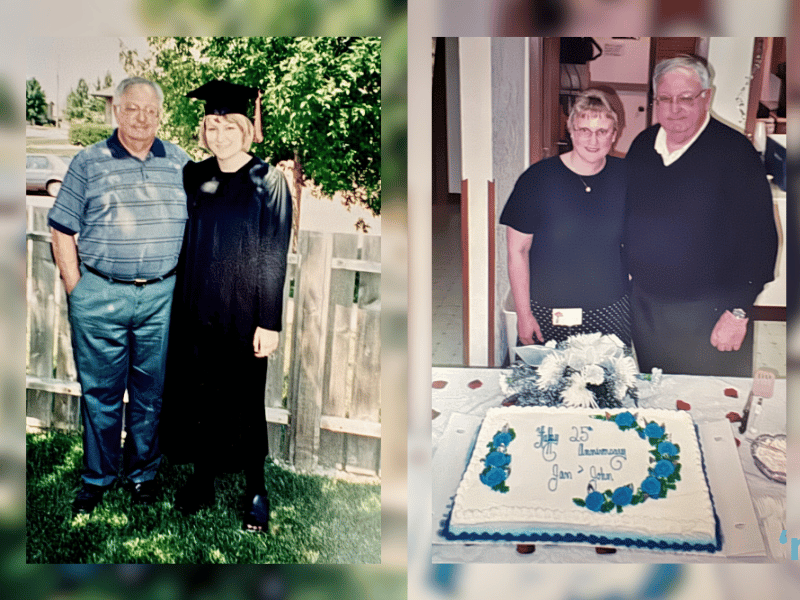
Visiting their home, it doesn’t take long to see that this home is filled with love and charm. The walls are filled with frames of family photos, photos that capture serious portraits, school pictures, and purposely silly photos in many of them. John is a constant reminder of his presence and his importance in their memories. Asking the family, if you could say anything to John today about his health, what would it be?
Denise DePaolo:
I wish that you’d been more proactive. I wish you could know your granddaughter because you’d have a lot of fun together. I wish you could see everything that we’ve been up to, because I think that he’d be really proud of where we all are.
(Piano music with woman singing)
“Here today and on through, I see my light in you.”
Jan Orton:
I wish he would’ve gotten that colonoscopy. How many times did I nag you to go get a colonoscopy? And he wouldn’t do it. I would tell him how much he’s missed with Mia. He would’ve loved having a grandchild, and that’s what I would tell him. And that I love him.
Get more episodes in this series
…
Posted In Cancer, Cancer Screenings, Cancer Treatments, General, Health Information, Health Plan, Healthy Living, Sioux Falls, Symptom Management, Veterans