An Alzheimer’s diagnosis can be devastating for a patient and their family members. The disease causes confusion, memory loss and personality changes, and it gets worse with time. When Jessica Remily found out her mother was diagnosed with Alzheimer’s disease, it was difficult, but it was not a surprise.
“She had been scared of getting Alzheimer’s for years. She had thought that she was going crazy, that she was losing her mind, and had thought that for years,” Remily said. “The day that we came in here and got the first diagnosis, I remember my mom feeling validated.”
Family history of Alzheimer’s
Remily’s mother is Sharon Walth, a 79-year-old resident of Bismarck, North Dakota, who has a family history of Alzheimer’s. Her mother and two of her brothers were also diagnosed with the disease.
“I was very young when my grandma started having issues with her cognition. I remember her telling stories over and over and over again,” Remily said. “It has been part of my whole memory as a kid of watching my grandma very slowly fade.”
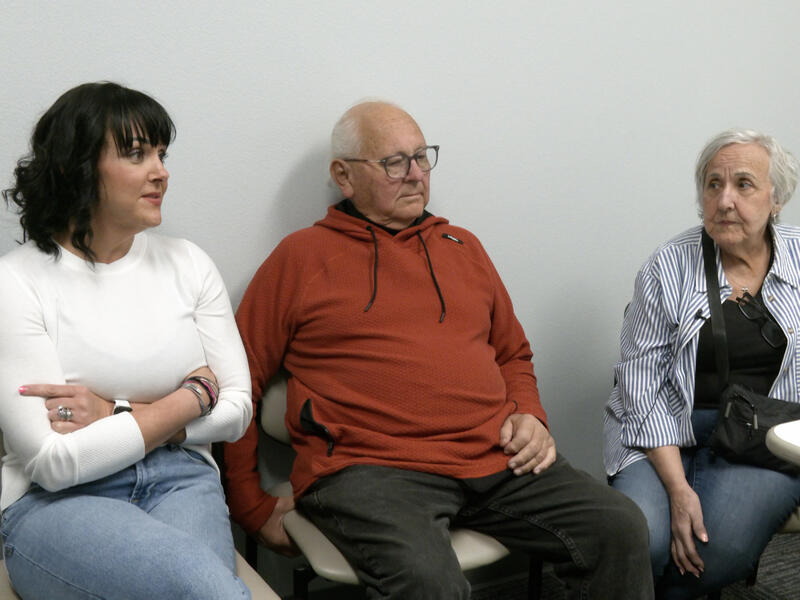
Bruce Walth now sees those same things happening with his wife of 60 years. He and Jessica are facing it as bravely as they can.
“She can sit and talk with you, but she won’t remember it,” said Bruce about Sharon. “There’s some long-term memories too. She asked me the other night about one of her brothers, ‘What’s the wife’s name?’ So it’s gotta be going back a ways.”
Bruce says he plans to care for Sharon as long as possible. But she’s not the only person in the family he’s concerned about.
“You look at the kids every once in a while, and you wonder, ‘Is this gonna happen to you? Are you gonna be the next one? Am I gonna be the next one?’ That part is always on the back of your mind,” Bruce said.
How neuropsychology helps
Sharon Walth is being treated by Nicole Norheim, Psy.D., a clinical neuropsychologist at Sanford Northern Sky Clinic in Bismarck. Sanford’s neuropsychology department helps families work on daily functions, emotional care, and when to seek outside care for a loved one. Dr. Norheim also helps people like Remily, who proactively try to stay ahead of Alzheimer’s.
“There has been more of a priority in me to do the things that I can do to prevent it,” Remily said. “Obviously you can’t prevent genetics, but there are things that I could do now that definitely could impact the future.”
This includes prioritizing sleep, exercising regularly, and eliminating sugars from her diet, which can increase the risk of plaque build-up in the brain that contributes to Alzheimer’s.
Remily will also be taking a cognitive baseline test so that she can measure any decline in her brain function.
“I actually really recommend baselines,” Dr. Norheim said. “So many patients come to me – ‘Well, I used to have a good memory’ or ‘I always had a bad memory.’ But I don’t know if that’s true because I never tested you before. I can only test you today compared to other people your same age.
“So having that baseline is really important. And then if in the future, five, 10 years she feels like, ‘OK, I am getting worse,’ then we can always have her come back and compare her testing to when she really didn’t have any significant concerns.”
Hope for the future
Going forward, Remily hopes for scientific advancements that could help her and other family members in the future.
“Every day there are new studies that come out, and new treatments that are coming out. I don’t know that that’s necessarily going to specifically impact my mom,” Remily said.
But someday there could be a breakthrough for her family and the estimated 7.4 million Americans living with Alzheimer’s.
“Hopefully 20 years. I’m hoping that we have a cure,” said Dr. Norheim. “That would be awesome. Or else we can really just identify early detection. Let’s freeze it. We can’t get worse. And so I really foresee us getting there eventually. I just don’t know when.”
Learn more
- Secrets of memory loss, according to a brain specialist
- Exercise, social time can slow progression of Alzheimer’s
- Dance class helps memory care residents stay active
…
Posted In Bismarck, Brain & Spine, Neurology