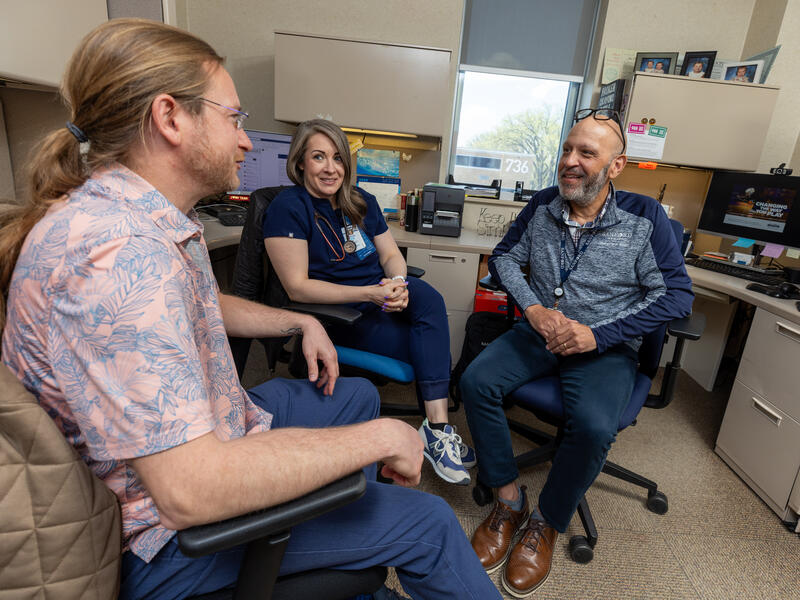
Substance use disorder treatment coordinators help people who are struggling with addictions. They meet them where they’re at. They listen to their experience. They help them commit to a better future.
John Campbell, a treatment coordinator at Sanford Health, has helped many people navigate the recovery process. What makes him especially valuable in his role is the way he brings his lived experience to work.
With over 17 years of sobriety under his belt, John understands the difficulties people go through with addiction. Treatment and recovery is a journey full of obstacles and fears, but it’s one worth taking, and John and his coworkers serve as steady, positive forces in other people’s lives as they face their addictions and begin to heal.
John’s personal journey from addiction to sobriety
John spent most of his upbringing in North Dakota. While he often struggled to focus in school, he excelled at connecting with others and had no problems making friends.
Looking back, he realized the roots of his addiction started when he was young, long before he understood the impact they would have on his future.
“I wasn’t good at saying ‘no,’” John said. “I was kind of a class clown, and I drank recreationally.”
After high school, John got married and had two kids within the first few years of marriage. Finances were tight, and plenty of stress factors were present.
It was during this time that John’s addiction gradually began to form and show itself. At first, the addiction was more general and included eating.
“I had gained quite a bit of weight, and I had developed sleep apnea and diabetes,” said John. “Because of that, I had gastric bypass surgery. My care team warned me about alcohol use after surgery, but I ignored them. I thought I could do whatever I wanted.”
Drinking alcohol after gastric bypass surgery can be dangerous, as alcohol’s effects can become stronger and last longer. But John’s drinking habit continued.
“I progressed and started to drink more and more on the weekends, then more and more on Fridays, then more and more on Thursdays, and so on,” said John.
At first, he didn’t realize his habit was taking a toll on his family.
“One of my earliest memories of realizing I had a problem was noticing how my kids acted around me,” said John. “I knew my behavior wasn’t OK, but I wasn’t stopping. My immediate family was walking on eggshells around me. They knew that nothing was really wrong with Dad, but nothing was right with Dad.”
John’s wife, Aaste, was covering up for John’ s addiction and behavior, and she didn’t realize how bad everything had become. Some of John’s doctors were concerned about his well-being, too.
Eventually, John was persuaded to go through an addiction assessment, and after receiving an ultimatum from Aaste, he agreed to go to outpatient treatment.
But John continued to drink, and he often went to the bar after group recovery sessions.
“I didn’t realize it at the time, but I was grieving that I had to let go of something,” said John.
A major turning point for John came during a group session. Aaste described how John’s drinking affected her and the family. It was difficult to hear, but it made an impact on John, and soon after that he began to earnestly work toward recovery.
“Recovery was hard, but my father always said, ‘The hard way is the right way,’” said John.
Being there for others as a treatment coordinator
Years after starting recovery, John joined the Sanford Fargo Substance Use Disorder Clinic as a treatment coordinator. Aaste, who is the director of clinician experience at Sanford Health, heard about the opportunity through work and knew John would be a great fit.
Through his job, John encourages others to overcome their addictions and improve their lives.
“My whole life, I’ve been looking at how I can help people fill the gaps,” said John. “At any given moment, most of us are about 50, 60 or 70% put together, and we offer support and resources to help with the rest. We advocate for people, listen to them, put together some goals with them, and then work on those goals.”
There isn’t a one-size-fits-all solution for addiction recovery. For some, starting out with harm reduction is the most effective method.
“The funny thing about harm reduction and having people pick their own plan is that the majority of those people move toward total abstinence, at least in my own personal experience,” said John. “People are the experts on themselves, so we empower them to find out what works and doesn’t work.”
And while every person’s recovery is different, John makes sure they get the same attention and advocacy they deserve.
“I try to get to know them by name and slowly find out what’s important to them. Then I try to link that with something that’s intrinsic in themselves,” said John. “I don’t believe I’ve ever met somebody that doesn’t have motivation or something that gets them going.”
With a job as impactful as this one, some days can be hard.
“The hardest part of the job is managing my expectations of a person. We see their potential, we see the way out and we’re invested in them,” said John. “We give through our story and our experience, but sometimes things happen. They relapse, they get injured, they go to jail, they die, and it affects us.
“It’s hard to not over-invest because people do recover, and that’s really cool to see. I love hearing about how someone’s doing, what actions or steps they’re taking, and how they’re recovering. People can improve their quality of life, get what they want and recover.”
John has first-hand experience in seeing what recovery can do to improve someone’s life, and his hope for the future is that more people step up to help others by working in addiction treatment.
“Whether you’re an addiction counselor, an intern or someone who’s looking into the addiction field, we need you,” said John. “At Sanford Health, we practice our culture. We have culture champions here. We’re working to meet the standard we’ve set, and we put in the effort to improve it.”
Careers at Sanford Health have excellent pay and comprehensive benefits, and above all, they empower you to serve others. If you’re looking for a rewarding career with plenty of room to grow, start exploring open positions today.
Learn more
- Addiction recovery digs into causes, healthier responses
- ‘I don’t drink anymore’
- ‘Wellbriety’ program helps Natives, others with addiction
…
Posted In Allied Health, Behavioral Health, Fargo, People & Culture