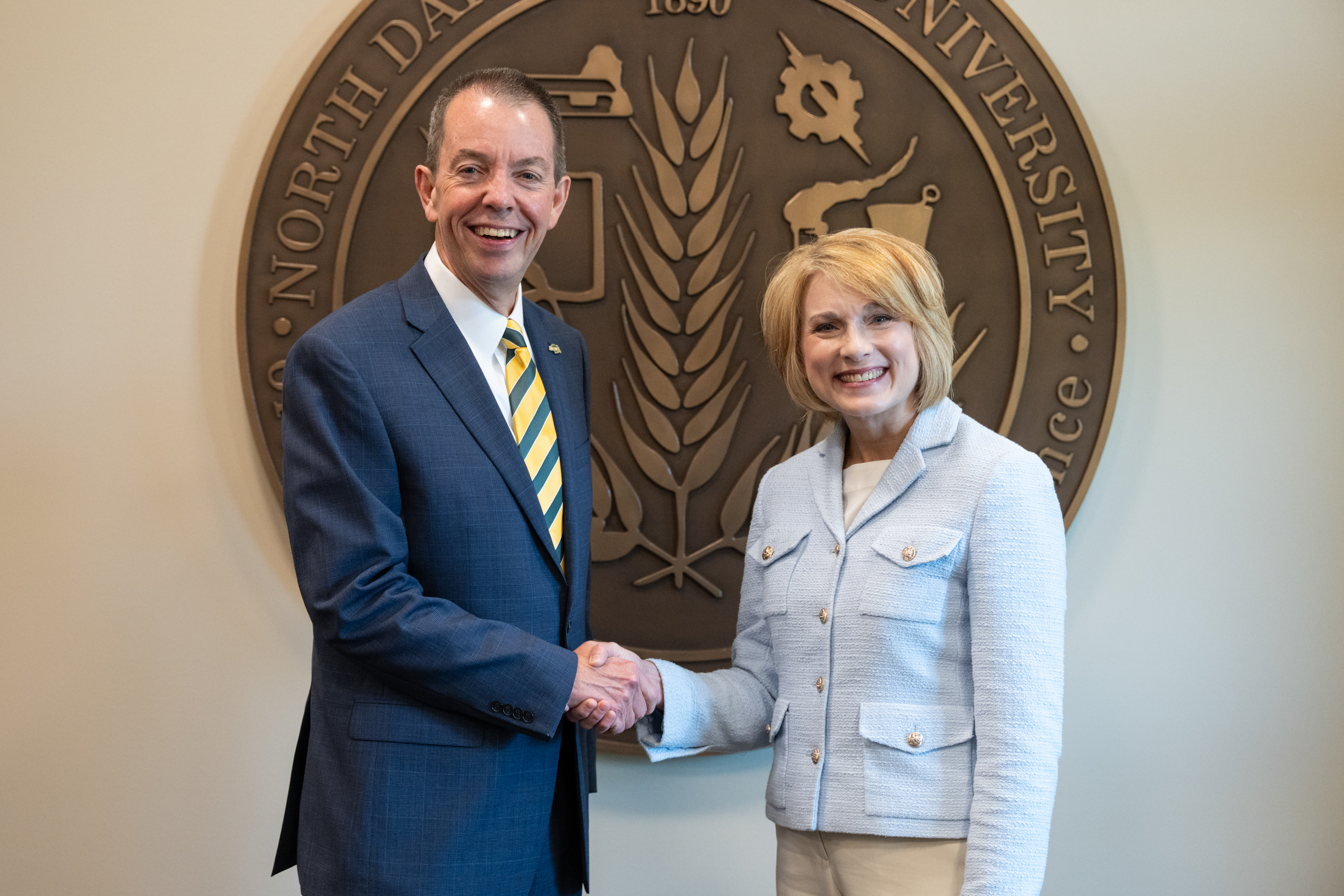
NDSU and Sanford Health are launching a research collaboration to evaluate factors that may affect the outcomes of next-generation GLP-1 obesity-management medications. The project is funded by a $210,000 investment from NDSU, Sanford Health and the North Dakota Department of Health and Human Services is designed to foster collaboration among research scientists with diverse expertise and backgrounds across both organizations.
The project, called PREDICTors of Clinically Relevant Outcomes on GLP-1 Treatment for Obesity, will examine a range of outcomes associated with new GLP-1 receptor agonist (GLP-1 RA) obesity-management medications. These medications mimic the GLP-1 hormone naturally produced in the human body, and the researchers will examine how they affect factors such as body weight, body composition, balance and fall risk, substance use, quality of life and health care utilization.
“We are excited to partner with North Dakota State University on this important project,” said Tiffany Lawrence, president and CEO for Sanford Health Fargo. “Sanford and NDSU have built a strong and enduring partnership in research that spans many years. This longstanding relationship reflects a mutual commitment to discovery, education and improving the well-being of communities across North Dakota and beyond. As a healthcare organization, we are committed to providing our patients with advanced, high-quality care close to home. Meaningful partnerships like this help us further that promise by translating research findings into tangible, real-world improvements in patient care.”
A sentiment echoed by NDSU President Marshall Stewart.
“Projects like this show the value of collaboration that crosses disciplines and institutions,” said President Stewart. “NDSU and Sanford Health are building on a strong foundation to better understand how these medications affect people’s lives. It’s a meaningful step forward in addressing one of the most important health challenges facing our communities.”
The researchers bring expertise from multiple fields. Their goal is to better understand how GLP-1 medications work by examining biological factors, such as gut bacteria, as well as behavioral factors, such as food cravings, mood, and food noise or intrusive thoughts about food and eating that occur outside of physical hunger. The experts will also apply multiple methods to ensure the results use rigorous, state-of-the-art assessment and evaluation techniques.
"Meaningful partnerships like this help us further that promise by translating research findings into tangible, real-world improvements in patient care.” Tiffany Lawrence, president and CEO for Sanford Health Fargo
“We know that biology directly impacts behavior,” said Kristine Steffen, professor of pharmaceutical sciences. “Using sophisticated research methods to study the way biology and behavior impact each other during GLP-1 therapy will help us to understand mechanisms that lead to the variable experiences people have on these medications with respect to weight, quality of life, substance use and others.”
The researchers hope the project will demonstrate the strength of collaboration across institutions and research settings, including two major research hubs within the Sanford Health System in Fargo and Sioux Falls, NDSU, and the Center for Advancement in Pharmacy at NDSU. Led by Elizabeth Skoy, professor of pharmacy, CAP provides educational, operational, and research support for faculty and pharmacy practitioners across North Dakota.
“Sanford and NDSU have a history of collaborating on research,” said Scott Engel, vice president of Sanford Biobehavioral Research. “ This team is comprised of many Sanford and NDSU researchers who have come together to provide distinct, but complimentary, expertise to examine an issue that is relevant to the 12% of US adults who are currently taking a GLP-1 medication. Our hope is that this pilot project will lead to larger collaborative efforts that will aim to optimize outcomes for patients using weight management medications.”
NDSU and Sanford have a long history of conducting federally funded research in the areas of eating disorders, obesity and bariatric surgery. Steffen and Engel have collaborated for the past 25 years on numerous research projects examining the impact of metabolic and bariatric surgery on patients.
Steffen said this new research is a logical next step in that collaboration. “Patients today have more effective weight-loss options than ever before, so this is a logical extension of our work,” she said. “We have studied the impact of MBS on substance use and quality of life, and it’s important for us to do the same with the GLP-1 RAs that patients are now using.”
Engel added that current data suggest that 1 in 8 U.S. adults is using a GLP-1 medication, making this research relevant to a rapidly growing segment of the population.
“With an estimated 1 in 8 adults using GLP-1 medications, this NDSU–Sanford collaboration recognizes the clinical importance of studying the effects of current and emerging GLP-1 therapies,” said Heidi Grunwald, interim vice president of Research and Creative Activity. “Together, we can do more to ensure that GLP-1 treatments evolve from blunt tools for weight loss into precision approaches for optimizing metabolic and neuro-protective outcomes, while safeguarding skeletal muscle mass and preserving gut microbiome health. This pilot project will collect baseline data across these areas of inquiry, positioning the collaborators to compete for larger investments in this timely and important work.”
Enrollment in the program is expected to open in later July.
…
Posted In Family Medicine, Fargo, Healthy Living, News, Nutrition, Research, Specialty Care, Weight Loss