Episode Transcript
Lora Black:
What I think about is this opportunity to have an expert hub that is tied into a broader community site, leveraging DCT elements, to really afford and offer patients wherever they are in a rural community or within even a city like Sioux Falls, the opportunity to participate in research.
Announcer:
“Reimagining Rural Health,” a conversation series brought to you by Sanford Health. In this series, Sanford Health leaders and expert guests share insights, innovations, and real-world solutions to the toughest challenges in healthcare today. Each episode explores the ideas, tools, and partnerships advancing rural healthcare and strengthening care in communities across the country.
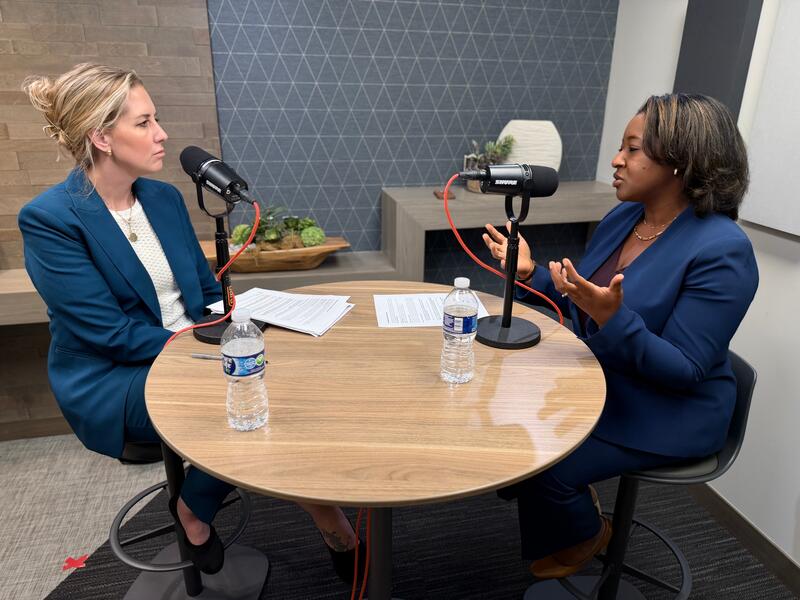
In this episode, Lora Black, vice president of clinical research at Sanford Health, sits down with Esther Krofah, executive vice president of health at Milken Institute. Together, they discuss expanding the reach of clinical trials and medical innovation through partnership.
Lora Black (host):
Esther, thank you so much for joining us today and making the trip to South Dakota.
Esther Krofah (guest):
Thank you so much, Lora, for having me. It’s been a terrific day. I look forward to our conversation now.
Lora Black:
So before we get started, do you have any initial thoughts on the day?
Esther Krofah:
I am incredibly impressed. I knew a little bit about Sanford research, obviously interacting with you, Lora, hearing the stories in Washington during our roundtables. It was nowhere near as close to the breadth and the depth of what I have seen today. So huge congratulations to you and to your team and the entire Sanford enterprise for creating an experience that everyone should come and see it live because it’s really hard to describe otherwise.
Lora Black:
Oh, that’s fantastic. And we appreciate you making the trip so very, very much. After spending the day with our teams, wondering a bit about what maybe stood out most to you in terms of connecting the broader challenges and opportunities across America that rural communities face and where Sanford really is hitting the mark.
Esther Krofah:
What really stood out to me, and maybe I will start in close to the latter part of our day, when we were visiting the oncology units and going through those infusion centers, I saw the patients that were sitting there, that are being treated. I was struck by the research unit that was just one floor below them.
And to see the opportunity for those patients that are coming for their care to have access to the highest quality care, but also have access to high quality research at the same time, it really summed up the entire day for me, which is this idea that no matter who you are and no matter where you come from and whatever part of the country you live in, you should be able to attain access to the highest standards of care that are afforded to you. And that you’re doing it here at Sanford is incredible.
I would also say that I didn’t really think about your virtual option. Certainly heard that you do telehealth, but when we saw the virtual care center and I thought would see perhaps some of your coordinators that are providing access to telehealth services and will see the computer monitors and it was beyond what I imagined it would be.
You have thought about every need of both the providers and the patients, that if you live two hours or five hours away from an actual physical unit, you can still have access to a specialist. And that’s what patients are looking for, which is within the comfort of the community in which I live. Can I get that guidance on what is offered to me? How can I get the best care? What are my treatment options? And they just want answers.
And for you to provide the answers to them – that they don’t have to drive all of those hours away where many would otherwise have not seen a specialist, and you have an entire virtual care team that is thinking about all of their needs – added a whole different component to, it’s not just the care, it’s not just the research, it’s also the access to the specialists all throughout this region in North and South Dakota, Minnesota, Wisconsin, that is really truly a full enterprise view. Amazing.
Lora Black:
Thank you for that. Thinking about the innovation that we’ve seen today and really the ingenuity that is employed every day, many times out of necessity, as you mentioned, thinking about that in the context of the mission of FasterCures and what we’re trying to do with ENRICH-CT (Enabling Networks of Research Infrastructure for Community Health through Clinical Trials), where do you see the greatest opportunity for Milken and Sanford to continue to collaborate around bringing clinical trial access to historically underserved populations?
Esther Krofah:
Yeah. Well, our mission at FasterCures is how do we accelerate the development of treatments and cures? How can we look across barriers that stand in the way for breaking down the silos across the ecosystem that limit the opportunities for us to develop those treatments and cures?
And what I saw certainly today and the work that we’re doing at ENRICH-CT is that we have the opportunity to make more trials available to more places throughout the country, including from early Phase 1 trials to later-stage trials, to even having investigators that are thinking about discovery based on the needs of their population, as we heard from your epidemiology team that you’re looking at prevalence of disease in this part of the country and then thinking about what are the innovations that come out of that.
And so for us at FasterCures and ENRICH-CT, we’re looking for these models. We’re looking for these examples. We want to understand what is best in class, what is happening on the ground what are the policy enablers that are going to allow us to see much more of community sites being established, being built to give patients more of an opportunity to participate in research. Oftentimes we quote either 4% or 14% of patients ever participate in clinical research, and often because we don’t have research in the right places.
And you have this research capability here at Sanford in the right place. We can use ENRICH-CT as a vehicle to think about are there policies that are standing in the way? How do we remove those policy barriers? How do we achieve this broader goal? And from what I saw today, what I think about is this opportunity to have an expert hub that is tied into a broader community site leveraging DCT (direct to consumer) elements to really afford and offer patients wherever they are in a rural community or within a, even a city like Sioux Falls, the opportunity to participate in research.
So the partnership will continue with Sanford and ENRICH-CT, but you really are an incredible model of a rural health system with a regional expertise. It’s demonstrating exactly what we’re looking for here in this country. The question is, can we get more resources to institutions like this to see more of this in more parts of the country?
Lora Black:
Thank you for that. We’ve today heard a couple of different times that now might be a great moment, right? It might be a time there’s a lot of energy and excitement around clinical trials, people are paying attention. And so some of the work that FasterCures is doing is trying to identify those models, aligning things with public policy and perhaps even a national plan around our life sciences.
I’m wondering how you foresee Operation Trialblazer adding to that and if you have some early indications of where some of the most benefit might be seen in the first year of the Operation Trialblazer program.
"You really are an incredible model of a rural health system with a regional expertise. The question is, can we get more resources to institutions like this to see more of this in more parts of the country?" Esther Krofah, Milken Institute
Esther Krofah:
I’m incredibly optimistic to see the attention of the federal government through Operation Trialblazer to focus its attention on clinical trial access and opportunities in the country. I think it is the beginning, not the end. I think the focus on early Phase 1, especially through some of the pilots that they’re announcing, is absolutely the right thing to do. We want to see a significant response to that, but it’s also going to have to be Phase 1 and later-stage phase, Phase 2, Phase 3 and beyond with can we enable easier enrollment for patients, just make it more accessible? Can we integrate more research into care settings?
So we are in a moment where, you know, from a federal perspective, we’re paying attention. We’re paying attention because quite frankly, we have to from a competitiveness perspective. Yet at the same time, we need to look at the broader lens of how we can develop a U.S.-based national life sciences strategy and understand where the opportunities for wins are for domestic innovation and for that innovation to benefit American patients, American population.
And in doing so, we will support our U.S. economy, we will protect national security, but we really have to find these models like Sanford and others across the country that are doing it well and building the components of it that are well into a national life sciences strategy. And so you’ll see much more from us on that.
Lora Black:
Maybe one final question for you. Thinking of the models that we’ve identified, the life sciences strategy, we understand that workforce is going to be a big issue that came up in many of our conversations today from physicians, biomedical researchers, clinical research coordinators, and other clinical research professionals. What do you think or what are you aware of in the national policy space that would be helpful in terms of developing and sustaining the workforce that we need to actually drive the innovation and the models that we’re identifying?
Esther Krofah:
Yeah, I would say that just as I talked about the attention on clinical trials and clinical research, defining some very specific policy opportunities in workforce is the next topic to tackle. Much of that is around NIH’s role as it has been for many, many decades and funding the basic infrastructure that has enabled the ecosystem to be what it is.
The basic research and investing in that builds academic labs, builds the opportunity for fellowships, builds a capable workforce, including the research coordinators that you talked about. It builds the opportunities for us to have both investigated initiated trials, but also to look across other trials across NIH, like NCI, for example. So that is the next opportunity. It is paying attention to our STEM programs, and we have to say that we need to support both academic research and other kinds of research and the workforce.
That’s going to take federal investment. That federal investment, of course, can be complemented by philanthropy and private investment, but for many decades, public investment has provided that foundation and that needs to continue going forward. So yes, it is an area that we need to address. I don’t know that it is at the same level of attention at the moment as we’ve seen on clinical trials, but many will say we cannot have innovation in biomedical life sciences strategy ecosystem without an investment in the workforce that it needs to sustain those levels of efforts.
We’ll like to see NIH funded. We’ll like to see those grants deployed. We would like to see those fellowships continued. We need physician scientists and beyond. We need all parts of the ecosystem to work well together.
Lora Black:
Well, thank you again, Esther. This has really been a fantastic day. Before we wrap up, is there anything final that you’d like to offer in terms of thoughts or perspective?
Esther Krofah:
Yeah, it’s been a fantastic day. I’ve certainly learned a lot from seeing the labs and, and all that you’ve offered, seeing the wards and, and the infusion centers, and the virtual care center. And I would say my takeaway is that we need an integrated approach. That is the strategy that Sanford has taken. It’s not any one of those components by itself. It is all of it working together.
And as we go forward and look toward what the future offers, it really is going to be about bench research to translational research, to clinical research, to patient care, to access through virtual care, all with this idea that patients ought to be at the center and we want that, the best patient outcome. So Sanford is an example of an integrated approach and I want to see more of them.
Announcer:
Thank you for listening to “Reimagining Rural Health,” a conversation series brought to you by Sanford Health. Hear more episodes in this series or other Sanford Health series on Apple, Spotify, or news.sanfordhealth.org.
…
Posted In Innovations, Research, Rural Health, Sioux Falls, Thought Leadership, Virtual Care