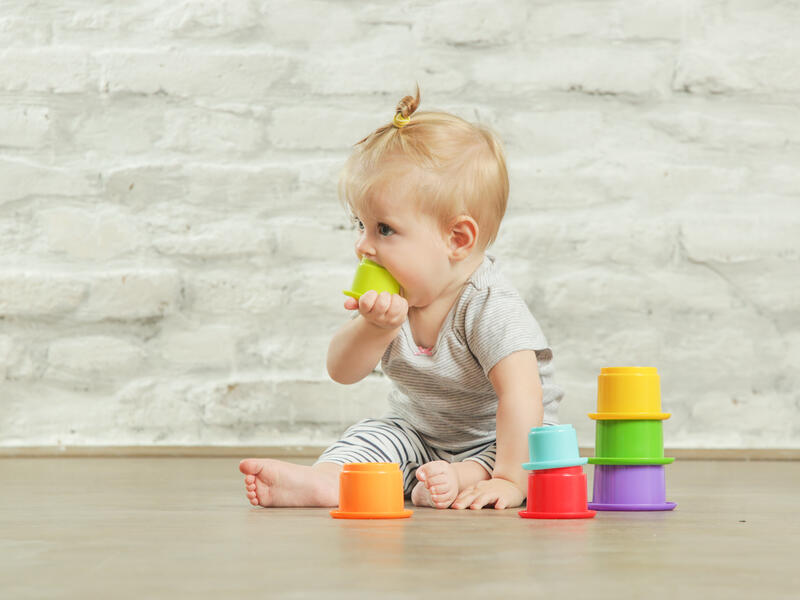
At 6 to 12 months, your baby is likely transitioning from a nonmobile infant to a mobile infant. This opens a whole new world to explore through play.
Exploration and play are how mobile infants learn about the world around them. Playing with your baby can help them develop and learn new things such as ways to move their bodies, thinking, and language skills.
How do I play with my baby?
Your baby will let you know what they are interested in if you pay attention.
- Develop motor skills
- Throw or roll a ball back and forth with them.
- Encourage crawling skills by putting a favorite toy in sight but out of reach.
- Engage curiosity
- Children at this age are learning cause and effect; they enjoy dropping things from their highchair to learn that it makes a noise when it falls.
- Encourage the learner
- Your baby will also enjoy putting things into other things such as putting toys in a bucket and dumping them out, just to do it all over again.
- Explore
- Allow your baby to explore their senses by giving them toys of various textures.
- Sing together
- Play music and sing to your child, using your baby’s name in the songs.
- Strike up the band
- Let your baby bang on plastic or metal pans and bowls with plastic or wooden spoons.
- Bring out the imagination
- Give your baby a cardboard box and watch their imagination come alive.
- Laugh together
- Play games like pat-a-cake and peek-a-boo.
Safety at this stage
Your baby can see many things on the floor that you may not notice. Be sure whatever they are playing with is safe.
Toy safety
- Prevent choking:
- When babies play with toys, they will probably put them in their mouths which is one of the ways they learn about their toys.
- Do not give your child a toy small enough that it could go through a toilet paper cardboard tube.
- Wash toys after they have been in your baby’s mouth.
- Make sure your baby’s toys are unbreakable.
- Check for sharp edges or loose parts.
Home safety
- Cover electrical outlets.
- Secure cupboards and drawers with safety latches.
- Get down on the floor and look around to see what your baby sees.
- As they are getting more mobile and pulling themselves up to stand, move breakables up out of their reach.
Learn communication through play
- With your help, your baby can learn simple sign language such as “more” and “please.”
- Teach your baby to wave bye-bye.
- Show your baby how to shake and nod their head for “no” and “yes.”
- Give your baby a chance to imitate what you are saying and doing.
- Have “conversations” with your baby by verbally responding to their babbling and vocalizations.
Every baby is different when it comes to what they enjoy while playing. Pay attention to what your baby is telling you with their nonverbal and verbal language. Use play as a bonding opportunity and a chance to teach your baby new things every day.
For more information about toy and home safety, visit our Safety Center at Sanford Children’s CHILD Services, 5015 S. Western Ave. Suite 120, Sioux Falls, South Dakota.
For more information about how your baby learns, check out our parenting series “Understanding Me Up to Age 3.”
Learn more
- Take steps to keep your little explorer safe
- Babies learn while on the move
- Poison safety tips for parents with small children
…
Posted In Children's, Family Medicine, Parenting