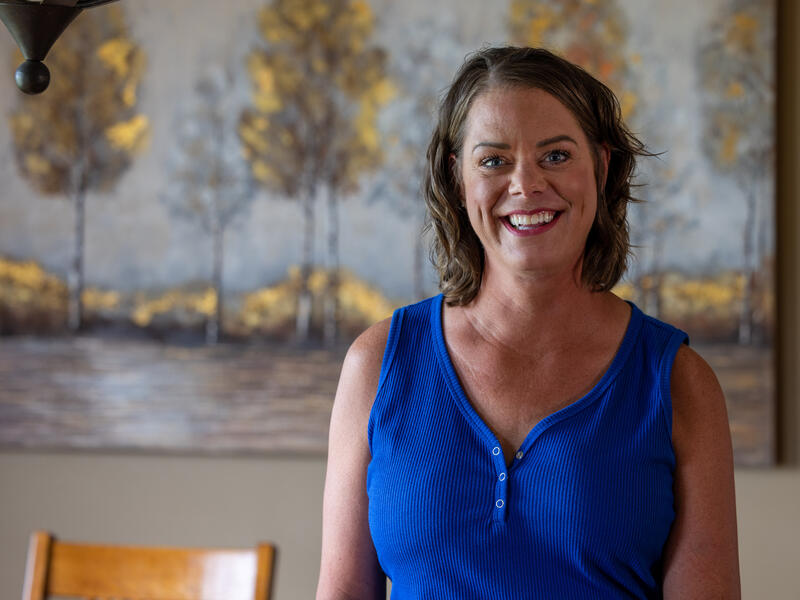
When Jaime Franken felt a lump in her breast, she wrote it off as scar tissue from a surgery a few years earlier.
But she couldn’t get it completely off her mind. Her mother died at age 39 from brain cancer. Her grandmother died at age 39 from breast cancer. Franken was 41.
“I kept it to myself for a couple of weeks,” said Franken. “Then I told my sisters, and they kept asking me about it.”
She was terrified of going to the doctor, but Franken decided to get the lump checked out. She was shocked when her doctor told her she had breast cancer.
“That was my biggest fear,” she said.
Following her diagnosis, doctors did a PET scan to ensure the breast cancer hadn’t spread anywhere else in her body.
“I remember them saying if it had, that would be considered Stage 4,” said Franken. “And it would be treatable, but not curable.”
The good news was that the PET scan revealed her breast cancer hadn’t spread. But there was a mass in her abdomen that her doctors wanted to look at a little more closely.
Going deeper to find answers
Franken started chemotherapy to treat the breast cancer. In the meantime, she scheduled a biopsy so doctors could determine what else was going on.
The results came back as leiomyosarcoma, meaning Franken had a second primary cancer.
At this point, doctors suggested genetic testing. When her results came back, she was diagnosed with Li-Fraumeni syndrome. This is a rare genetic disorder that makes people more likely to develop a variety of cancer types including breast cancer, brain cancer, sarcomas, adrenal gland cancer and leukemia.
“The great news for my immediate family is that God brought us down the path of adoption,” said Franken. “So, I didn’t have to worry about getting our kids tested.”
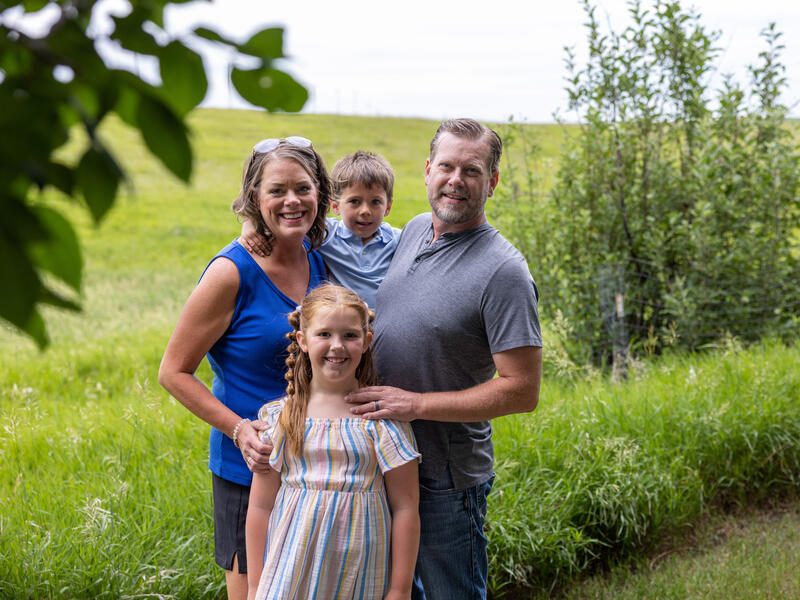
Photo by Jay Pickthorn, Sanford Health
Franken’s three siblings got tested. Her two sisters were negative, so their children did not need testing. Franken’s brother tested positive, and of his two children, his daughter was positive as well.
At first, the results felt “like a death sentence.” But, with time, their mindset has shifted.
“My mother didn’t have this opportunity,” Franken said. “He now knows, his daughter knows, and we can just be that much farther ahead of it and catch things earlier.”
Coordinating care for multiple cancers
Now, Franken needs treatment for two cancers. Her care team from Edith Sanford Breast Center in Sioux Falls, South Dakota, continued treating the breast cancer while working closely with a team at Mayo Clinic to address the sarcoma. They worked together to administer as much care as possible in Sioux Falls so that Franken could stay close to her family.
“We are so lucky to be in Sioux Falls and have a cancer center like we do here,” said Franken.
In addition to chemotherapy and radiation, Franken had surgery to remove much of her small intestine as well as a double mastectomy. During a follow-up PET scan, a spot on her adrenal gland caught her doctor’s attention. He decided to take it out as a precaution.
Franken’s doctor called a week later and told her the gland came back positive with a third primary cancer.
“I think the chemotherapy, because of the other two cancers, kept that one from blowing up,” said Franken. “For me to not have to do any follow-up treatment other than remove that – I’m really, really lucky.”
Not many would describe Franken’s journey as “lucky,” but she does.
“I remember one of my doctors saying that I’m the luckiest unlucky person in the world,” Franken said. “And honestly, it helps me to think of it that way.”
Now, Franken is cancer-free. She’s become a big proponent of getting annual cancer screenings and is hopeful that sharing her story can make an impact in other people’s lives.
“If I could convince one person that might have a fear to go in and get checked, that makes me feel like some of this had a purpose.”
Learn more
- Yearly checkups help find breast cancer early
- Breast cancer basics you need to know
- Five breast cancer screening options
…
Posted In Cancer, Cancer Screenings, Cancer Treatments, Genetics, Sioux Falls