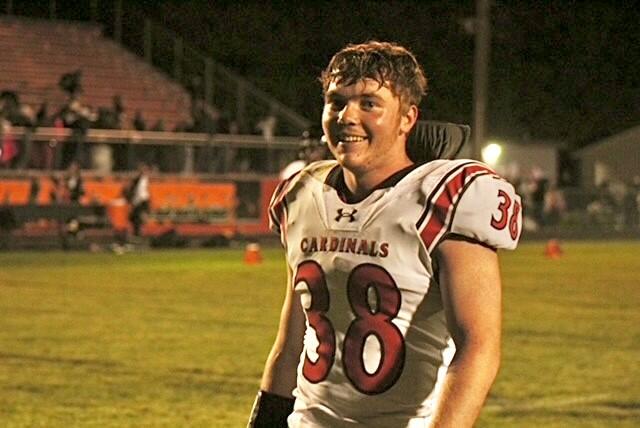
Carson Marko got a two-for-one deal during a football game his junior season when he injured two parts of his knee in one play.
He completely tore his posterior cruciate ligament and partially tore his medial collateral ligament while making a tackle.
He didn’t know immediately how bad the injury was. But after an MRI revealed the extent of the damage, he realized that his season was over and that getting back to where he was before the injury would be a process that would take time, effort and help.
Any assurance that he would be able to return to the field for his senior year at Deuel High School would go a long way toward shaping his attitude about what came next.
On what could have been his worst day in dealing with this – the day when he had to listen to a surgeon tell him what he was up against – he instead heard words that fired him up. His conversation with Clint Benge, M.D., would become a cornerstone for his recovery.
“He said, ‘We’re going to be able to get you back on the football field,’” Carson said. “He said, ‘Your leg is going to be stronger than it was before and it’s going to produce for you better than it did before your injury.’ As soon as I heard those words it was like, ‘OK, this is not going to affect me long-term.’ I was super happy to hear that.”
Success returns
Carson, a 5’6”, 180-pound linebacker and running back, led Deuel in tackles his senior year and his Cardinals made it to the Class 11B semifinals a season after finishing under .500. What Dr. Benge had promised came true. Carson had played a vital role in Deuel’s resurgence.

“It was a speed bump in the road,” Dr. Benge said. “If he was diligent and on-board with the therapy and the treatment plan, it was going to work out. And it’s not just the surgery – it’s also the rehab and the therapist. When your patient understands that, it goes better. They realize it’s a team that will get them back to achieving their goals and playing at the level they want to be at.”
After two weeks of staying off his knee, Carson began light training in Sioux Falls and Watertown. His recovery was guided by Tyler Turbak, a board-certified orthopedic physical therapist for Sanford Sports. Turbak was able to tell Carson when it was OK to get after it and when it was time to be more cautious.
“At the beginning it was difficult because my leg was weak,” Carson said. “But once I got past that, it flew by. One thing that really helped me was that Tyler believed in me and pushed me to my limits. It made my recovery quicker and easier.”
Sweating it out
Carson accompanied his physical therapy with farm work. The progress was steady enough to keep his recovery on schedule or even ahead of it.
“I knew right away he was a hard-working kid,” Turbak said. “Leading up to his injury, he was a workhorse for his team. When I meet with new patients, I tell them they’re going to get out of it what they put into it. I wasn’t going to have tell Carson that more than once because he was dedicated to the process and he was going to follow the recommendations to a T. He was balancing his school, his job, his workouts with his teammates – he was obviously a busy kid who was putting in the work.”

Motivation can be a huge part of recovery for athletes recovering from knee surgery. They will quickly understand the same principles that get them from one practice to the next when they’re healthy will need to be applied when they’re working their way back.
Turbak prefaces the recovery journey for athletes like Carson with a conversation about goals. Then they put a plan together. It will often involve targeting an upcoming season and will be accompanied by periodic physical tests to measure advancement. None of it is a guarantee, of course.
“One of the phrases I use is, ‘You didn’t come here to get a haircut,’” Turbak said. “When you’re ready to be doing workout-type of things, it should feel like a workout. I want you sweating. I want you breathing hard.”
Ready to play football again
Carson successfully navigated a series of “functional tests” through the course of his rehab that gave Dr. Benge and Turbak feedback on his strength, range of motion and ability to move. As he approached being cleared to play, he also answered questions to help determine his psychological readiness. In recent years, it has become an emphasized part of the recovery process for Sanford athletes.
“We want to know where their confidence level is at with their injury,” Dr. Benge said. “We’ve found that it is actually more important than the testing data that assesses their physical strength. Some people who have returned to full strength are still not psychologically ready to return. Studies show those people are at a higher risk for re-injury, regardless of what their strengthening tests show.”
Carson’s answers confirmed he was ready to play football again. If there were any serious lingering doubts in the back of his mind, he shooed them out the door in Deuel’s 2025 opening game. He wore a knee brace as a precaution, but abilities he left behind had returned – and then some.
“I was definitely nervous,” he said. “A buddy on the team, Ethan Prins, was also coming back from a knee injury and we were both pretty nervous, so we talked about that. Then after it was over, everything clicked. We didn’t have to worry about anything. I got the hang of it again. I took on the hits. It was like, ‘Well, I feel normal now. The leg injury isn’t there anymore.’”
Learn more
- Runner and football player gets back on track after injury
- Student athlete keeps working for gridiron greatness
- ACL injury is focus of Fargo researchers
…
Posted In Clear Lake, Orthopedics, Rehabilitation & Therapy, Sioux Falls, Sports Medicine