Legacies often aren’t talked about until the end.
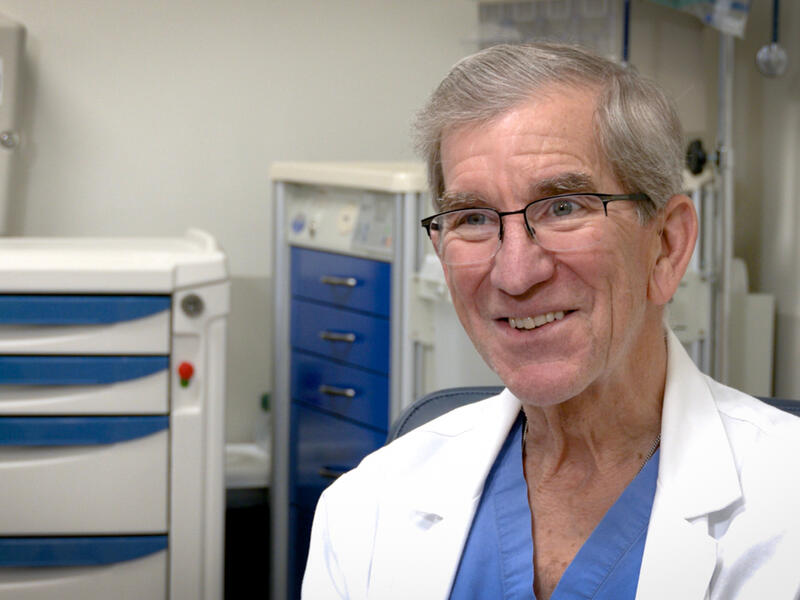
In terms of building something from the ground up at Sanford Health, few resumes stack up quite like that of gastroenterologist Jeffrey Murray, M.D.
When he first started practicing in 1987 – at what was then Sioux Valley Hospital in Sioux Falls, South Dakota – a patient could count the number of gastroenterologists on one hand.
“We were busy,” Dr. Murray recalled with a smirk.
But the minuscule wasn’t a detractor. In fact, it was the draw for Dr. Murray, who’d made his mind up on a field as a second-year medical student.
“I remember that I wanted to be a gastroenterologist because I was amazed at villi,” he said. “Those are the little finger-like projections in the small intestine that absorb what we consume. And not only do they do that, but they prevent us from being harmed. I thought that was just fascinating. I still think it’s fascinating.”
Over the course of Dr. Murray’s nearly 39-year career in Sioux Falls, the number of gastroenterologists with the Sanford Center for Digestive Health quadrupled. More hands for more work in a growing community. The work itself also grew more complex.
“It’s never let up. When I think of gastroenterology, I’ve relearned it probably four or five times in my career,” Dr. Murray said. “It’s continuing to evolve, which I think is also part of the charm. You’re learning new things, new techniques on a daily basis.”
‘10 steps ahead’
Meeting the challenge of evolving healthcare demands a team of people dedicated to recognizing the reality of the present as well as the possibilities of the future.
Kathy Schuler first met Dr. Murray after she was promoted to manager of the GI lab in 2009.
“Dr. Murray was the first person that greeted me and welcomed me to the lab,” said Schuler, now the vice president of surgical and digestive services at Sanford Health.
The two of them worked together in fluid capacities over the years as Schuler rose through the ranks from manager to director to vice president.
“He and I set out on a journey of working as a team in building the department,” she said.
Their accomplishments include expanding and adding several digestive health services along with guiding Sanford Health to become first and the only GI lab in South Dakota recognized by the American Society for Gastrointestinal Endoscopy.
“He’s always been a champion for gastroenterology,” Schuler said. “He has always been phenomenal at the cutting edge and thinking about being 10 steps ahead. What have we got to do next? How do we partner together to make sure that we’re growing our service line?”
Questions encourage the pursuit of answers. And pursuit requires time, effort and energy – commodities Dr. Murray conjured over the last four decades.
“He never stops thinking. His mind continues to go,” said Jorge Gilbert, M.D., chair of the GI department. “He never missed a national meeting. He never missed the conferences that were necessary for various certification processes. He was clearly up to date in the most important literature that any spectacular GI physician has to have.”
For Dr. Murray, it was an exercise in staying ahead of the curve – and sharing the knowledge with others – in the name of improving patient care.
“There’s a lot of exciting changes in gastroenterology,” Dr. Murray said, “and it behooves us to stay ahead of that to help the patient as much as we can.”
Guiding the next generation
The U.S. is facing a shortage of roughly 1,600 gastroenterologists. Mending that shortfall won’t happen overnight, but Sanford Health is making investments to meet the need through the only GI fellowship program in the Dakotas.
“We had started talking about what does that look like?” Schuler said. “Always continually talking with Dr. Murray about how do we build the program? How do we recruit? How do we retain?”
The three-year fellowship program received accreditation from the Accreditation Council for Graduate Medical Education and drew more than 400 applications each of the first two years. It welcomed its first two fellows in 2025 and will add two more in the summer of 2026.
“For me to have a program here in the state of South Dakota, in my home IM (internal medicine) program, it was a blessing in disguise,” said Deepan Panneerselvam, M.B.B.S., a gastroenterology fellow physician in the program.
Seeing another opportunity to lead, Dr. Murray served as the fellowship program’s first director, overseeing the curriculum, clinical learning experiences, faculty development and supervision of gastroenterology fellows.
“He was so passionate about it, the way he spoke about the new program and the way that he was trying to build it,” Dr. Panneerselvam said of his first meeting with Dr. Murray. “At that moment, I knew ‘this is definitely happening.’”
Now in his second year in the program, Dr. Panneerselvam is making strides in his educational and professional development, guided by those who are teaching with a wealth of experience and respect.
“They start seeing us as colleagues from the beginning because they know that we are going to be practicing soon,” he said. “They don’t see us as trainees. They see us as colleagues.”
In Dr. Murray’s eyes, the program has become what everyone had hoped. Fellows are learning “the latest and the greatest” while those in the GI department are staying on their toes as instructors.
“It’s fun because you’re watching somebody learn a procedure that you yourself can do,” Dr. Murray said. “You’re teaching that individual to do it, knowing full well that in the future they’re going to be the ones taking care of patients, and maybe even ostensibly teaching fellows themselves.”
The drive is contagious throughout the department.
“With challenge comes excitement. With excitement comes the ability to learn more so that you can teach better and have them become better GI doctors,” said Dr. Gilbert, who now serves as the fellowship program director. “Becoming an instructor in GI makes you a better doctor and thus, it’s better ultimately for patient care.”
A home to grow our own
In July of 2024, Dr. Murray stood shoulder to shoulder with colleagues, equipped with large scissors used for ribbon cutting ceremonies. The grand opening for Medical Building 1 (MB1) represented the bridge to an enhanced experience for gastroenterology patients and a home for future GI fellows.
“This is a huge step in establishing Sanford Health as the destination for gastroenterology care as we become the premier rural health system in the country,” Dr. Murray said at the time.
The 45,000-square-foot center includes 10 procedure rooms and 40 pre- and post-procedure rooms. It also houses clinical space, making it a one-stop shop for patients.
“We have everything in gastroenterology on the same floor. That’s almost unheard of,” Dr. Murray said.
The setup also creates an ideal learning environment for fellows while setting the standard for recruiting and retaining the next generation of gastroenterologists.
“To have the privilege to move into a beautiful new center, to have a GI fellowship program to partner alongside all the amazing people that we have, and to grow our own has been amazing,” Schuler said.
Among the photos snapped at the ceremony for MB1, one captured a congratulatory handshake between Dr. Murray and Sanford Health President and CEO Bill Gassen. It wasn’t the last handshake they’d share, but it was among the most meaningful – recognition for more than a decade of vision and hard work to bring a dream to reality.
“It gives you pause because you realize this is something you’ve been working on for a long time,” Dr. Murray said. “It’s great to have a brand new building, and it’s great to have a fellowship, and it’s great to have fellows here, but that’s actually when the work really starts.”
‘He cares deeply about patients’
The work, to put it broadly, was the root of investment for Dr. Murray, who retired in February. It showed in the day-to-day – both for those who worked with him for years and those who punctuated his final stretch inside MB1.
“He would be the first person in the hospital even before the cleaning crew was in. He’s there in the hospital at four, five in the morning,” said Dr. Panneerselvam.
“He cares deeply about patients. He cares deeply about his colleagues and the success of gastroenterology,” added Schuler. “It’s been an honor to work alongside him, to know him, to learn from him, to partner with him.”
Dr. Gilbert recognized his colleague’s technical skills, saying he has “gifted hands” when it comes to endoscopy – highlighting a possible coordination connection to Dr. Murray’s love of fishing. There’s also something to be said about his intangible skillset.
“In complex moments, he could make decisions very fast and very abrupt, but at the end of the conversation, he always blended it in a very humane way,” Dr. Gilbert said. “Never making his work a sophisticated work, just simply a pathway to help heal the patient.”
Dr. Panneerselvam recognized it, too. It’s one of the many takeaways he’s working to implement into the care he provides to patients.
“He would use fishing metaphors to explain what was going on, and that was much easier for patients to grasp,” he said. “Everybody was excited to see him, even though they were getting colonoscopies, which nobody likes to do.”
Patient experiences are built person by person, one interaction at a time. It’s something that Dr. Murray maintained with charisma, candor and humor over nearly four decades of service and hundreds of thousands of procedures.
“We all want the greater good for the patient. We want them to have not only a great experience, but a great outcome, which are not necessarily synonymous terms,” he said.
Those experiences compound over time to build lasting relationships and friendships. Some patients weren’t ready to let their doctor off the hook entirely, asking whether he could come out of retirement to perform their next scheduled colonoscopy.
A sign of respect for a legacy built on providing the best possible care – today and tomorrow.
“That’s what medicine is really about. It’s about touching lives. It’s about ushering people through their lives and helping them maybe even dodge some landmines,” Dr. Murray said. “You won’t believe how rewarding it is.”
Learn more
- Sanford Fargo now offers AI-assisted colonoscopies
- Young colorectal cancer patient urges others to get screened
- Younger age for colon screening catches polyps early
…
Posted In Digestive Health, People & Culture, Physicians and APPs, Sanford Stories, Sioux Falls