With colorectal cancer rates rising among younger adults, health care experts – including doctors at Sanford Health – recommend regular screenings at earlier ages. The old standard was 50 years old for a first colonoscopy, but that’s no longer the case.
“Because we’ve seen this increase in the rate of younger people being diagnosed with colorectal cancer, a lot of societies have dialed back to an age of 45 for patients to consider colonoscopy or other colorectal screening,” said Matthew McGee, M.D., a hematologist oncologist at Sanford Health in Bismarck, North Dakota. “If there’s a first-degree relative, it’s recommended that you consider screening at age 40, or 10 years before the youngest person diagnosed with colorectal cancer, whichever came first.”
Signs and symptoms
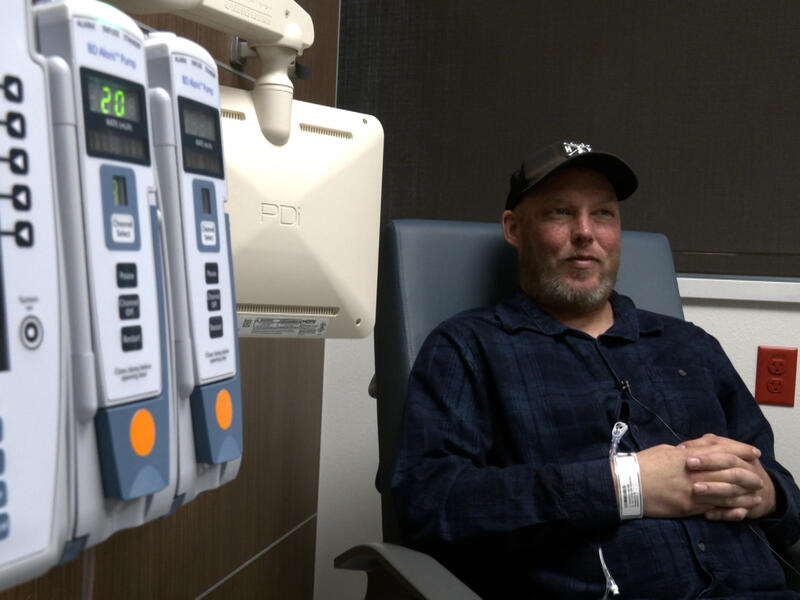
For Eric Knopik, his first screening didn’t come soon enough. The 40-year-old from Mandan, North Dakota, was diagnosed two years ago after his body sounded the alarm.
“Initially I was just super tired,” Knopik said. “Then all of a sudden my digestive system changed where bowel moments pretty much didn’t exist anymore. About a month after that, when I was able to go, I was starting to get signs of blood in my stool and then I talked to my doctor.”
Knopik had a tumor in his colon the size of a tennis ball. He was diagnosed with Stage 3B colon cancer.
“I had surgery where we removed the section of colon and the tumor. We started chemotherapy, which we did for six months, and then all the scans came back clear. Then back in November 2025, I came back in for another CT and cancer showed on that again,” Knopik said. “That was a real shock.”
The cancer had progressed and spread to his lymph nodes, including in his neck and back.
“I try to avoid stress and just stay positive. I got a little 4-year-old daughter at home I think about constantly. I got to keep fighting and be there for her,” said Knopik.
An advocate for screenings
Knopik now wants other people to know they should get their colonoscopies as early as possible, and that there is no excuse to put one off.
“I inform everybody that the colonoscopy is pretty much nothing. They give you the anesthesia and you’re in and out. That part’s really simple,” Knopik said. “You can’t be scared of it. Because it’s a pretty simple procedure. And I also tell them that if they have any sort of symptom, talk to the doctor right away so they could possibly catch it before it was at a stage where mine was at.”
Most instances of colorectal cancer – about 75% in fact – occur with no symptoms. But changes in bowel habits and bloody stool are common symptoms. Other things to look out for include:
- Diarrhea, constipation or feeling that the bowel does not empty completely
- Abdominal pains, aches or cramps that don’t subside
- Unintentional weight loss
Early detection can save your life. It can also make treatment much easier as well. If found early enough, some colorectal cancers can be treated with surgery alone, before chemotherapy or radiation are needed.
Learn more
- Colorectal cancer screening: Check out the options
- Colon cancer in millennials: What you need to know
- Colonoscopies: Debunking the myths
…
Posted In Bismarck, Cancer, Cancer Screenings, Cancer Treatments, Digestive Health