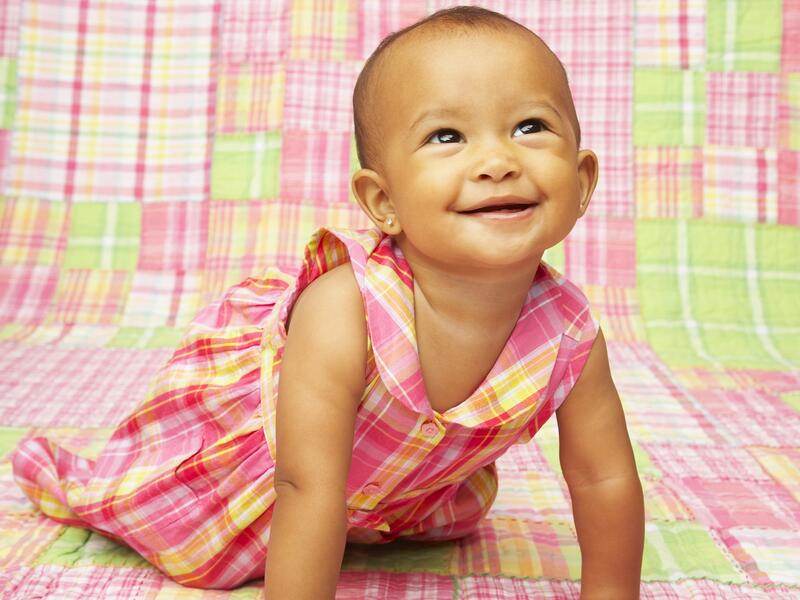
You have worked on tummy time with your baby, watching them learn how to push up with their arms. You have watched your baby kick their legs and learn how roll from front to back. All that muscle building can now be put to work crawling.
Watching your baby learn to crawl and become an independent mover is an exciting time. Take advantage of this period because it will go by fast. Soon your baby will be pulling up, standing and walking.
Process of crawling
Some babies are able to get up on all fours and rock back and forth – something like a rocket ship waiting to take off. It can take weeks for babies to get out of this stage.
The process of crawling is actually pretty complex. Babies need to learn how to coordinate the movement of their arms and legs while also developing the muscle strength in their arms, shoulders, and legs so they can support their own weight. That’s why you see different styles of crawling in babies.
Styles of crawling
Not every baby crawls in a traditional manner. There are many different styles of crawling.
- Classic hands-and-knees or cross crawl. This is when babies hold their weight on their hands and knees, then move one arm and the opposite knee forward at the same time.
- Bear crawl. This starts out looking like a classic crawl, but babies who do this keep their elbows and knees straight, walking on hands and feet like a bear.
- Belly or commando crawl. This military-style crawl features babies who move their bodies forward with their arms while dragging their bellies against the floor.
- Bottom scooter. Some babies simply scoot around on their bottom, sometimes using their arms to move forward.
- Crab crawl. Moving backward or sideways like a crab, babies can propel themselves with their hands.
- Rolling crawl. Babies with this style of crawl get to their destination by rolling from one place to another. This may not seem like a crawl, but it takes many of the same muscles and coordination as the other styles.
- Skip it. Some babies skip crawling and go right to walking. Who wants to waste time crawling when you can just walk where you want to go?
As your baby learns how to make all the movements needed for crawling, you may notice your baby’s first attempts at crawling might actually be a scoot backward. This is normal as your baby tries to figure out how to do that arm-leg-arm-leg movement. Your baby might even cry in frustration as they find themselves moving away from the very person or object they are trying to reach.
Help your baby practice crawling
Give your baby opportunities to practice this new skill. Encourage your baby to reach for and move toward the toys or objects they are interested in by laying the object a short distance on the floor from your baby.
Let your baby go barefoot so they can use the muscles in their feet and toes to grip the floor. Make sure your baby has a safe space to explore where they can roll, crawl and pull up on furniture. This is also the time to think about child-proofing your home as your baby may move quickly and end up in an unsafe situation.
Some babies catch on quickly, and some need extra time on the floor and encouragement from you. As long as your baby is making progress in their ability to use their body to get around, that’s what matters – no matter the style of crawl. Have fun watching your baby learn this new skill and get ready for a whole new world to open up for your baby.
For more information on how to keep your home safe for your mobile baby, contact Sanford Children’s CHILD Services at (605) 312-8390 for a free safety consultation.
Learn more
- What is tummy time? How does it help a baby?
- Movement milestones in your baby’s first 6 months
- Take steps to keep your little explorer safe
…
Posted In Children's, Family Medicine, Parenting