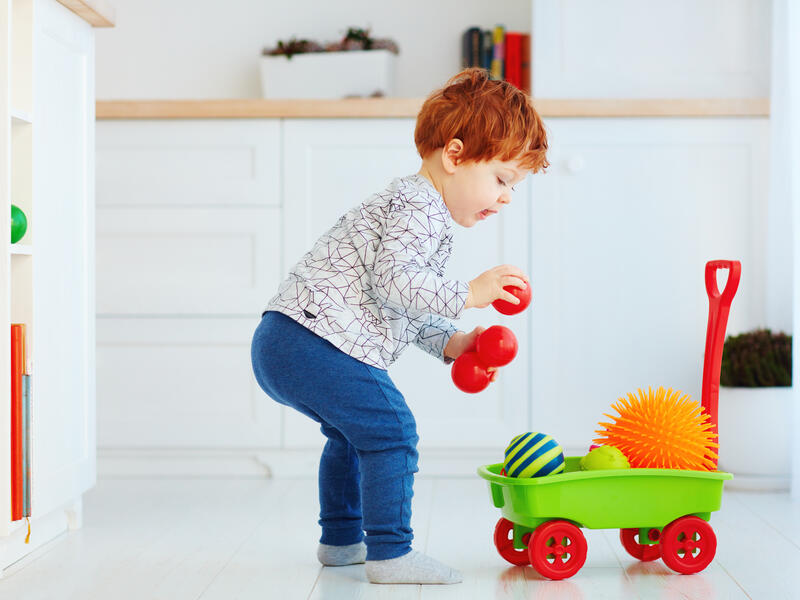
Your toddler is learning all the time. What may look like simple play is actually one of the key ways your toddler learns about the world. Your toddler’s brain is busy developing the ability to think, comprehend, create and predict what happens next.
Watch your toddler think during playtime as your child:
- Takes things apart and puts them back together.
- Puts toys in a container and dumps them back out.
- Builds a tower and watches it fall down.
- Lines up toys in a straight or not-so-straight line.
Simple activities to encourage thinking skills
Your toddler’s brain is rapidly growing and developing. Support development of thinking skills with these simple activities.
Basic puzzles: Puzzles develop thinking skills as your toddler figures out what goes where. Memory is improved as your child remembers that a piece didn’t fit in one spot and sets it aside until they need it later.
Ask simple questions: Toddlers love to ask, “Why?” Well, now it’s your turn to ask some questions. Help your toddler stop and think with simple questions like:
- “Which piece could make this tower even taller?”
- “How do you get the shapes back out of the box?”
- “Can you find all the animals that feel soft?”
Read books: Toddlers like to repeat actions over and over again. You probably have a book you’ve read together a thousand times. Next time you read it out loud together, encourage your toddler’s thinking skills by:
- Leaving out a word and letting your toddler fill in the blank
- Asking what will happen next or what’s on the next page
Play “find it”: This simple game develops problem-solving skills and following simple directions. Ask your toddler to:
- Hide a toy in a different room and you’ll go find it.
- Find a different toy in the toy box.
- Find a toy you’ve hidden under a blanket or pillow.
Explore same and different: Toddlers enjoy grouping objects that look similar, such as wooden blocks in one basket and plastic blocks in another. Your toddler is categorizing when:
- Sorting objects by color, shape, size or function
- Stacking rings in the right order
- Putting socks in one pile and shirts in another
More ideas for toddler fun
- Noodle time: Young children love to play with textures. And young children love to dump and pour things. Gather some dry pasta noodles, two big bowls, measuring cups and some spoons. Show your child how to pour the noodles from one bowl to the other. Place on a plastic tablecloth for easy clean up.
- Indoor basketball: Get a wastebasket and some rolled-up balls of paper and let the fun begin. Great for eye-hand development.
- Leaping lily pads: This activity transforms your living room into a pond. Place cushions around the room (close enough for your child to jump from one to another) and have your child jump from cushion to cushion. Great for large muscle coordination and development.
- Indoor camping: Make a table into a tent to create your indoor camping excursion. Simply place some sheets over the table so the edges of the sheet extend to the floor. Add some fun with play food and cooking gear. Crawl in and enjoy your newfound private play space. Young children love to play hide and seek and this space works great for this game.
- Clean up fun: Toddlers love to help, so take advantage of this industrious spirit. Give your toddler a little squirt bottle filled with water and a sponge or rag. Show them how to squirt the water and clean up the spot. Provide your “clean up rules” such as “you can only squirt water on the kitchen floor” and start the cleaning fun.
Even simple activities will keep your child occupied and learning – like using painter’s tape on the floor to create a road for toy cars, or getting a plastic baby doll, a washcloth and an empty plastic tub to give the doll a “bath.” This kind of imaginary play is natural for children at this age and helps them make sense of everyday life through play.
Classes and consultations
For more information, attend the class “How I Learn” to learn more about:
- How to continue nurturing your toddler’s learning.
- Tips and tools to encourage your toddler’s natural desire to learn.
Learn more
- Read aloud to help your child learn to love books
- Create safe and simple household baby toys
- The power of consistency while parenting young children
…
Posted In Children's, Family Medicine, Parenting