As Travis Barfknecht climbed out of the fog of the surgery that saved his life, he was offered a drink of water. He reached out with his left hand, grabbed the cup, and took a few sips.
Using his left hand was a sign that the stroke that sent him in an ambulance to Marshfield Medical Center was not going to leave him permanently disabled.
One small sip for Barfknecht, a 41-year-old with a wife and seven children, amounted to a giant gulp for those who had collaborated to clear the blood clot from his brain that made this recovery possible.
“I didn’t understand why everyone was making it a big deal that I was using my left hand to drink,” Barfknecht said. “But over time, I realized the gravity of my situation. The more I heard about what I’d been through, the worse it sounded.”
What he knows now is that an entire team of medical professionals assembled quickly at the hospital in anticipation of an emergency operation. He learned that his neurosurgeon, Vivek Gonugunta, M.D. – who specializes in endovascular techniques for brain and spinal cord blood vessel problems – persisted amid increasingly dire circumstances in trying to clear the stubborn clot that caused the stroke.
As is the case with all strokes, especially with major strokes like Barfknecht’s, time was a crucial factor in clearing the clot. And once cleared, there was no assurance he would be the same when he woke up.
“When I talked to Travis’ wife after the surgery was done, I said, ‘I’m sorry but he had a big stroke,’” Dr. Gonugunta recalled. “I told her we did what we could, but she had to be prepared that he may still have a lot of damage. He could still die from it. He could still spend the rest of his life in a nursing home.”
Instead, he went to his own home less than 48 hours later.
“I’m in the high 90s in functionality now,” Barfknecht said. “I have a little bit of involuntary toe-curling and nerve issues in my fingertips, which in the grand scheme of things is really nothing. I see it as a reminder of what could have happened.”
Cath lab visit
Factors in successfully taking care of a patient in Barfknecht’s situation involved teamwork that began in the moments after he collapsed to the floor at his job.
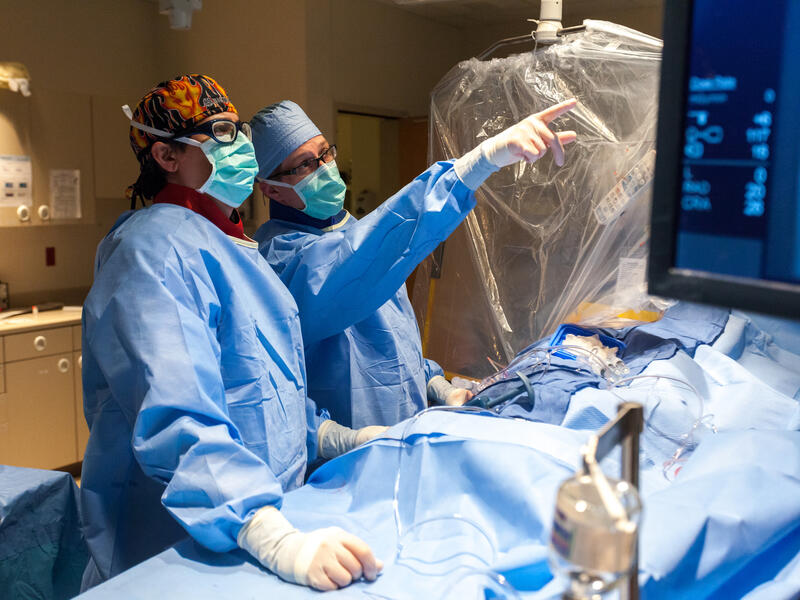
It carried over to his ambulance ride, and then on to the Marshfield “cath lab,” where a team pulled from their normal duties at the hospital congregated to prepare Barfknecht for surgery.
“Cath lab” is medical shorthand for a catheterization laboratory. It is an area in a hospital set up with equipment that allows medical staff to handle emergency procedures. In this case, it meant restoring Barfknecht’s blood flow as quickly as possible using catheter-based techniques.
It was in this environment that Dr. Gonugunta presided over a life-saving surgery that could have come right out of your favorite TV medical drama.
Hospitals often have separate cath-lab teams in place for heart patients and brain patients. Because Barfknecht had his stroke at the beginning of his workday, there were plenty of available staff to assist in the surgery. As Dr. Gonugunta explained:
“We had about 20 people who stopped what they were doing because they knew somebody needed a surgical operation and they needed it now. As soon as he got to the operating room, everybody was helping,” he said. “We had people helping with setting up the equipment, we had someone shaving hair, we had someone positioning for the anesthesia, someone was putting in the IV lines and others were opening my catheters – it was really a team effort.”
On the floor
In February, Barfknecht was working on an electrical conduit at the factory where he was employed. He was not working with live electricity at the time, so when he collapsed to the floor without being able to get up, it was not because of electrical shock. Fortunately, he was sitting at the time, minimizing the damage of the fall itself.
His recollections from that point forward are a mix of his memory and what others have told him. In hindsight, the symptoms of a stroke were obvious, though when he told someone he had been on the ground for five or 10 minutes, he didn’t think much of it – all he needed was help getting to his feet and he’d be fine.
“Whoa,” he heard back from another worker. “That’s way too long. Let me get you some help.”
The fellow employee quickly brought over an off-duty emergency medical technician who worked in the building. The EMT identified that it was a stroke that sent Barfknecht to the floor. With an ambulance now on the way, Barfknecht had no use of his left side – his arm, his leg, face, and even his hearing and sight were affected.
“People were talking to me on my left side and I would look to my right trying to find them,” he said. “My whole left side basically dropped out, but I wasn’t aware it was happening.”
His new EMT friend rode with him in the ambulance to the Marshfield Medical Center, providing the hospital with valuable information about Barfknecht’s condition in the meantime. Curiously, Barfknecht’s memories of the journey from the factory floor to the operating table are in audio only.
“I remember granting permission for surgery – so I was coherent,” he said. “But I don’t have any visual memory of any of it.”
What was happening
Stroke is a sudden, life-threatening medical emergency often described as a “lightning strike” in the brain. One moment Barfknecht was doing his job and the next moment he was on the floor. He didn’t know why and he couldn’t get back up. Blood flow to the right side of his brain, which controls the left side of the body, had stopped flowing. Brain cells were being deprived of oxygen and dying quickly.
The urgency surrounding stroke care cannot be overstated. It is extremely common — occurring roughly every 20 seconds in the United States — and every minute without treatment can cause significant, irreversible damage. On average, about 1.9 million brain cells die every minute during an untreated stroke. The longer a stroke goes untreated, the worse the outcomes, including permanent disability or death.
Stroke symptoms do not have to be as severe as Barfknecht’s to warrant immediate attention. A simple way to remember the signs and symptoms of a stroke is to use the acronym BE FAST.
Sanford Health advises people to call 911 right away if you or someone near you experiences these sudden symptoms:
B – Balance problems
E – Eye and vision changes
F – Facial drooping
A – Arm or leg weakness
S – Speech changes
T – Time to call 911 (also Terrible headache/worst-ever headache)
“You should not ignore the signs of a stroke,” Dr. Gonugunta said. “You may think that, ‘Hey, I slept funny. That’s why my arm is kind of weak.’ But you can’t sit on it. You can’t tell yourself, ‘Hey, I’ll wait for my husband to come back from home, and then I’ll go to the ER.’ That’s not how it should be. You need to call 911.”
On the operating table
When Barfknecht arrived at the hospital, he received a CT scan to determine whether the stroke was caused by a blockage (ischemic stroke) or bleeding in the brain (hemorrhagic stroke).
This distinction is crucial because the primary treatment for ischemic stroke — a clot-dissolving drug called a thrombolytic — cannot be used if there is bleeding. In Barfknecht’s case, the clot-dissolving drug did not provide the thrust needed to get rid of the blockage. This meant he would need surgery.
“He had a tear in his carotid artery in his neck that caused the clot and then the clot broke loose, went to brain and caused the stroke,” Dr. Gonugunta said. “This made his case more challenging because I wanted to open up the affected brain artery, but I couldn’t get to the brain until we fixed the problem in his neck.”
The delay added another layer to a procedure that was already complex. Navigating to the brain involves threading catheters and their extremely thin wires through small, twisting blood vessels. In this case, after finally reaching the clot in the brain with a catheter, the clot didn’t want to leave.
“We usually try two times and sometimes three times to open the artery in the brain,” Dr. Gonugunta said. “In his case, I kept trying and trying. I told the team, ‘I’ll try one last time.’ It was the fifth or sixth attempt. That time, we opened it. I remember one of the people on the staff saying, ‘Hey, I’m going to the chapel now. I’ll pray for you and for the patient.’ Maybe that saved him.”
Shoutouts to the team
The National Institutes of Health Stroke Scale (NIHSS) is a score that is used to measure the severity of stroke. Barfknecht’s score was 16, indicating a severe stroke with a strong probability of long-term care in his future if he survived and did not deteriorate from brain-swelling and additional complications that may ensue from a large stroke.
Coupled with the amount of time that had elapsed in surgery in eliminating the clot, it explained Dr. Gonugunta’s sobering conversation with Barfknecht’s wife after completing the procedure.
“We were all hoping for the best,” he said. “But we had to be prepared to deal with the worst.”
And then came the left-handed drink of water that amounted to the answer to a lot of prayers.
“I’m really proud to be part of the institution where everybody comes together, everybody is trying to help,” Dr. Gonugunta said. “When we started the procedure, everybody was asking, ‘Are you OK? Do you need anything?’ It’s a team effort with that amount of camaraderie. They don’t know the patient, but they know they need to save him. Everybody understands the importance.”
Both Dr. Gonugunta and Barfknecht are generous with the shoutouts.
For Dr. Gonugunta, that includes anesthesiologists and other Marshfield colleagues who altered plans to make room to accommodate this emergency situation, in addition to the all-hands-on-deck attitude from the rest of the support staff.
As Dr. Gonugunta would write:
“With team effort, miracles do happen, as Barfknecht is a proof that he not only survived and made a rapid recovery and was discharged home within two days, whereas most patients would be spending weeks or months in rehab and or still dependent even after successful surgery!”
For Barfknecht, there was the person who discovered him on the floor, then the EMT who quickly understood Barfknecht had suffered a stroke and alerted the hospital of what to expect. There were the prayers from his pastor who came to the hospital immediately after learning of Barfknecht’s stroke.
“It’s pretty humbling,” Barfknecht said. “I’m super thankful to be part of such a supportive community. It’s wild to think about how this hospital will rally around a complete stranger. It’s a huge blessing to know that at the worst moment of a person’s life there are people at a place who can make the difference between life and death.”
Learn more
- Sanford launches Stroke Comprehensive Treatment Clinic
- ‘Time is brain’ for patient who recovered from stroke
- Sanford USD is nationally recognized for stroke care
…
Posted In Brain & Spine, Emergency Medicine, Healthy Living