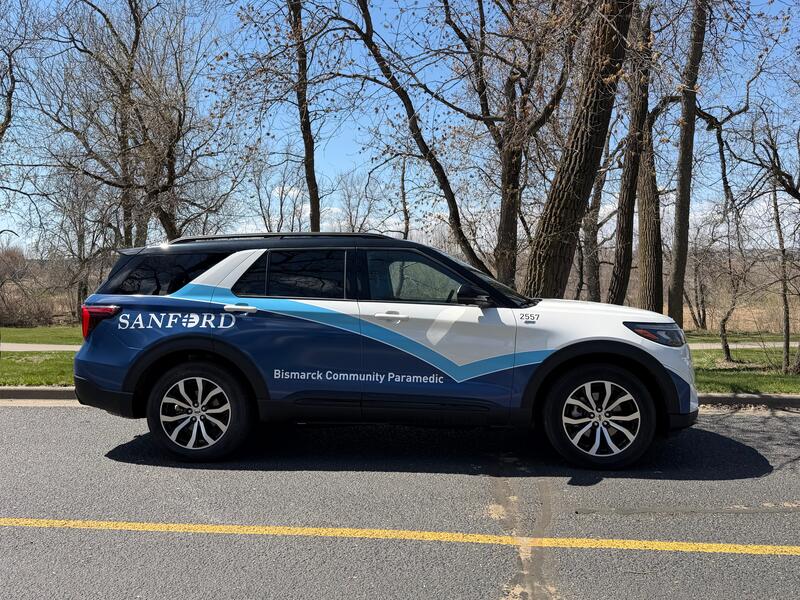
Paramedics everywhere are the people who stay ready for medical emergencies and then get in an ambulance and go out and save lives, right?
In Bismarck, North Dakota, they still do that. But they also play a vital role in the everyday delivery of healthcare to those whose circumstances make access to clinics and hospitals more difficult.
Kelli Sears, MS, NRP, CP-C, is the emergency medical services supervisor for the Sanford Bismarck Community Paramedic Program.
Sears oversees a versatile mobile paramedic team trained to take healthcare on the road.
“The program is designed to address the needs that exist for each individual patient,” Sears said. “That could mean something different for every patient.”
Not just the miles
Potential obstacles in healthcare in the Upper Midwest often begin with geography. In rural areas particularly, clinics and hospitals can be located long distances away from the people who need them. There are also many other factors that can get in the way.
The patient might be a stay-at-home parent with toddlers who can’t conveniently leave the house, for instance, or they could be someone who doesn’t drive a car, or who is recovering from a surgery that makes traveling difficult.
“Ultimately, it’s about identifying patients who have gaps that exist within traditional healthcare services,” Sears said. “We try to fill those gaps.”
Collaboration is a big piece of building bridges over the gaps. As a result, the program has steadily broadened its scope as health leaders find new ways to use it for the mutual benefit of patients and those caring for them.
As Sears explains in this scenario:
“Let’s say a wound care clinic is inundated with patients and can only see so many people a week because they have only two providers at that clinic. If a patient needs wound care three times a week, our people might be able to treat the wound two times a week. Then the patient only has to go to the clinic once a week. We are in direct communication with the providers at that clinic, which allows us to come up with a plan.
“It’s an example of increasing the capacity for patients and for providers. We’re meeting the patients where they’re at and giving them the right healthcare at the right time in the right place.”
Kindness delivered
The right place for 95-year-old Alvina Roehrich, who lives in Bismarck, is her own house. A few years ago, when Roehrich needed a regular B12 shot, she had to ask someone from her family to take her to a clinic. Her children did not live in town – and just one grandchild lived in the area – making it a cumbersome process, especially during the winter.
Her doctor alerted her to the paramedic program and since then Roehrich has had regular visits.
“They are so kind, every one of them,” Roehrich said. “I’m so very fortunate to find people who are all so kind when they come. I really appreciate the help – I just appreciate everything they do for me.”
As a testament to her appreciation, she can rattle off the names of everyone from the program who has cared for her. It started with a visit from Tyler Kientopf, who has since been joined by Donovan Glerup, Kelli Sears, Freddie-Leigh Griffin, Lisa Bean, Connor Anderson and Alec Mill.
She knows them all.
“I just think they’re all wonderful,” Roehrich said. “I don’t know how a company can be so lucky to find people who are all so nice in this day and age.”
Comprehensive care
The expanded services platform began with the work of Kientopf, EMS operations supervisor at the time. As he pursued his bachelor’s degree – while also serving as operations supervisor – Kientopf designed the program as a business project for one of his classes. This model came to fruition in January of 2020.
Supported by Sanford resources focused on community well-being, the program now delivers a wide range of state-approved services, including:
- Help with infusions and medication
- Chronic disease monitoring and education
- Immunizations
- Lab specimen collection
- Wound care
- Medication management
- Safety evaluations
- Care‑plan compliance assessments
Essentially, the program is designed to enhance patient access, reduce hospital admissions and readmissions, shorten time spent in the hospital, help patients follow care instructions, and improve patient satisfaction — all in a cost‑effective and efficient manner.
“We go out and see patients after they’ve been in the hospital,” Sears said. “In some instances, such as patients who are at high risk for readmission, we will follow them to make sure they’re staying on track and that we’re able to answer their questions and educate them outside the hospital environment.”
Patients can feel overwhelmed when they leave the hospital after dealing with a serious illness or injury. A home visit from a paramedic can help simplify and re-energize a challenging recovery plan.
“It can seem like a firehose in the face with the information you receive after getting discharged and all you’re thinking about is getting home,” Sears said. “We like to spend time with patients to review the treatment going forward. What can we do to keep the patient from needing to go back into the hospital? We pride ourselves on the patient education part of what we do.”
Learn more
- Sanford Ambulance offers paramedic apprenticeship
- Sanford Ambulance expands trauma care in the community
- Community health workers make connections beyond clinic
…
Posted In Allied Health, Bismarck, Community Impact, Emergency Medicine, People & Culture, Rural Health, Thought Leadership