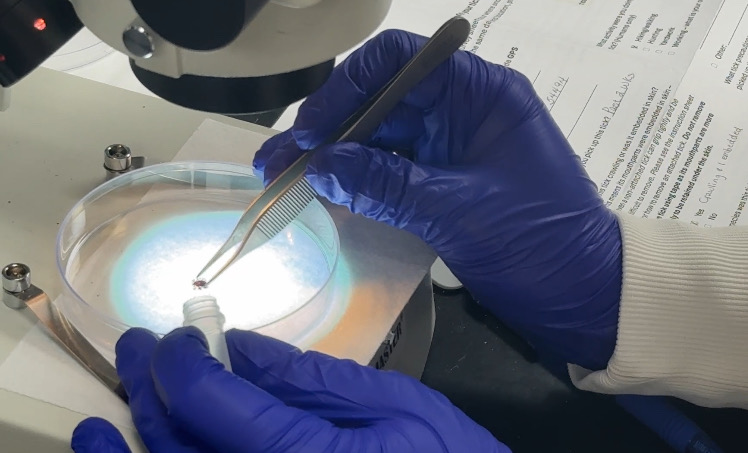
Ticks are crawling all around us as we work and recreate outside. Now you can send in the ticks you find crawling on yourself or your pets as part of a citizen scientist study.
Marshfield Clinic Research Institute, part of the Marshfield Clinic region of Sanford Health, is expanding its Tick Inventory via Citizen Science (TICS) from Wisconsin to Minnesota. Launched in 2024, TICS is an effort to identify ticks to assess risk of encountering a tickborne disease and to learn more about who is being exposed and diagnosed with tickborne diseases.
Over 6,000 ticks from nearly every Wisconsin county were submitted in 2024. More than 5,400 have been identified so far this year. Ticks in the Midwest are typically active until temperatures drop below freezing in late fall.
“We had overwhelming support from people who are curious and invested in helping better identify the health threats associated with ticks,” said Jennifer Meece, Ph.D., Marshfield Clinic Research Institute executive director. “With Marshfield Clinic now part of Sanford Health, and the widespread population of ticks throughout the Midwest, it was natural to expand our study into Minnesota.”
Of the ticks collected this year, about 3,500, or more than 65%, were the American dog (wood) tick and the majority of the remainder were the deer (blacklegged) tick. Much of that difference is likely due to the larger wood ticks being easier to spot than the smaller deer ticks.
“With new tick species becoming more prevalent in Wisconsin and Minnesota, the risk for potential newly introduced diseases increases,” said Daniel Hoody, M.D., chief medical officer of Sanford Health Bemidji. “By joining this effort, we are trying to determine the extent and significance of this spread and the potential health effects.”
Request a kit
Tick collection kits are available at the Sanford Bemidji Walk-In Clinic, located at 1611 Anne St. NW, in Bemidji. No appointment is necessary, and kits are available in the lobby.

Photo by Jillian Johnson, Sanford Health
For more information, or to request a pre-paid collection kit be sent directly to you, contact tics@marshfieldclinic.org or (715) 389-7796 ext. 16462. Parks and nature centers interested in having kits available for their visitors also are encouraged to contact Marshfield Clinic Research Institute.
Once the tick, dead or alive, has been placed in the collection kit, drop it in the mail to submit using the kits provided. Any tick found on people or pets is appreciated. Each kit will come with a unique identification number that participants can use to look up, via an online dashboard, the species of ticks they submitted. Multiple ticks can be submitted but identification of ticks is limited to 10 per kit.
The kit has additional optional survey questions including the types of precautions the person is taking to avoid ticks, if they have ever been diagnosed with a tickborne disease and if the Marshfield Clinic Research Institute can follow up with the person for potential future studies.
“We are interested in learning more about the diseases and how they affect people,” Dr. Meece said. “Tickborne diseases are complex to diagnose, and sometimes, complex to treat. Having a better understanding of the people affected can better help us in future research.”
Tick submissions from all over Minnesota are encouraged, regardless of whether the person is a Sanford Health or Marshfield Clinic patient.
Learn more
- Prevent Lyme disease and other illnesses ticks can carry
- West Nile virus: An annual threat from mosquitoes
- A little bug bite or a bigger problem?
…
Posted In Bemidji, Healthy Living, Marshfield, News, Research, Rural Health, Thought Leadership