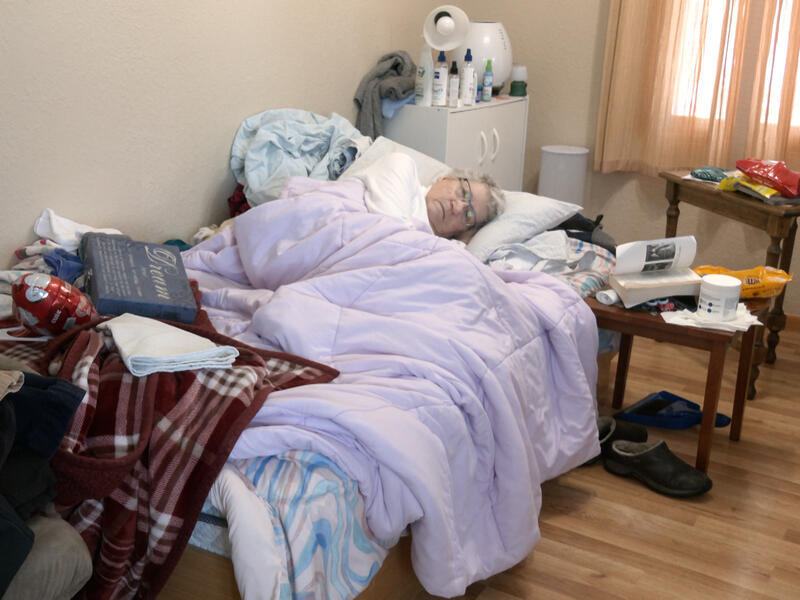
The living room of the Farstad home in East Grand Forks, Minnesota, has been modified a bit. It currently doubles as a bedroom as well. For Maggie Farstad, the majority of her time at home the past year has been spent lying right here.
“I read a lot,” Farstad said. “I put my pillow up against this wall over here and lean against it and then I can read. I’m not walking around, but I’m sitting up.”
An injury followed by diagnosis
To say her past year has been difficult would be an understatement. It all started around Christmas in 2024, as Maggie’s husband Ken Farstad recalls.
“We went out to my son’s place, and she was going up three steps into his house and her hand slipped on the railing and she fell backwards and her head hit the concrete,” said Ken. “She broke five ribs, got a concussion. And then when they did a CT scan, they found out she had breast cancer and a bladder mass. So from there, everything started.”
After that, Maggie underwent five rounds of chemotherapy, which her body did not handle well. Then one night while in the hospital, her blood oxygen plummeted.
“From then on it was test after test after test,” said Ken. “But they found out she had a hole in her heart.”
Hypoxia’s effect on the whole body
That hole led to a diagnosis of hypoxia, a condition where the blood is not receiving enough oxygen.
“Typically the blood from the rest of your body — which has low oxygen — goes to the right atrium, then to the right ventricle, and then to the lungs,” said Jason Go, M.D., an interventional cardiologist at Sanford Fargo, with outreach in East Grand Forks. “For Margaret, instead of going to the right ventricle, part of that blood goes through that hole into the left atrium. So the amount of blood that went there just completely bypassed the lung tissue. Now you’ve got poorly oxygenated blood in the left system where it’s pumped into the rest of your body.”
The condition was debilitating, and left Maggie bedridden.
“When you have low oxygen in your body, it basically starves your muscles for oxygen, starves your brain for oxygen, starves your heart for oxygen,” Dr. Go said. “It’s a necessary ingredient to life. Basically that makes everything more tiring.”
Maggie could barely sit up. According to Dr. Go, patients on oxygen typically receive about two liters. When Maggie laid down, she could survive on four liters of oxygen. When she was upright, however, that number jumped all the way up to 16 liters.
“It was scary,” Maggie said. “It was very scary because I didn’t know if something was going to happen to me or not.”
Finally, out of bed
That’s when Dr. Go was contacted by a colleague at another hospital system. Maggie would be sent to Sanford Health in Fargo, and Dr. Go would close the hole in her heart.
“He said, ‘You’re going to be okay. I know what it is. We’re going to take care of you.’ And he did,” Ken said. “They brought her up and the first thing she did, she sat up, no oxygen.”
“I could breathe and move around and walk and everything after surgery,” Maggie said. “I couldn’t believe it.”
Now Maggie Farstad is able to get up and move around the house. She still gets tired easily, and her body must get stronger after all that time in bed. But things are looking brighter every day, and she has a goal.
“I want the summer to come so I can be outside with my little great-grandchildren,” said Maggie. “That’s something I really look forward to, the summertime.”
Learn more
- Heart and vascular screenings: What’s the difference?
- Innovative nurses, sisters invent new device for heart patients
- Cancer-related fatigue: The most common survivor symptom
…
Posted In Cancer, Grand Forks, Heart