Being a leader at Sanford Health is always going to start with a sound knowledge of responsibilities. But it expands well beyond that to knowing your teammates and identifying challenges.
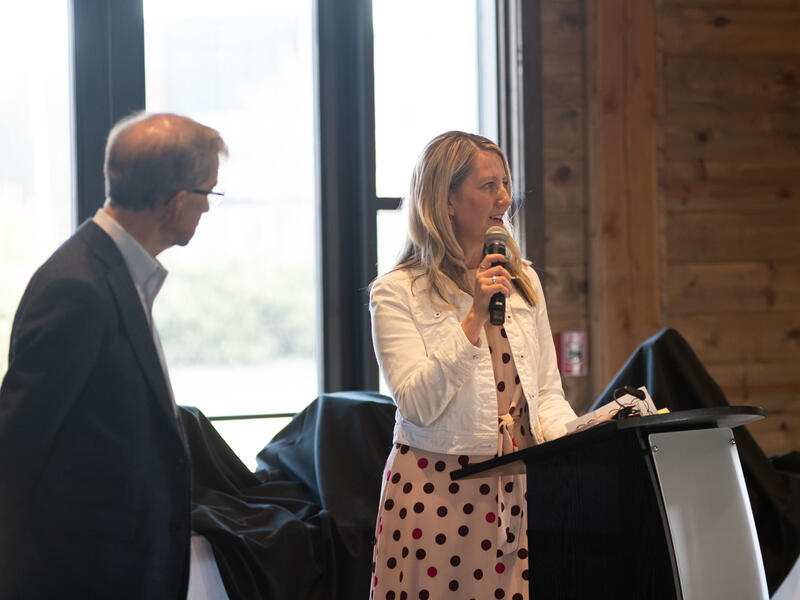
This process captures the essence of Sanford RISES, a two-year development and career-growth initiative that lifts clinicians at Sanford Health within its Clinician Experience program by helping them grow professionally and personally.
RISES stands for reach, impact, strategy, empower, and serve. What does this mean exactly to the people the program is designed to benefit?
“The Sanford RISES clinician leadership program provides clinicians with the opportunity to regularly meet with colleagues from across our footprint and learn from each other,” said Heather Spies, M.D. “Some RISES clinicians are new leaders and some have been in leadership of some form, both formally and informally, for decades.”
Dr. Spies, a specialist in women’s health at Sanford Women’s Health Plaza in Sioux Falls, South Dakota, is physician director of clinician experience and well-being at Sanford Health.
She has been part of designing a RISES curriculum where clinicians learn more about how to recognize and support colleagues while also developing new skills in adaptive and wellness-centered leadership. The result is that what they learn can be applied in situations with both their teams and their patients.
“Clinicians are better at what they do when they find joy in their work, and we know that some of that joy depends on who you work with and the relationship you have with your team,” Dr. Spies said. “By working to be better leaders, better listeners and better problem-solvers, they are better able to care for patients well and lead their teams well, even in difficult times.”
Discovering what to do differently
During the program’s regular in-person meetings, participants discovered that open conversations about becoming better clinicians can lead to just that – becoming better clinicians.
“Servant leadership was a constant theme which always had me asking myself: ‘How can I improve myself to elevate and recognize those around me?’” said Andrew Skattum, D.O., a RISES program graduate who specializes in surgical critical care at Sanford USD Medical Center. “Every session ended up both with the wrap-up and a ‘do differently,’ which translated to what I was going to take from the session to improve myself, those around me, and ultimately the compassionate care that we deliver to our patients.”
Part of the program’s effectiveness is that as they address issues they’re presented with as clinicians, they get to know each other. That familiarity, as Dr. Spies describes it, can often lead to learning to “help each other work through and find solutions to challenging things.”
“RISES was a great way to meet other clinician leaders and discuss challenges at work,” said Ryan Zimmermann, M.D., also a RISES program graduate and a specialist in family medicine at Sanford West Dickinson Clinic in Dickinson, North Dakota.

“Having other colleagues going through similar concerns helped us brainstorm ideas for improvement. It also helped me feel ready to take on a new challenge and helped me see the need for a clinic chair role for primary care in Dickinson. Having this program gave me the tools to work as a servant leader in my department.”
Common and uncommon ground
Andrea Patten, M.D., another RISES program graduate, is a specialist in emergency medicine at Sanford Bemidji Medical Center in Bemidji, Minnesota. She discovered that while getting to know others in this environment, she got to know herself better.

“It enabled me to make close professional and personal connections with colleagues that I would not have had the opportunity to do otherwise,” Dr. Patten said. “I advanced my leadership skills and learned about my leadership style, communication style, and personality traits which helped me better understand my leadership style.”
Kari Smith, a certified registered nurse anesthetist, was also a graduate of the most recent RISES cohort and works at Sanford Broadway Medical Center in Fargo, North Dakota. The fact that she (from Fargo), Dr. Skattum (from Sioux Falls), Dr. Patten (from Bemidji) and Dr. Zimmermann (from Dickinson) all represent different spots in the Sanford footprint is not a coincidence.

Together they shared many things in common within the health system but also brought unique observations to their conversations because they work in different regions.
“The program expanded my awareness of the resources available not only within the Fargo market but also across the enterprise,” Smith said. “I was able to explore tools, best practices, and system-level strategies that directly support my role as a clinician. These resources have helped me bridge clinical and leadership responsibilities, allowing me to better serve patients, colleagues, and the organization as a whole.”
Prioritizing leadership
At the conclusion of the RISES program, clinicians complete “impact projects” to propose a solution to a real need at Sanford. Navigating through this teaches them more about the organization and how to engage key stakeholders in solutions.
After graduation from RISES, they then have a network of clinician leaders they can reach out to when needed.
“Sanford is unique in that as an organization it has prioritized and significantly invested in its clinician leaders through the RISES program,” Dr. Spies said. “It shows a true alignment with its mission to care, comfort and cure, because to carry out this mission for patients, clinicians have to know that they are valued and have the right tools to lead their teams well. This program provides them with these tools and is one of the keys to building a sustainable culture of engaged clinicians at Sanford.”
Learn more
- How Sanford Health supports clinician well-being
- Well-being at work: What doctors do for self-care
- AMA honors Sanford Health for promoting clinician well-being
…
Posted In Bemidji, Dickinson, Fargo, Nursing and Nursing Support, People & Culture, Physicians and APPs, Sioux Falls