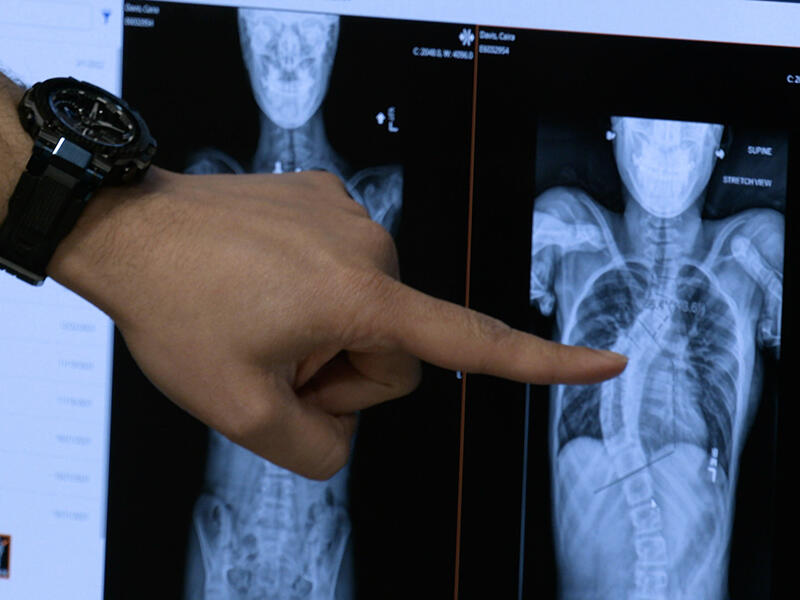
As children grow and their bones and muscles develop, spine deformities like scoliosis can start to form. Left untreated, these conditions can lead to pain and health issues down the road.
For parents, it’s important to know the signs of scoliosis so they can get effective treatment for their children. With the help of a skilled pediatric spine specialist, scoliosis can be corrected, protecting the long-term health of a child.
What is scoliosis?
Scoliosis is a deformity where a portion of the spine has a side-to-side curve with an S or C shape. Children with scoliosis often look like they have uneven shoulders, back, chest or pelvic crest, or are leaning to one side.
William Hadden, M.D., is a pediatric spine and orthopedic trauma surgeon at Sanford Orthopedics and Sports Medicine in Sioux Falls, South Dakota. As a specialist in pediatric scoliosis, he has a lot of experience helping parents navigate the treatment process.
“When an adolescent is growing rapidly, parents might start to notice signs in their children,” said Dr. Hadden. “It can be alarming to find scoliosis in your child, but it’s important to remember that it’s almost never an emergency. It’s a fixable problem.”
Different kinds of scoliosis
Scoliosis can come in several forms and is categorized by its cause.
The most common is idiopathic scoliosis, meaning there’s no clear underlying cause. It is typically more prevalent in girls than boys, with most diagnoses occurring between the ages of 10 and 16.
Overall, there are seven main kinds of scoliosis:
Idiopathic – No clear cause in an otherwise healthy child
Early onset – Before age 10
Congenital – Different shaped spinal components formed in utero
Neuromuscular – Secondary to a neuromuscular condition like cerebral palsy
Syndromic – Associated with other diagnoses like Marfan Syndrome, Down Syndrome or Neurofibromatosis
Thoracogenic – Developing after a previous cardiac or lung surgery
Degenerative – Adult, age-related curvature
“The most common type we encounter in our clinic is idiopathic,” said Mohammed Waseemuddin, M.D., a specialist in pediatric orthopedic surgery at Sanford Orthopedics and Sports Medicine Fargo in North Dakota. “And among those, the adolescent scoliosis is the one we see most often.”
How is scoliosis diagnosed?
Signs of scoliosis are often discovered at required physicals kids undergo for sports or school or during a yearly exam with a family doctor. Once detected, your child may also need these tests:
- X-ray. This test makes images of internal tissues, bones, and organs. It’s the main tool for diagnosing scoliosis. It measures the degree of spinal curvature.
- MRI. This test uses a combination of large magnets and a computer to make detailed images of organs and structures within the body.
Finding scoliosis early is important for treatment. If left untreated, scoliosis can cause problems with heart and lung function and affect breathing, cause fatigue and lead to other respiratory issues.
It is important to note that mild pediatric scoliosis typically is not painful, which can make early detection more difficult.

“If I’m a parent, I would just look for any warning signs – maybe kids complaining, not because they’re in pain, but they notice something. Maybe they see that their shoulder is sticking out,” Dr. Waseemuddin said. “Or their pelvis or hip seems to have shifted to one side. These are warning signs there may be some underlying spinal issue.”
Most often these issues are not noticeable in early stages, especially if the child wears loose or thick clothing. Dr. Waseemuddin advises parents to visually monitor their children’s spines for abnormalities.
Though not as common, if a juvenile (ages 4-10) is complaining of back pain, it’s definitely time to seek medical attention.
“If your child has a back pain that is keeping them up at night with no other symptoms, just back pain, I would have it checked out right away,” Dr. Waseemuddin said.
What are the treatment options for scoliosis?
Multiple treatment options for scoliosis are available depending on the condition’s severity and the child’s overall health. Bracing and physical therapy may help with many minor cases, but in more severe circumstances, surgery is the best treatment option.
“Our care team recommends evidence-based treatments for each child we treat,” said Dr. Hadden. “For large curves, surgery is the most effective option for improving and preserving long-term function.”
The thought of a child undergoing surgery can be intimidating to parents, but Dr. Hadden has seen many children return to a high level of activity after they finish recovering from their surgery.
“We’ve had patients who are gymnasts, horseback riders and football players,” said Dr. Hadden. “Families are often surprised at how smooth and short the recovery is.”
Having advanced pediatric spine care in places like Sioux Falls and Fargo benefits the local community. Without specialists like Dr. Hadden and Dr. Waseemuddin, many families would have to travel a great distance to receive care.
“Providing scoliosis surgery at a Sanford location can keep patients closer to home so they don’t have to travel to a place like Denver or Dallas,” said Dr. Hadden. “With the correct treatment, children with scoliosis can forget about their diagnosis and live fully functional lives.”
Scoliosis treatment advances
Modern braces are now 3D, meaning they address spinal rotation – not just side-to-side curvature – making them more advanced and effective than older 2D designs.
Tethering is a newer technique that aims to correct scoliosis while preserving spinal motion, potentially enabling the patient to avoid spinal fusion surgery. It’s in the early stages of development, however, and patients must meet specific criteria.
Those who need spinal fusion surgery will benefit from technology advances, as well. Personalized 3D printing and mapping, coupled with improved materials, can minimize and reduce complications.
Learn more about Sanford Health Pediatric Orthopedics.
Keep reading
- Surgery helps repair middle schooler’s severe scoliosis
- Follow these backpack tips to help protect your child’s back
- After life-changing UTV crash, teen commits to recovery
…
Posted In Children's, Fargo, Orthopedics, Sioux Falls, Specialty Care