Much like others considering a career in healthcare, sisters Gracie and Sophie Wilczek are standing at the foot of the mountain.
Gracie is a first-year student at the University of St. Thomas in St. Paul, Minnesota, while Sophie is a junior in high school in Marshfield, Wisconsin. Both are interested in nursing.
“The biggest thing is being able to make an impact on people’s lives every single day. You can truly see how you affect people,” Sophie said.
“I love the science part of it and getting to learn about the body,” added Gracie, “but most importantly, being able to see the impact I’m making directly with patients and that face-to-face patient care.”
Both sisters have been volunteers with Marshfield Clinic for several years through the Volunteen Program, which allows high school students to gain experience in a variety of service areas.
Hands-on experience provides unique learning opportunities. So, when Gracie and Sophie had an opportunity to attend the Fritz Wenzel Science Conference, an annual event hosted by Marshfield Clinic, they jumped at the chance.
“A couple of my friends had done it the year before and really enjoyed it,” said Gracie. “Having a really strong interest in the medical field, I thought it would just be a great experience to get to see more things, hear from professionals and have new experiences in the medical field.”
Providing real-world perspective
The Fritz Wenzel Science Conference is a day-long event dedicated to health and science, aimed at educating and inspiring the next generation of healthcare providers on their journey.
The conference, named in honor of Frederick “Fritz” Wenzel, is open to high school students throughout Wisconsin, though it’s geared toward students who are giving thought to a career in healthcare. It draws roughly 100 students each year.

Photo by Teri Wilczek, Marshfield Clinc
“They’re all able to experience a lot of really cool things that I think students otherwise wouldn’t really get that hands-on experience to do,” said Marshfield Clinic medical education specialist Southern Gruen, who has organized the event the past few years. “It does such a good job of linking the schools with the clinic and opening that collaboration.”
The conference features lectures from keynote speakers as well as demonstrations and individual workshops – each led by Marshfield Clinic staff – covering an array of fields. In 2026, the 40th year of the official conference, workshops included:
- Psychiatry
- Morgue tour
- Robotics in healthcare
- Radiology
- Simulation lab for training
- Pharmacy
- Histology
- Virtual reality scenarios for providing care
“It does a really great job of exposing kids to things they wouldn’t otherwise be exposed to,” said Gruen, noting that signups for the morgue tour typically fill up sooner than other workshops. “I think it’s good for the students but also professionals, too, to advocate for their profession.”
Keynote speakers do more than run through the generic ins and outs of their job. They’re called on to have a down-to-earth conversation with students.
“I want you to tell them about the ups and the downs, the problems, the difficulties you’ve encountered over the years in your education, and maybe even beyond that in your current position,” said Wenzel, who takes pride in selecting quality speakers. “If you’re going to motivate students and encourage them, you’ve got to tell them the truth. And the best truth comes from experience.”
Students have a voice in the conversation, too. They’re asked to fill out a survey at the end of each conference, providing feedback on speakers, workshops and the overall experience.
“It’s always fun to read the comments at the end,” said Gruen. “It’s interesting when they say, ‘I never really knew about this,’ or ‘They did a really good job of explaining what a day would look like.’”
‘They’re eager to learn’
Motivating students has always been at the core of the Fritz Wenzel Science Conference – even before the collaboration had a name.
The seeds of what would become the conference came about after Wenzel, a former research assistant, was hired to expand the Marshfield Clinic laboratory.
“The laboratory played a key role in the development of the program,” said Wenzel, who went on to serve as executive director of what is now Marshfield Clinic Research Institute. “It was just a small building. We didn’t have much space to do much stuff, but we started expanding it into doing a lot of chemical testing.”
He was also following the examples he learned from his college biology professor who fostered his intrigue for science.
“I was always curious about stuff, but it really didn’t blossom until I got in college,” Wenzel recalled. “He involved me in some of his experiments and things that he was doing in research. It wasn’t anything fancy, but nonetheless it was inquiry. It really began to satisfy my curiosity about things and how the world was put together.”

Photo by Marshfield Clinic
At one point in the 1960s, a science teacher from Columbus Catholic High School named Sister Loretta approached Wenzel and asked if he would mentor some of her students. Seeing the opportunity, and a shared curiosity, he agreed.
“She was an incredible person,” Wenzel said. “She told me, ‘We have raw material in these students. They’re young. They’re eager to learn. Many of them have latent talents, and it’s necessary for us to discover them. We have to do all we can to excite them about the sciences and really motivate them, and at the same time, be square with them and tell them that it’s not an easy path.’”
Once a month, Wenzel met with students – and Sister Loretta – in the clinic library. Sometimes he would bring in scientists from the University of Wisconsin and nearby University of Wisconsin-Stevens Point for additional insight.

Photo by Marshfield Clinic
Relocation of the clinic in the 1970s led to more learning space, which opened the door to students from more high schools around the area. Amid the growth and evolution, the Wisconsin Department of Education recognized the program, which officially became the Marshfield Clinic Student Science Conference in 1987.
The clinic continued to support the conference with staffing over the years and eventually moved it into the Froehlke Auditorium, where it resides today. In 1999, the conference was renamed in Wenzel’s honor for his dedication and service, including serving as the executive director of Marshfield Clinic from 1976 to 1993.
“It started as kind of a labor of love way, way back in the 1960s,” said Wenzel. “I don’t think it would’ve lasted this long if it hadn’t really been a high quality, well-accepted program. And if you look at the evaluations over the years that the students provide, I think there’s no question about that is the case.”
Keeping students at the center
Student evaluations have remained a measuring stick for the success of the conference.
“It was an amazing opportunity. It exposes you to so many different aspects of healthcare and you get to hear from nurses and people share their stories,” said Sophie, recently completed becoming a certified nursing assistant like her sister.
“It was just good to have that reassurance that I’m going the right way with my future and that this is for sure what I want to do with the rest of my life,” added Gracie, who met Wenzel when she and Sophie attended the conference. “It was good to actually meet Mr. Wenzel and to thank him for getting this going.”
There’s also no time limit on feedback, like one instance when a man approached Wenzel in an airport – and thanked him.
“He said, ‘You don’t probably know me, but I was one of the students in your science program,’” Wenzel said. “And boy, those kinds of things floor you. You talk about rewards – it’s there.”
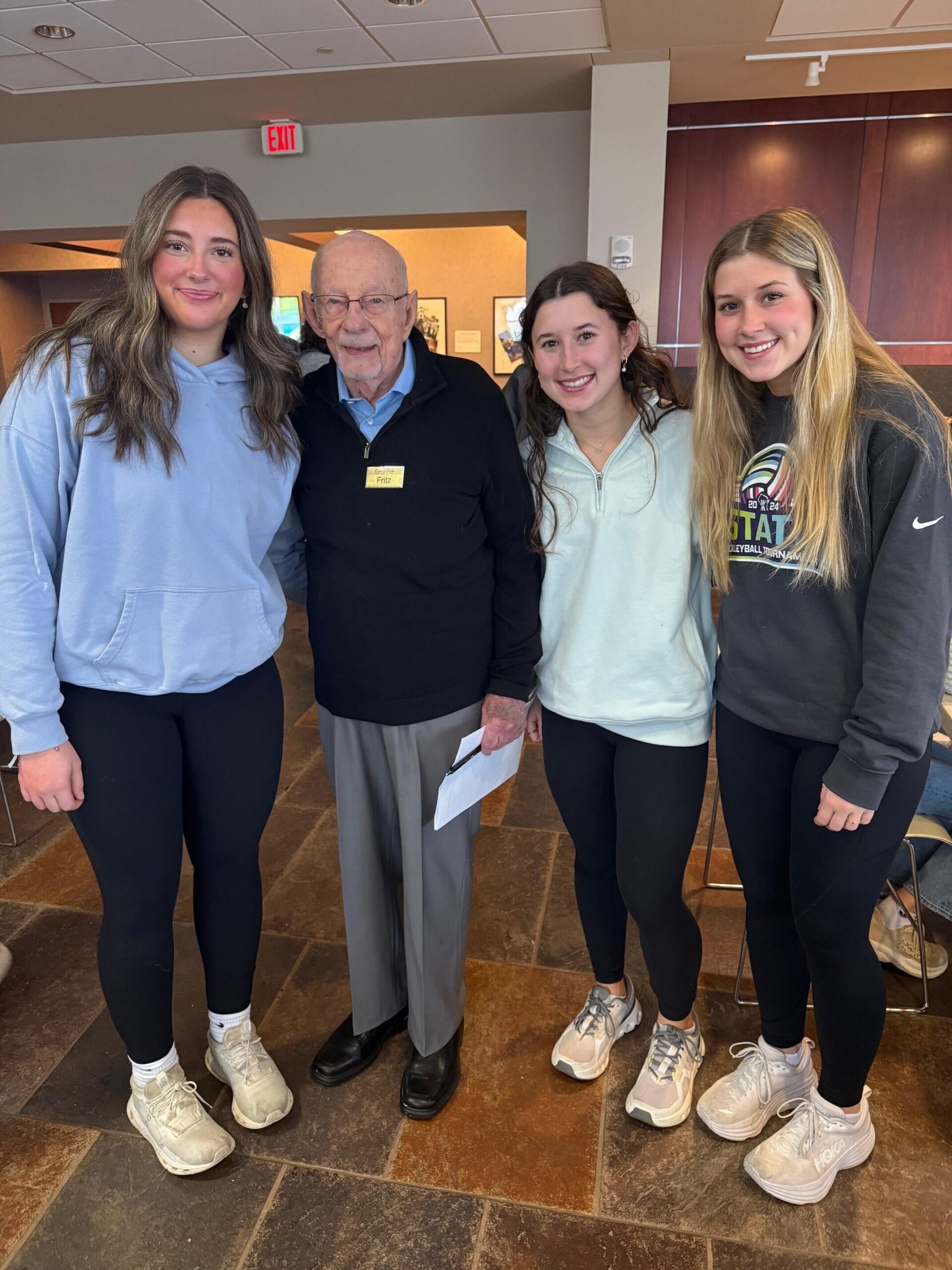
Photo by Teri Wilczek, Marshfield Clinic
At the age of 95, Wenzel remains involved with the nearly year-long planning for the conference, though he has handed the reins over to his son, Tom, and daughter, Ann.
“I thought, ‘Fritzy, you’re not gonna live forever, that’s for sure,’” Wenzel laughed. “But I want the program to live forever.”
Based on the view from Gruen’s front row seat, the conference is in good hands.
“The family has such a passion towards making sure students have access to anything that is out there,” she said. “They always do a really good job of keeping the students at the center of everything.”
As prospective medical students in the greater Marshfield area prepare for their own mountain, few can appreciate the path like Wenzel, who has climbed both figurative and literal mountains. His adventurous highlights include Mount Kilimanjaro, Machu Picchu and advanced base camp at Mount Everest.
“The mountains teach us all kinds of things,” Wenzel said, “about being dependent on others, about self-sufficiency, about self-determination, about patience, and trying to understand the environment that you’re in. And knowing that it can change.”
Learn more
- Aspire program gives students a closer look at Sanford jobs
- Sanford PROMISE celebrates 10 years of learning by doing
- Sanford nurses continue their education on the job
…
Posted In Back to School, Community Impact, Marshfield, People & Culture, Research, Thought Leadership, Workplace Health