“Even two and a half years in, it’s still kind of hard to let my children know when I’m having a bad day.”
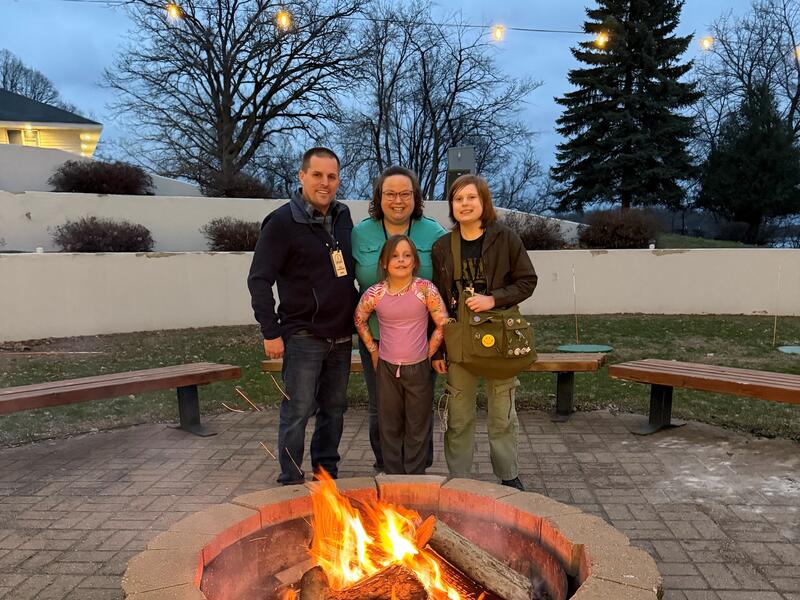
Those are the words of Angie Grossman, a breast cancer patient from Wilton, North Dakota, who recently attended a sleepaway camp with her husband, Phil, and their two daughters, Piper and Paisley. The camp is designed specifically for families like theirs.
What is Camp Voyage?
Camp Voyage is a free weekend camp for families with an adult cancer patient. The patient can attend with their partner and any children ages 6-18. The stated goal: to empower families to face cancer with strength and unity.
“When someone receives a cancer diagnosis, it doesn’t happen in a vacuum for that individual. If a parent is diagnosed with cancer — any stage, any cancer type, any treatment type — that is inevitably going to affect the entire family,” said Andrea Paradis, a behavioral health counselor and one of the creators of Camp Voyage. “One of the first things that we hear from people with a diagnosis who have young kids at home is, ‘How do I help my kids?’ So we wanted to be able to provide some kind of education or skills-building time together.”
The camp takes place one weekend per year on Pelican Lake, just outside of Detroit Lakes, Minnesota. At the camp, families learn coping skills and they work together on communication. They also break into adult groups and children’s groups to discuss relevant topics in a safe, non-judgmental space.
Time for kids, adults, and classic camp fun
“Kids are learning about cancer and emotions, how to cope, and communication skills that are age appropriate. Small kids in one group, then preteens and teenagers in another, and then the adults are all together,” Paradis said. “We’re talking about similar things, like how do you deal with your own emotions and stress? And how do you communicate with your kids? So they’re getting separate but mirroring information and education, and then we have them come together to do a family activity. That’s pretty fun.”
Angie said she and Phil enjoyed being able to talk about their concerns as parents with other parents.
“We could get some tips and tricks on how other families have dealt with those issues,” Angie said. “I really loved the sessions that explained the range of emotions in kids and how to get them talking about those emotions instead of just having frustration all the time. That was really helpful for us to use those techniques with our kids when there are bad days or weeks.”
Of course, because it’s a camp there is plenty of fun to be had as well. Craft projects, game rooms, bonfires and more are all part of the weekend.
For the Grossmans though, a major part of the camp experience was meeting people who were going through some of the same jarring experiences they were.
“This camp was good for the kids,” said Phil. “Being in a smaller town there’s only a couple of kids that have gone through it or been around it, but even then it’s maybe not at the same stage in their life as Piper and Paisley were. So I think that was a key bonding period. They were trauma-bonded in a way. They didn’t really have to talk about it. Paisley latched onto another little girl. Piper latched onto a couple kids there and normally she’s a little more reserved. They just knew what each other was going through.”
The Grossmans also said the camp provided a respite, and let them focus on their interactions without being distracted by everything else at home.
“It was just nice that you didn’t have to go right back to day-to-day life,” Angie said. “You could enjoy that evening time with your family, and nobody had to go to work or school. You just got that time together to discuss and still be in that moment rather than rushing off to something else.”
‘Life is now different’
About two and a half years ago, Angie was diagnosed with Stage 4 breast cancer. The disease had already spread throughout her body, including in bones from her neck to her femur. Her treatment was extensive.
“I started out with a femur rod surgery for the cancer in my leg, and then radiation. My monthly treatments are hormone blocking shots and bone builders. I also take an oral chemotherapy targeted drug every month,” Angie said.
As hard as the treatment could be, home life was just as difficult to navigate.
“Within hours of the diagnosis, it was, ‘Let’s get the whole team rolling and meet all these people,’” said Phil. “It’s a whirlwind the first two, three months of trying to navigate work and working around all those doctor’s appointments until she kind of got settled in.”
The schedule, the appointments and the illness all took their toll not just on Angie, but on Phil and their children as well.
“Anytime I’d go to pick the kids up, they’d be worried, like, ‘Where’s Mom? Mom always picks us up. Is Mom back in the hospital again? Is she gonna come home tonight?’ ‘No she’s just in for a checkup or lab work or something like that,’” Phil said. “Mom can only give so much energy. So I use the analogy of there’s only so much gas in the gas tank.”
That’s why Camp Voyage was such a welcome opportunity for the Grossmans and the other families who attended this year.
“Everybody is having their own experience. There are, however, some similarities across the board,” said Paradis. “It’s stressful for everybody, right? No matter who you are and what your diagnosis is, you’re trying to juggle your doctor’s appointments, plus what your kids are doing, plus getting dinner on the table, plus, plus plus.
“Emotions can be very similar as well. A lot of what we see is this grieving process that happens after a diagnosis that ‘life is now different.’ That is a huge commonality.”
Lessons for the voyage home
After meeting with counselors and the other families at Camp Voyage, the Grossmans say they felt connected to other families going through similar situations, and they learned plenty of lessons they can bring home as well.
“To give ourselves grace was the biggest thing,” Angie said. “I still have trouble with that. At the beginning I felt like I had to do everything for my kids. It was so hard to ask for help. Two and a half years into it, it’s still hard. So it was great to hear that it’s still OK to ask for help.”
It also created boundaries and a little space for their girls.
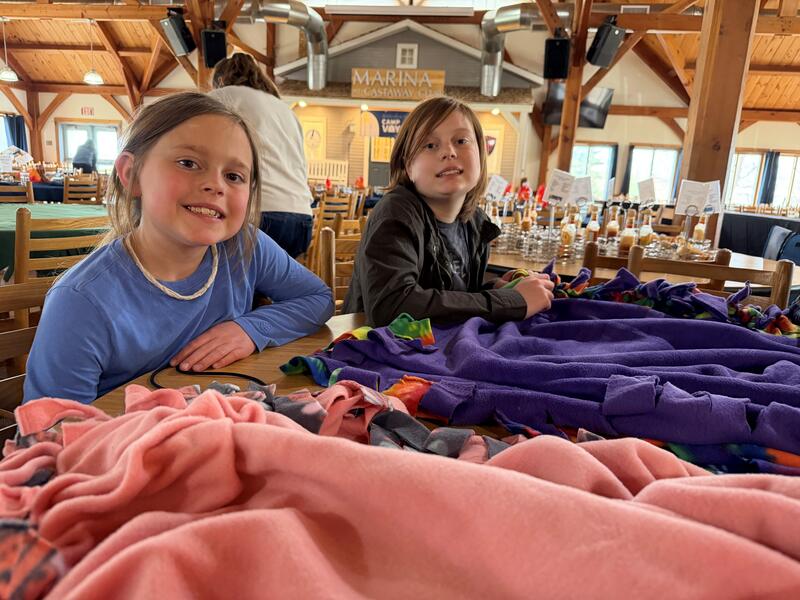
Photo courtesy of Angie Grossman
“We made a tie blanket,” said Phil.
The blanket has one solid side and one patterned side. The idea being that if the solid side is up, the child doesn’t want to talk, and if the patterned side is up, they do.
“The other day I walk out, and it’s been a couple weeks now since camp, and she’s got the blanket laying there and she can see me coming around the door. She flipped it over and pointed it out,” Phil said. “It was just like, ‘I don’t wanna talk right now. I’m gonna flip this blanket over.’ But there’s probably that time when she’s flipping it the other way, you know?”
Connections that continue
With new relationships and skills, families like the Grossmans learned valuable lessons at Camp Voyage.
“Parenting skills and learning about cancer at a developmentally appropriate age level, stress reduction, and emotional coping and communication skills. Those are our three main objectives to help build and strengthen the family unit,” Paradis said.
The connections they made, and knowing they aren’t alone on this journey, are just as important as well.
“It was wonderful for us all,” Angie said. “I was really hoping to connect with other families that are going through the same thing, and we really did, which was wonderful.”
How to attend or support Camp Voyage
Camp Voyage is offered at no cost to patients thanks to the generosity of donors to the Sanford Health Foundation. Donations make it possible for Sanford Health to provide this program and support the campers and their families.
- Attend: If your family is interested in attending Camp Voyage for free, visit sanfordhealth.org or call Sanford Health Fargo’s cancer survivorship line at (701) 234-7463 for more information.
- Support: If you would like to support Camp Voyage with a gift, call (701) 234-6246 or visit sanfordhealthfoundation.org, select the Sanford Children’s fund, and add Camp Voyage in the comments.
Learn more
- Survivorship: A critical part of the cancer journey
- Podcast: How to manage stress after cancer diagnosis
- Cancer treatments can take a toll on body image
…
Posted In Bismarck, Cancer, Detroit Lakes, Fargo, Foundation, Rural Health