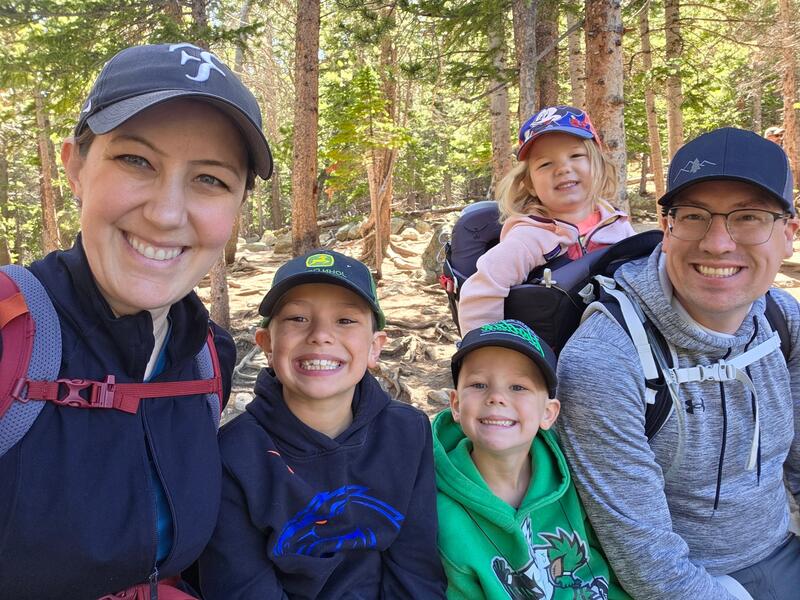
Tara Mertz-Hack, M.D., wears more hats than most.
She is a physician who practices family medicine in Oakes, North Dakota.
In addition to being the only family medicine doctor across a four-county area – where the physician shortage is very real – she’s a clinical educator, a medical chair and director in various health sectors, and an active participant in a number of Sanford Health-related leadership committee roles.
Above all, she’s a mom of three.
“This is some of the most rural of all of Sanford’s footprint,” Dr. Mertz-Hack told Sanford Health News.
She completed rural training in Idaho after graduating from the University of North Dakota.
Now, she’s practicing where she grew up: Dickey County, North Dakota.
“I did my rural training with the intention of coming back to this area,” she explained.
She’s been back for nine years and currently the only family medicine doctor covering four counties.
“I have a self-proclaimed existence as a country doctor,” she laughed. “I truly don’t know what every day will bring.”
In rural medicine it’s especially true.
“It’s because we wear a lot of hats, not because of anything other than what our community needs at that time.”
She recognizes the many challenges to rural care.
“We’re not going to be doing cardiac caths in Oakes or joint replacements in Ellendale, but we can stand by providing the best care after some of those tertiary services and ensuring the highest quality can be provided to patients in these rural areas,” she said.
“That’s what motivates me.”
Finding purpose in her care
Dr. Mertz-Hack covers a broad scope of family medicine ranging from pediatric and adult well visits and prenatal care to senior care and everything in between.
“About half of my clinical practice is procedural,” she said. “I do GI endoscopies, musculoskeletal injections, dermatologic procedures and gynecological procedures.”
She considers her work with patients the biggest privilege, splitting her clinical time primarily among three clinics, one nursing home and the local hospital.
“I’m caring for people who I don’t often have to take a family or social history because they’ve known me my whole life. That adds a layer.
“They don’t have to question about my background, or why I’m here,” Dr. Mertz-Hack said.
Dr. Mertz-Hack is part of four generations who live in the area.
“My grandmother, my parents, me, my children. It’s such an opportunity to be committed to bringing the best care possible to as close to home as possible,” she said.
She is married to her high school sweetheart with whom she raises their three kids.
“I truly want to give back to the people who raised me and who are a part of my community, my kids’ community and my family’s.”
Service beyond the clinic
When you’re a country doctor, actually providing care is only part of the job.
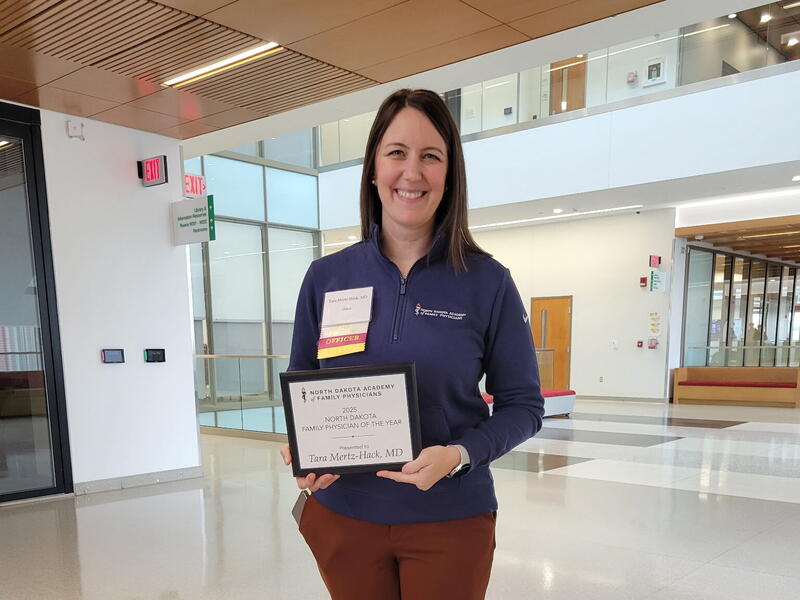
Photo courtesy of Tara Mertz-Hack
Dr. Mertz-Hack holds a variety of significant roles and affiliations, demonstrating her extensive involvement in both clinical practice and healthcare leadership.
She serves as a clinical assistant professor of family and community medicine at the University of North Dakota School of Medicine & Health Sciences.
Her leadership extends to professional organizations, where she was the president and board chair of the North Dakota Academy of Family Physicians, in addition to sitting on numerous other boards and committees.
Within her local community, she holds several medical directorships, overseeing emergency medical service units across four communities, local public health units in three counties and five skilled nursing facilities.
At Sanford Health, she is deeply involved in leadership and committees, including her services as department chair for the Sanford Southeast North Dakota Area Clinics, a Sanford Accountability for Excellence (SAFE) coach, participating in numerous enterprise-level committees.
She values the importance of education and bringing up the next generation of providers.
“I tell students, as a family doctor, you can practice anywhere in the world,” she said. “It is family physicians who are needed in super densely populated areas but also the most frontier of rural areas.”
Often, she’ll take in students well before they’re in medical school or residency.
“I came to this practice with my former partners as a pre-med student and then back as a medical student,” she said. “I think it’s important that we’re taking a chance on students because you never know when that person is going to potentially be your partner someday.”
She was recently selected to sit on the Rural Health Advisory Council for the American Academy of Family Physicians, representing her medical colleagues across the country.
“Sometimes I feel like, my goodness, am I alone out here?” she said. “We are focusing on rural care all over the country which helps make this job not feel so isolating.”
Finding balance in her care
Dr. Mertz-Hack recognizes that the connection between the provider and patient is so important and never takes that part of her job for granted.
“It’s an interesting position to be in,” she said. “We are part of somebody’s life at the best and worst days of their lives from pregnancy care and to a cancer diagnosis or end-of-life care.”
She also prioritizes finding balance in the workload between home and clinic settings.
“For rural physicians, these areas often blend,” she said. “That doesn’t mean it has to be a hindrance. It really can be a very important part of both your professional and personal life to be able to really be present at the times that are needed.
“There’s no other job in the world where I feel like you could make more of a difference than to walk beside your patients, who live in the community that you do, and to try and make the biggest impact on their care.”
Learn more
- Medical field to hay fields: The life of a rural doctor
- A rural-urban residency rotation model
- Telestroke program offers fast stroke care in rural areas
…
Posted In Family Medicine, People & Culture, Rural Health, Thought Leadership