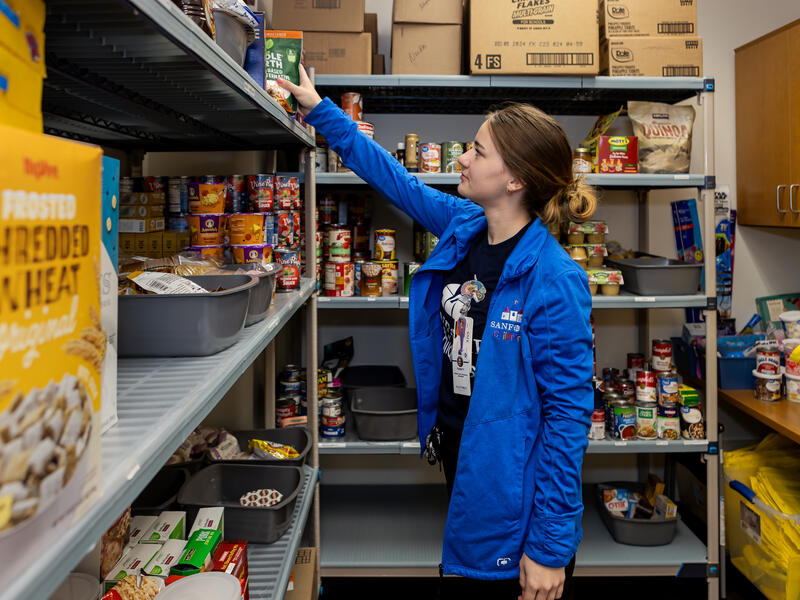
A resource to help Sanford Health patients find world-class care, no matter their situation, has proven effective.
Connection within communities
In April 2022, the health care system launched Sanford Helps, a website for patients to better connect to social care community resources – financial assistance, food pantries, housing, medical care, and other free or reduced-cost help.
Erica DeBoer, chief nursing officer at Sanford Health, says sanfordhelps.com is a nonthreatening way for patients to be connected to easily accessible resources where they live.
“Sanford Health is committed to identifying and connecting individuals with social risk factors, such as food insecurity, unstable housing and lack of transportation that contribute to poor health outcomes to organizations to meet these needs,” she said.
She said the program assists providers, helping them see what patients may need within their communities.
“Sanford Helps provides a consistent way across our footprint for staff to identify and connect patients to local and national resources for patients, as well as an anonymous way for patients and community members to seek and find services,” DeBoer said.
The ability to translate the information into over 100 languages in addition to providing resources by email and text offers equal access for every patient regardless of their native language or technology preferences, she added.
Available to anyone
Lindsay Daniels, vice president of care management at Sanford Health, emphasized the platform’s accessibility and impact.
“Sanford Helps is user-friendly and available to anyone in need – not just Sanford Health patients. Individuals can access it directly at sanfordhelps.com and links are provided on their after-visit summary, My Sanford Chart account, and at sanfordhealth.org,” Daniels said. “By entering their ZIP code, anyone can find free or reduced-cost programs that provide service to their local area as well national resources available to them.”
With many families experiencing financial strain, Sanford Helps is helping to bridge the gap between health care and social care.
“Sanford Helps is improving our communication and connection with community-based organizations to create a stronger, more integrated health and social care system,” Daniels said. “Especially now, it’s vital that we meet individuals where they are and improve equitable opportunities for health and well-being.”
Daniels also highlighted the importance of addressing social drivers of health.
“There is consistent evidence concerning how social drivers shape a person’s health,” she said. “We in the health care sector have expanded our approaches to address these needs upstream from the clinical encounter to achieve more equitable health outcomes.”
She explained that factors like housing instability, food insecurity, transportation barriers, and financial stress can significantly influence a person’s ability to manage chronic conditions, access preventive care, and recover from illness.
“Health doesn’t begin in the exam room. It begins in homes, schools, workplaces, and communities,” she said. “When people lack access to basic needs, their health suffers. That’s why Sanford Health is committed to identifying and addressing these drivers as part of our care model.”
Daniels stressed that connecting patients to resources is a shared responsibility.
“It’s not just one department’s job. Everyone at Sanford plays a part. For patients unable to self-navigate, Sanford Helps makes it easy for any staff member – from patient access, to care management to a nurse – to connect patients to resources. The site is translated into multiple languages and allows staff to text, email, or print information for patients, improving access during this critical time.”
Helping thousands
In 2025, more than 22,000 patients and 1,500 staff members used the online resource, resulting in more than 43,000 searches of community-based organizations connecting more than 63% of those patients to a program that fits their needs.
Statistics show the most common search needs were:
- Housing
- Food
- Health
- Transportation
- Money
Sanford Health has communities across the entire Midwest and rural America, but the most-searched communities were:
- Sioux Falls, South Dakota
- Fargo, North Dakota
- Bismarck, North Dakota
- Moorhead, Minnesota
- Bemidji, Minnesota
- Thief River Falls, Minnesota
- Mandan, North Dakota
- Dickinson, North Dakota
- West Fargo, North Dakota
- Watertown, South Dakota
Find support when it’s needed
Social drivers of health like housing, food security, and social connection can have just as much impact on a person’s well-being as any clinical treatment, Daniels said. Her staff sees these challenges firsthand.
“Whether it’s a nurse helping a patient find a ride to a follow-up appointment, a care manager connecting someone to housing resources, or a team member simply listening with empathy, they understand that healing doesn’t happen in isolation. It happens when we care for the whole person,” she said.
“This work is not always easy, but it is essential. And it reflects the heart of who we are: a team that believes everyone deserves dignity, support, and the opportunity to live their healthiest life.”
Learn more
- Wellness pantry program feeds patients at doctor visits
- Sanford volunteers build tiny homes for veterans
- Sanford report details pledge to patients, communities
…
Posted In Behavioral Health, Community, Company News, Here for all. Here for good., News, Rural Health