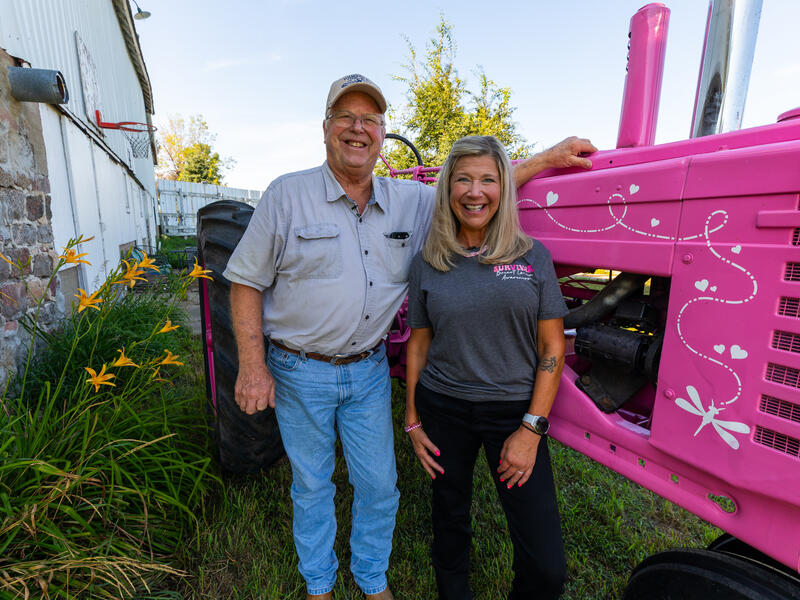
Traditionally, the Humboldt Threshing Show in South Dakota draws a crowd and some old-school equipment.
Tractors clad in classic paint colors of green, red, orange and yellow.
Thanks to Kelli Aberson and her dad Ron Heemstra, a new fan favorite is making the cut.
“It’s the only one,” Heemstra said regarding the color of their tractor.
Aberson added, “You don’t know what people’s reaction will be. Especially since for the most part I’m riding around with a lot of old farmers.
“Their reaction is usually a smile and a wave or a nod. It’s been well received.”
Aberson’s bright pink tractor is a 1948 John Deere Model A.
“It’s a great talking point. It’s a great way to bring people together,” said Aberson, who is operating a booth this year by her ride. “I think people when they see this, there’s not that awkwardness. They know what it represents based on the ribbons and the color. So they’re not afraid to say, hey, tell me about your journey. How are you doing today?”
For the first time, the Sioux Falls resident is comfortable sharing her own journey with breast cancer.
“I was that person who always thought there’s no reason to do self-exams. I wouldn’t know what it would feel like if I found one,” Aberson said.
‘Started by feeling a lump herself’
In February of 2020, Aberson felt something different and went to Sanford Health for help.
“Kelli’s cancer story is unique because she actually started by feeling a lump herself,” said Allison Watson, M.D., a specialist in hematology and oncology with Sanford Health.
Aberson remembered, “This doesn’t quite feel right. Kind of that frozen pea type feeling. Very solid.”
After some medical testing, the phone rang the next day with the news.
“Caught me off guard. Rough time for everybody in 2020 anyway. A lot of uncertainty,” Aberson said.
At 44, Aberson was diagnosed with early-stage breast cancer.
“I opted to have a double mastectomy and for me that was the right choice,” Aberson said.
With no family history of cancer, everyone was stunned, including her dad.
Eight weeks later she underwent successful surgery at Sanford USD Medical Center.
“When she went through this was the COVID time, so she did it all on her own. Nobody could be there,” Heemstra said about family not being allowed due to pandemic protocols at the time. “You drop her off at the door and you go home. It couldn’t have happened at a worse time.”
Bringing the tractor to life
Aberson still had trusted caregivers at her side.
“I’m thankful to the doctors and nurses who put themselves out there and kept doing what they needed to do to take care of their patients,” Aberson said.
Still, Heemstra felt helpless.
“Well, absolutely. What do you do? You just don’t know,” Heemstra said.
Aberson, a wife and mother of two, gets emotional thinking about what her dad might have been going through seeing his daughter in that situation.
“It’s not as easy as a Band-Aid or a hug. This was one of those times where Mom and Dad couldn’t fix it,” Aberson said.
Known for being able to fix anything, Heemstra got to work on a way to show support from the family farm west of Sioux Falls.
A nearly 80-year-old, broken-down tractor purchased from a neighbor found a new purpose.
“It had to come to life,” Heemstra said about the John Deere. “All these old farm tractors are an inch deep in grease. Lot of steam cleaning and sanding and then priming.
“After it was painted, the graphics were put on, and we were ready to go.”
A welcome surprise for his daughter, now a cancer survivor.
“This is Dad’s way of putting that positive spin on it. This is his way to show his love and to show his compassion,” Aberson said.
Heemstra said he’s proud of “how strong she has been through this.”
“That was something we thought we could do just to brighten things up and have some fun with it. Try to make something good out of something bad.”
It certainly filled a need.
“I definitely felt the love for sure that went into that,” Aberson said.
“He’s my hero.”
‘Early detection was key’
The two have been riding together in the Humboldt Tractor Drive every year since.
“Down the highway and off we went,” Aberson said.
Dr. Watson says everybody has their own specific way of supporting cancer patients.
“That was a very unique way to support his daughter and I think that meant a lot to Kelli. It’s definitely served as a means of advocacy for the community,” Dr. Watson said. “The more women we can keep on their routine imaging surveillance, the more women we diagnose with breast cancer at early stage when it’s curable.”
Having access to care in rural America is also making a difference.
“Rural healthcare is really important living especially in the Midwest,” Aberson said. “You don’t think of those things until you need it and then once you do, you’re sure grateful that you’ve got it this close.
“Now I’m just thankful to be where I’m at. For me specifically, early detection was key. It was very treatable.”
Learn more
- Breast cancer isn’t one-size-fits-all
- Mobile mammography brings convenience, care to northern MN
- Breast cancer survivor opts for mastectomy, plastic surgery
…
Posted In Cancer, Cancer Screenings, Cancer Treatments, Rural Health, Sioux Falls, Thought Leadership