
During a visit to Sioux Falls, South Dakota, leaders from the Milken Institute got a firsthand look at how Sanford Health brings research, technology and specialized care to patients across rural communities.
The two organizations have partnered since 2023, with a shared commitment to advancing community-based clinical trials.
The Milken Institute is a nonprofit, nonpartisan think tank that brings together leaders from healthcare, research, industry, philanthropy and policy to advance solutions that improve health and well-being.
As part of ongoing collaborations with industry partners, the Milken Institute visited Sanford Health to better understand the health system’s integrated model, learn from one another and explore shared priorities related to rural health and clinical innovation.
Sanford Research hosted Esther Krofah, executive vice president of health at the Milken Institute, and her colleague Kristin Schneeman, senior director of FasterCures, for an opportunity to learn more about Sanford’s broader work and approach to transformation across the health system.
Sanford’s Vice President of Clinical Research Lora Black said the visit was a great opportunity for the Milken team to see innovation at work.
“This moment feels a bit surreal,” Black told Sanford Health News. “Being able to show them the integration, all that we do in rural health and clinical innovation is an incredible opportunity. But even more so, it’s learning from each other and focusing on how we can build on what we do well, together.”
Their tour included visits to Sanford Research, the Virtual Care Center, the Edith Sanford Breast Center, and the Sanford Health Foundation, along with a roundtable discussion involving leaders and stakeholders from healthcare, research, education, industry and public policy.
Play the podcast: Trailblazing with clinical trials
Conversations focused on care delivery transformation, workforce innovation, clinical trial access, virtual care, AI and cross-sector partnerships that can accelerate innovation and improve patient outcomes.
For Krofah, seeing Sanford’s programs and teams firsthand brought the full scope of that work into focus.
“I knew a little bit about Sanford Research from hearing stories in Washington, D.C., during our roundtables, but there’s no way I could have understood the breadth and depth of what I saw today,” Krofah said. “It’s really hard to describe otherwise.”
Strengthening a partnership for rural patients
The Sanford-Milken relationship grew through the COVID-19 pandemic when Milken leaders started to look at whether the nation had the infrastructure needed to conduct clinical trials in more communities.
“We were struck by the fact that there were so many trials happening on the coasts, at academic medical centers and institutions across the country,” Krofah explained. “We did not, at the time, understand where capabilities were in other regions.”
In 2023, Sanford joined ENRICH-CT (Enabling Networks of Research Infrastructure for Community Health through Clinical Trials), a national coalition convened by FasterCures to advance community-based clinical trials.
The coalition includes about 90 organizations representing health systems, life science companies, tech, community organizations and federal agencies.
“It was important to bring Sanford Health in to represent the largest rural health system in the country and share with this group what is happening with clinical trials and clinical research,” Krofah said.
“Sanford has been an incredible partner in that way, but we’re also interested in how we can expand what we’re doing together.”
During the tour, Krofrah was particularly struck by the close connection between patient care and research at the Edith Sanford Breast Center.
“Seeing patients receiving treatment and then seeing the research unit just one floor below really summed up the entire day for me,” Krofah said. “No matter who you are or where you come from, you should be able to access the highest standards of care and high-quality research.”
“Sanford is really thinking about how to use its platform and its presence to spread out and reach all patients with everything that they need,” she added. “That’s pretty impressive.”
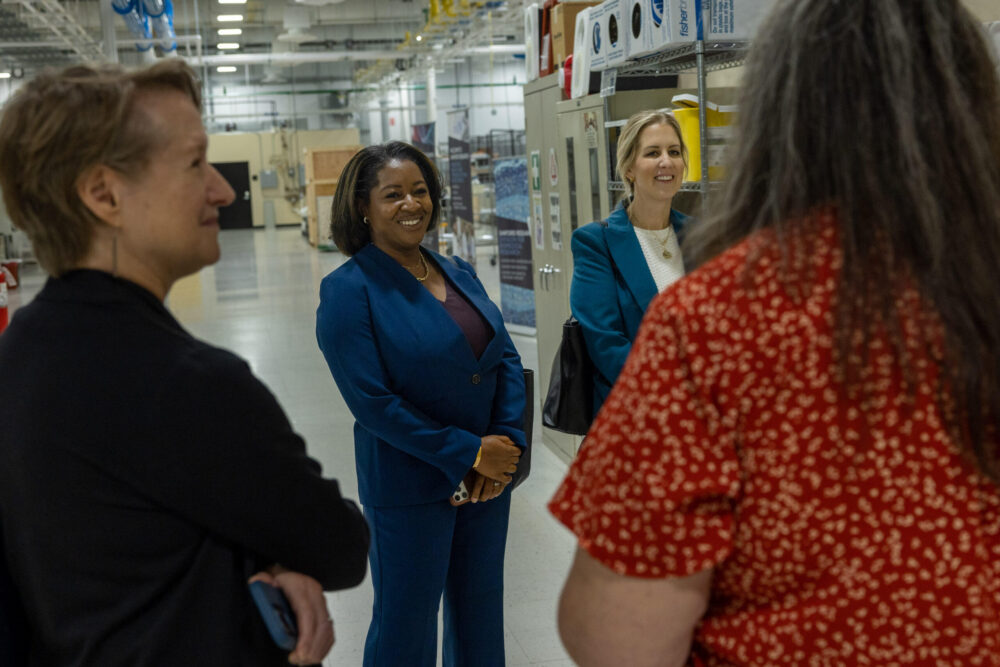
Photo by Jay Pickthorn, Sanford Health
Scaling innovation to reach more patients
Sanford Health has built one of the most comprehensive rural clinical research networks in the United States with 1,300-plus active clinical trials, more than 220 investigators and over $28 million in external research funding.
To further accelerate the work, Sanford recently aligned its research enterprise around five strategic divisions: biobehavioral research, biomedical research, clinical research, rural and population health, and AI and precision medicine.
During the tour, a walk through the Virtual Care Center offered a look at how technology can take access across Sanford’s more-than 320,000-square-mile footprint.
“We thrive on solving challenges in rural health care and thinking creatively to develop new care options,” said Susan Berry, vice president of operations for virtual care. “Our Virtual Care Center demonstrates how technology can help remove geographic barriers and connect patients in rural communities with the expertise and services they need.”
“Having the Milken Institute team here gave us a chance to share how we’re reimagining care delivery and how continued collaboration can help bridge that gap.”
On average, Sanford’s virtual care visits save patients 176 miles in roundtrip travel and $273 in travel-related expenses like fuel, meals and lodging.
“You’ve really thought about all parts of what people need in this part of the country, ensuring that they don’t really need to leave the region for top-notch care,” Krofah said.
“Even if you live several hours away from a physical location, you can still have access to a specialist within the comfort of the community where you live,” she added. “Patients can get guidance about what is available, understand treatment options and get the answers they need without having to drive all of those hours.”
Ultimately, Black said this work is all about giving patients options closer to home.
Looking ahead with shared priorities
The visit also presented an opportunity to draw on Milken’s national perspective to identify shared priorities and explore future collaboration.
Right now, Krofah said the institute is working to elevate the national conversation around biomedical research and innovation, emphasizing the need for continued investment in research, sustainable telehealth policy, and greater access to clinical trials.
The Milken Institute’s FasterCures works across sectors to identify promising approaches, understand what makes them successful and advance policies that can help extend their reach.
“At FasterCures, we’re looking for these models and examples,” Krofah said. “We want to understand what is best in class, what is happening on the ground and what policy enablers could allow us to see more community research sites established across the country.”
Krofah points to Sanford Health as a model for expanding high-quality care, shaping policies, and demonstrating what’s possible in rural health care.
“Sanford is an incredible model of a rural health system with regional expertise,” she said. “The question is: how can we bring more resources to institutions like this so we can see more of it in more parts of the country?”
The visit created a foundation for Sanford and the Milken Institute to continue exploring how Sanford’s experience serving rural communities can inform broader conversations about clinical research, care delivery and biomedical innovation.
“As we go forward, I think about how Sanford can be a part of that narrative with us and help us define exactly those needs.”
Learn more
- Clinical trials offer help, hope for patients in Bemidji
- Virtual care at Sanford Health reaches milestone
- Sanford Health hosts Navy leaders at Virtual Care Center
…
Posted In Innovations, Rural Health, Thought Leadership, Virtual Care