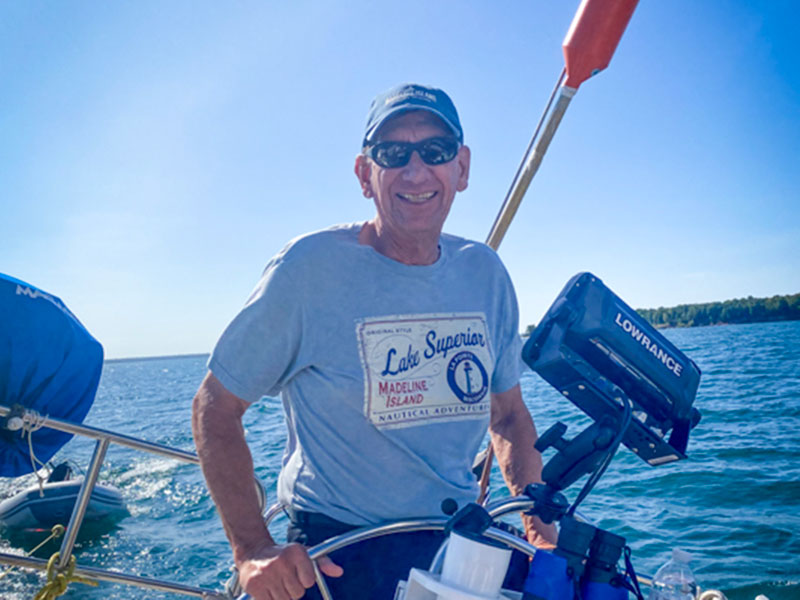
Mike Schmidt appreciates a good journey.
The 79-year-old retired president of St. Joseph’s Hospital (now Marshfield Medical Center) spends a lot of time on the water with family and friends, sailing through the Apostle Islands off the northern coast of Wisconsin.
“You can spend several days sailing to different islands and then working your way back. It’s just a wonderful experience,” Schmidt said. “It’s all about focusing on life as a journey and not a destination. That’s what I’ve been trying to focus on for quite a number of years.”
Some voyages go as planned. Others see rougher waters.
“Sometimes storms will come up, and you need to change anchorages,” he said.
About 10 years ago, Schmidt embarked on a journey he hadn’t expected – he learned he was living with a heart murmur. His doctor monitored the condition through routine echocardiograms, but the results didn’t warrant anything further – until last fall.
“There was leakage of my mitral valve into the lungs, and it was sufficient enough that it needed to be fixed or replaced,” Schmidt said. “It takes your breath away just a little bit.”
Turning off the leak
Schmidt was diagnosed with severe mitral regurgitation, or leakage of the heart valve.
The way Marshfield Clinic cardiothoracic surgeon Stephen Kwan, M.D. explains it, heart valves function like doorways, opening wide and closing tightly to push blood on a one-way path.
Schmidt’s mitral valve was opening, but not closing as it should. Many of his heart chords, which enable the heart to close the mitral valve leaflets, were also ruptured or disconnected.
“It was in the constant open position, so blood would move from one area of the heart to the other, and then more than half of that blood would return back to its original position,” Dr. Kwan said. “Ultimately, everything backs up and goes to the lungs. And when it goes to the lungs, you feel like you’re congested and you’re drowning, you’re short of breath, and your exercise capacity is limited.”
Prior to his diagnosis, Schmidt worked out three days a week, along with playing golf with friends and taking long walks with his wife.
“He had gotten to a point where the mitral valve was so dysfunctional, he was getting symptomatic and short of breath, and could not do physically the things that he wanted to do,” Dr. Kwan said.
The game plan going into surgery was to repair and preserve Schmidt’s mitral valve, but there was still a small amount of leakage after the procedure.
“I could have left it alone, and a lot of surgeons do leave it alone,” Dr. Kwan said. “But I do not accept any leakage after surgery.”
Dr. Kwan and his surgical team ultimately decided to replace the valve with a tissue valve made from the lining of a cow’s heart, otherwise known as the pericardium. According to Dr. Kwan, research has shown it to be durable with an average lifespan of around 15 years.
“Probably longer for an older person because calcium metabolism is not as severe as a young person,” he said. “Also, the immune system is not as strong, so it doesn’t fight the artificial heart as much.”
Breaking the block
On the other side of surgery, Schmidt was still dealing with a left bundle branch block, meaning the heart wasn’t transferring electrical signals the way it should. By the fourth day of recovery, he was still dependent on a temporary pacemaker.
That’s when Dr. Kwan brought cardiac electrophysiologist Weijia Wang, M.D. into the mix.
“By day two or three, if there’s no recovery of the conduction or the heart rate’s just very slow, they’ll let us know,” said Dr. Wang. “Options are usually we keep waiting or we place a permanent pacemaker.”
Schmidt and his care team agreed to go with the latter, implanting a small pacemaker just below his collarbone. The device monitors his heart rate and prevents it from beating too slowly.
It also coordinates the top and bottom chambers of the heart to beat more efficiently and pump blood more effectively. For Schmidt, his top chamber is being paced less than 5% of the time, while his bottom chamber is being paced entirely by the device.
“It’s really something that every single heartbeat is controlled by the pacemaker,” said Dr. Wang. “It really speaks to the reliability and safety of this procedure and of this device.”
Schmidt’s pacemaker is also equipped with an accelerometer that senses his motion. If he’s more active, the device will pace the heart faster.
“Nowadays, the pacemakers are pacing the heart a lot more effectively and more efficiently because we are able to engage in the natural conduction system or the natural wires within the heart. We are achieving not just letting the heart beat, but also beat as if it is completely normal,” said Dr. Wang. “The goal is to really have patient go back to their normal life.”
More journeys ahead
Between both procedures, Schmidt spent a little more than a week in the hospital. It took him about two weeks after that to start feeling like himself again. With the help of cardiac rehab – one hour three times a week – life was regaining its motion.
“Started slow there, but I was able to pick up what I was doing. Every week I could feel more energy coming back,” Schmidt said. “It’s been a great experience. You get to know the people there who are doing it at the same time you are, and it becomes a little a bit of a social experience, which is kind of fun.”
Doctors advised Schmidt to limit strenuous use of his arms for eight weeks after surgery. At week nine, he was getting back in the swing of things he enjoys.
“I could do more with my hands. I could start playing golf again. That next week I went to the driving range a couple times to make sure I could still hit it, and then I went golfing a couple times the following week,” Schmidt said. “I’m near full recovery. My energy’s pretty well back.”
Schmidt’s pacemaker is powering his heart, but he’s the one charting the course.
“I have many more sailing trips I want to do. I have many more parks or cruises we want to do,” he said, “so I hope this journey continues for a while.”
Learn more
- Bismarck patient receives smallest pacemaker in the world
- SD’s first valve-in-valve procedure benefits Sanford patient
- Cardiac rehab a surprise Rx for former teacher
…
Posted In Heart, Marshfield