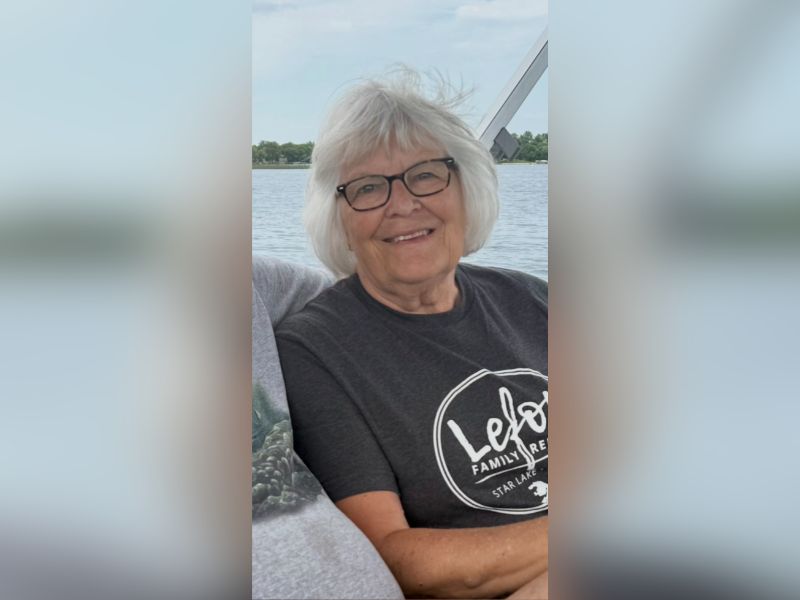
Verna Rasmussen spent most of her career as a first-grade teacher in West Fargo, North Dakota, and retired in 2014. That year marked another major life change.
In March 2014, Rasmussen was asked to come back for another mammogram. She initially thought the first scan showed a shadow, but something in the back of her mind made her wonder if something was wrong.
“I remember standing there and the doctor said something about carcinoma. You know what carcinoma is, but it takes a while for your brain to make sense of what he’s saying,” Rasmussen said. “At that point, you’re in just a big state of shock and disbelief.”
Diagnosis: HER2-positive breast cancer
She had lumpectomy surgery in April 2014. After surgery, she completed chemotherapy, a year of Herceptin infusions and radiation.
“I spent a lot of time at Roger Maris Cancer Center. You get to know the people there and appreciate them,” Rasmussen said.
She finished treatment in April 2015.
“Everything went well, and I have been very lucky to be doing amazingly well now,” Rasmussen said.
Rasmussen lives a full life with her husband of more than 50 years in North Dakota. They have three grown children and several grandchildren, and they enjoy spending time together at the lake boating, playing games and enjoying what she calls her sanctuary.
She used her experience to find a new purpose
While recovering at home, Rasmussen wondered how she could help other women facing the same diagnosis.
“I had to have something good come out of this scary time in my life,” she said.
She talked to Shelby Terstriep, M.D., her oncologist at Sanford Roger Maris Cancer Center.
“I’m just one person, but what can I do to help others who may not have a strong support system or who just need someone positive to check in on them?” she asked.
At the time, Dr. Terstriep was already working to create a mentorship program connecting breast cancer survivors with newly diagnosed patients. Within a few months, the program launched and Rasmussen joined the first group of mentors.
“These mentors provide a unique and valuable perspective as individuals who have walked many of the same paths. They offer compassionate support and a listening ear, help identify barriers and guide toward resources,” said Megan Rogers, survivorship and oncofertility nurse navigator at Roger Maris Cancer Center.
Currently, Sanford Health’s program has 43 mentors. They mentor around 100-150 mentees annually.
“We’ve evolved the program to better match people based on personal needs, not just treatment plans,” said Jenna Linder, community programs supervisor. “Often, life circumstances matter more than medical details when creating meaningful connections.”
Once matched, mentors reach out to introduce themselves and offer support.
“I always add in that I’m a breast cancer survivor,” Rasmussen said. “The doctors and nurses are wonderful at giving you information, but most of them have never had breast cancer. They don’t know all the tips and tricks, like how to make it feel better if your bra is rubbing on your incision, or thinking ahead to make frozen meals for after surgery.”
Reaching a mentoring milestone
Rasmussen has been involved in the program since it launched in 2015. She remembers her first mentee clearly.
“We connected many times over the phone and found that we had very similar backgrounds and even had a grandson with the same first name,” she said. “We decided to meet at a coffee shop and talked and talked. I will never forget her.”
Now, more than 10 years later, Rasmussen has mentored 200 women.
“Dr. Terstriep told me I’ve had 200 mentees – it was very surprising to me,” she said. “It does not seem like I visited with that many people.”
Rasmussen felt honored to be entrusted with this opportunity to help others.
“It’s satisfying to be a small part of their journey to help them with their fears or just be there if they need someone to talk to,” she said. “It’s a small thing, but it can mean a lot. It makes you feel truly content knowing you made someone’s day a little better.”
Rasmussen’s impact hasn’t gone unnoticed.
“Through every change in the program, she has remained dedicated, continuing to give so generously of herself to support and encourage individuals facing something as life-changing as a cancer diagnosis,” Rogers said. “I have seen how a single interaction with a mentor can completely transform someone’s perspective. When you multiply that by 200 people, it becomes impossible to fully capture the difference she has made.”
Supporting family through their own cancer journeys
“Finding out you have cancer is tough, but finding out your child has cancer is 1,000 times worse,” Rasmussen said.
Rasmussen’s oldest daughter was diagnosed with ovarian cancer in March 2017 at age 39.
“She was so young, and her cancer was very rare. She had surgery and chemotherapy. At the time, she had a 6- and 9-year-old and it was tough,” she said. “She is doing absolutely wonderfully now.”
In March 2025, Rasmussen’s youngest daughter was diagnosed with breast cancer at age 41. She had all her treatments done at Sanford.
Rasmussen has wished she could take this hardship from her daughters, but she focuses on supporting them how she can.
“I can’t help but think, ‘Why not me?’” she said. “I could handle it. Watching your child go through cancer, no matter their age, is awful. So, you just support them however you can.”
She always gives others hope
Through both her mentoring and her personal experience, Rasmussen shares a consistent message: you always want to give people hope.
“If you go into cancer treatment with a negative mentality, it’s going to be tough,” she said. “A positive attitude can make a big difference in the long run.”
She shares that life continues after cancer, even if it looks different.
“There’s life before cancer and after cancer,” she said. “Over time, you think about it less and you get busy with life again. It becomes a new normal.”
Support comes in many forms
Mentors in the program must meet several criteria, including being at least one year out from diagnosis and being recommended by their care team.
But Rasmussen says anyone can show support.
“I encourage people to ask themselves, ‘What can I do?’” she said. “Bring a meal or pick them up groceries. Just do the thing. I remember during my treatment, someone brought a huge pot of soup, and it felt like magic. It made me feel better, even though I didn’t have much of an appetite. But they showed up for me.”
If you’re interested in learning more about mentorship, talk with a member of your cancer care team or sign up online.
Learn more
- Encouraging women, positivity with mentor program
- Breast cancer survivor now supports others in community
- Survivorship: A critical part of the cancer journey
…
Posted In Cancer, Cancer Screenings, Cancer Treatments, Fargo