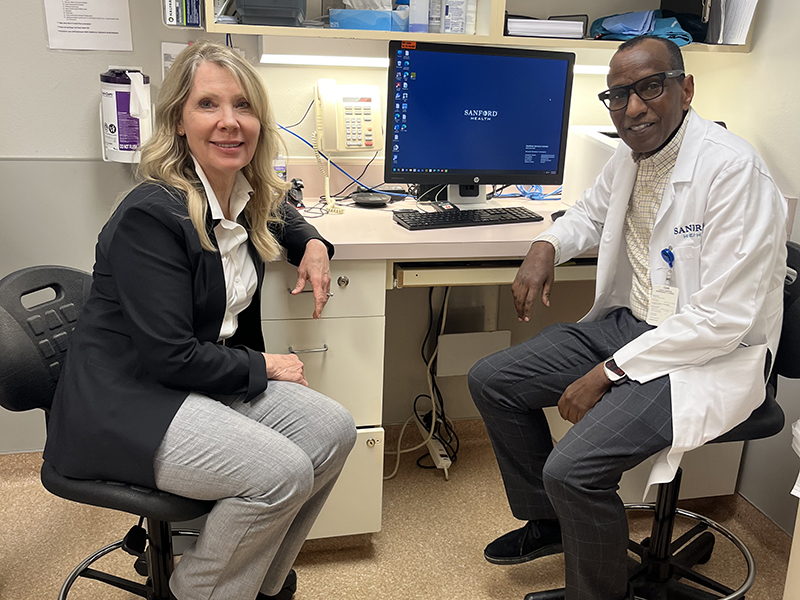
As vice president of operations for Sanford Health Bismarck in North Dakota, Jackie Farland knows a lot about health care. She also knows — and occasionally falls victim to — a common refrain among health care workers as well.
“I’m not a very good patient. I’m a nurse and sometimes we take care of others better than we do ourselves,” Farland said.
So when the time came for her regular colonoscopy screening, she admits that she procrastinated a bit.
“I got several calls from the direct scheduling and endoscopy staff saying, ‘You are due for your colonoscopy,’” Farland said. “Life goes by. I’m going to call them. I’m going to do it tomorrow.”
Instead, several months went by. When she finally did schedule the appointment in November of 2022, a colleague, gastroenterologist Yeshitila Mengesha, M.D., performed the procedure.
“A few days later, he called me and said, ‘Are you in your office?’ And I said, ‘No but I’ll be there in a few minutes.’ This is 6:30 in the morning,” Farland said. “I came in and I’m thinking it’s just something in regards to operations here at Sanford. But he said, ‘With your colonoscopy, I found cancer. We found three polyps. One of them was a one-centimeter polyp and it was cancerous.’”
Family history
As it turned out, Farland had a family history of colon cancer. Her father was diagnosed at age 40. He had to have surgery and chemotherapy, but luckily for Farland, her cancer was caught early thanks to her screening.
“The bottom line is, if she didn’t show up or if she hasn’t decided to do the colonoscopy, then it could have been a different outcome,” said Dr. Mengesha. “That tells us the importance of doing the usual preventive medicine that includes a screening colonoscopy.”
Farland had her cancer removed endoscopically by Dr. Mengesha, and she did not need to undergo surgery, radiation or chemotherapy. She considers herself lucky to have found it so early, especially considering her delay in getting screened. It’s the reason she has become an outspoken advocate for colonoscopy screenings.
“Even though I had a family history, I still avoided that call,” Farland said. “So absolutely I’m a proponent. Anytime I can tell my story, I do. Look at me and learn from my experience.”
In March of 2026, three years after her original diagnosis, Farland had her latest follow-up colonoscopy. The results were clear. No cancer found.
Mutual respect
Farland and Dr. Mengesha remain coworkers and friends. Farland speaks highly of him as a person and health care provider.
“He is a very humble man, a very kind man, a very caring man,” Farland said. “And he’s an incredible doctor. He takes such great care of his patients.”
For his part, Dr. Mengesha says he hasn’t seen a change in their working relationship, but has seen an increase in Farland’s advocacy for screenings.
“I know she’s very appreciative of what we have done for her, but we treat everybody equal and there is no difference in terms of the care,” said Dr. Mengesha.
“It’s different to be on the other side of the bed. She understands that. She should be commended for her bravery to come out and increase awareness.”
Colonoscopy recommendations
Sanford Health recommends all adults schedule a colonoscopy at age 45. Follow-up appointments are recommended every 10 years after that if results are normal. If polyps are found, follow-up recommendations vary anywhere between three months to seven years depending on the nature, size and number of polyps removed.
Those at higher risk of colon cancer, including those with a family history, should schedule an exam 10 years prior to the age of diagnosis of their family member or at age 40, whichever comes first. Follow-up appointments are recommended every five years after that if results are normal.
A colonoscopy may also be right for you if you’ve had abnormal stool-based test results, or if you are experiencing potential symptoms of colon cancer such as abdominal pain, blood in your stool, changes in bowel habits or unplanned weight loss.
To request a colonoscopy, visit My Sanford Chart or talk with your primary care provider for more information.
Learn more
- Colorectal cancer screening: Check out the options
- Colon cancer in millennials: What you need to know
- Family cancer history makes preventive care make sense
…
Posted In Bismarck, Cancer, Cancer Screenings