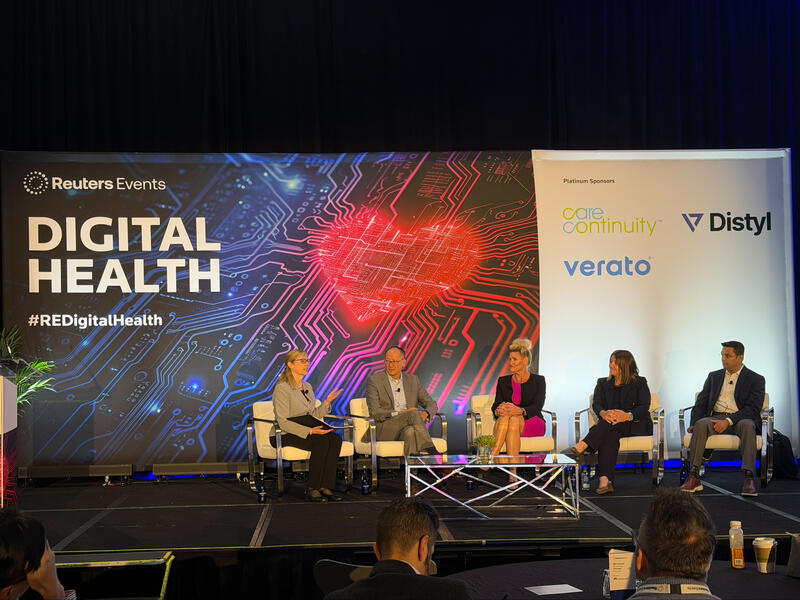
Sanford Health leaders recently joined healthcare executives, policymakers and technology innovators from across the country to discuss how health systems are responsibly scaling AI and digital innovation to improve patient care, workforce sustainability and operational performance.
At the Reuters Digital Health Summit, three Sanford Health leaders were featured as speakers.
Tommy Ibrahim, M.D., executive vice president and chief transformation officer, joined a fireside chat discussing how Sanford Health is redesigning care delivery by leveraging AI and digital innovation to advance more connected, data-driven and patient-centered care across rural America.
“It’s an exciting time,” Dr. Ibrahim told Sanford Health News.
“The way we’re coming at this is a very holistic, broad stakeholder buy-in approach. We’re building governance around our transformation strategies, really trying to identify where those high-value use cases are, both on the operational side as well as the clinical side, and bringing the right leadership to the table to decide how we begin to advance our priorities moving forward.”
He said transformation is ultimately about rethinking how care is delivered — not simply implementing new technology.
“It’s been about four or five months now of hard effort on the ground and we’re ready to really begin taking things to the next level, seeing some of the results that we know that we can get.”
David Newman, M.D., chief medical officer for virtual care, and a practicing endocrinologist out of Fargo, North Dakota, joined an executive panel discussion sharing how Sanford Health is harnessing AI tools and virtual care to strengthen the patient experience.
“Bringing clinicians along on this journey is paramount,” he said, and uses what’s known as a chronic kidney disease predictive AI algorithm as an example.
It’s a technology that’s a few years old.
“We knew, based upon Sanford-specific data, who was going to get chronic kidney disease, who wasn’t, and who needed treatment. The problem was we couldn’t operationalize it,” Dr. Newman explained. “That’s on me as an administrator. I worked with our data analytics team to develop the product, but we didn’t talk with the doctors and APPs, the ones who were going to actually use them.”
After talking with providers and decreasing any burden of use, making it one click, front-and-center, he said the difference is profound.
“We have doubled the rate of diagnosis of chronic kidney disease, and we’ve tripled the rate of treatment all by utilizing a digital therapy.”
It’s moving beyond the hype phase, he said, and into the real work of using tools in practice in ways that reduce friction for clinicians while improving the patient experience.
Erica DeBoer, senior vice president and chief nursing officer, joined a panel discussion on Sanford’s virtual nursing journey.
She shared how the organization is co-designing tech with the people who will use it, building workflows that strengthen patient care, reduce time spent doing administrative tasks, and create more sustainable nursing roles.
“With virtual nursing, the most evident thing we’ve seen is a reduction in turnover, reduction in safety events – specifically falls – because virtual nursing uses computer vision technology to identify high-risk patients so they don’t fall while they’re in a hospital setting,” DeBoer said.
She’s looking forward to the opportunity to use AI digital health to enhance relationships with patients as well as front-line teams.
“AI is amazing, but if I think about AI in a different way, we can use digital tools to help us have authentic interactions, bring that joy back to the work that we’re doing … the opportunity that we have to take care of our patients every day.”
Learn more
- Virtual care at Sanford Health reaches milestone
- NDSU’s advances in nursing school keep human touch
- Sanford Health CEO to join keynote at Healthcare AI Summit
…
Posted In Innovations, Leadership in Healthcare, Rural Health, Thought Leadership, Virtual Care